
Christopher Nolan’s Oppenheimer opened to critical acclaim late last year. It details the work of J. Robert Oppenheimer. Widely regarded as the nation’s foremost theoretical physicists and father of the atomic bomb, Oppenheimer was born in New York and received his undergraduate training in Chemistry at Harvard University. He received a doctorate in physics from the University of Gottingen in in Germany in 1927. Afterwards, he joined the physics department at the University of California Berkeley becoming full professor in 1936. While at Berkeley he made significant contributions to theoretical physics, including quantum and nuclear physics, Born-Oppenheimer approximation for molecular waves, electrons and positrons, the Oppenheimer-Phillips process as well as work on quantum tunneling, neutron stars, black holes, quantum field theory and the interaction of cosmic rays. In 1942, he was recruited to the Manhattan Project. In 1943, he served as the Director of the Los Alamos Laboratory in Los Alamos, New Mexico. There he developed the nation’s first nuclear weapons and promoted atomic energy.

No less important than Oppenheimer were more than nineteen African American scientists, men and women, who also made important contributions to the development of atomic energy in the United States. They worked at the Oak Ridge in facility in Tennessee, and the Chicago Metallurgical Laboratory. Black laborers also worked at Oak Ridge and played a seminal role in the support work to produce the bomb. Its estimated that 7,000 Black laoborers worked at the site, although no more than 2,000 laborers worked there at any given time. These Black scientists, technicians and laborers played an important role in the work of developing the atomic bomb.
Historianspeaks is pleased to present this series, Beyond Oppenheimer: Black Scientists and the "Bomb," focused on African American participation in the creation on the atomic bomb. We will feature biographical information and discussion of the work of these scientists throughout Black History Month. We welcome your questions and comments.
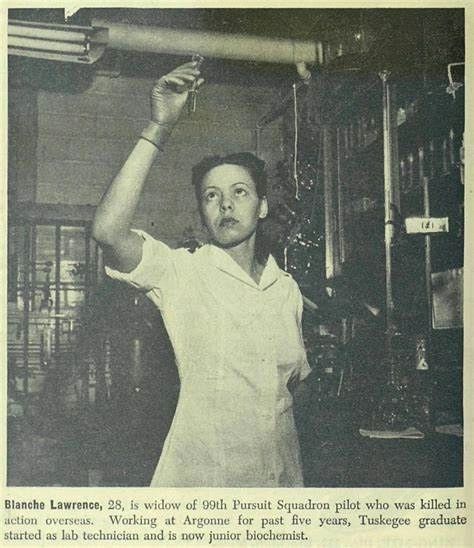
The fifth installment installment in the series focuses on the career of Blanche Josephine Lawrence. Lawrence was a Tuskegee University graduate who worked at the Met Lab in the Health Division. Her work focused on radiation and human health.
Blanche Josephine Lawrence was born in Houston, Texas in 1920. Her parents, John Coleman, and Blanche Elizabeth Thompson were teachers. They raised their children to value education Growing up, she was exposed to two key values that would shape her life: A focus on education and a dedication to social justice. Lawrence attended Tuskegee University in Tuskegee, Alabama. She became very passionate about science, especially biology. At Tuskegee she was a member of both the Physical Education Club and Creative Dance Group.
In the Met Lab Lawrence worked in Health Division as a research assistant that studied issues related to radiation and human health. Within five year, she became a junior biochemist at the lab. A Lawrence emerged as a determined scientist. One of her biggest challenges was the lost of her husband, Tuskegee Airman Captain Erwin Lawrence. Lawrence was a pilot and a member of the 99th Pursuit Squadron. He died on a mission over an enemy airfield near Athens, Greece.
After the war ended, Lawrence went on to pursue her work at Argonne National Laboratory, Met Lab’s successor laboratory. Her work in the lab gained public attention and she was featured on a September 1949 issue of Ebony Magazine that focused on Atom Scientists.
Lawrence’s ability to work as a Research Assistant in the Health Division of the Met Lab while negotiating societal boundaries reflects her intelligence, focus and resolve. Lawrence’s work represented strides for Black women not only scientifically but in the white-male dominated arena of scientific research. that eventually allowed science to achieve the major breakthroughs which allowed scientists to build the atomic bomb.
Ask the Historian
Have a question about this story, or an idea for a future post? Send it here.