
What's New
The latest features and additions to HistorianSpeaks.
November 13, 2026
The 2026 election joins the timeline
New timeline entries mark Deb Haaland's election as the first Native American woman governor, Scott Colom's Mississippi Senate race, and Janeese Lewis George's election as mayor of Washington, D.C., each linked to our coverage.
Explore the timeline →November 13, 2026
30 new Black Creatives
The Black Creatives Directory adds 30 profiles, including architects Paul Revere Williams, Julian Abele and Norma Merrick Sklarek, photographers Moneta Sleet Jr. and Ernest C. Withers, and dancer Pearl Primus.
Explore Black Creatives →November 13, 2026
Election and reparations sources in the Research Repository
Five new collections help readers follow the story themselves: the Black Voter Project, the MIT Election Lab, the Brennan Center's voting rights tracking, the Joint Center, and Tulsa Race Massacre collections.
Explore the repository →November 13, 2026
More than 50 new podcast episodes and Shorts
Every blog since late October now has a narrated episode, and archive series on Tulsa and reparations, Black science and medicine, and Southern voting rights release daily through December.
Listen to the podcast →November 7, 2026
Student membership: $4.99 a month
Students with a verified .edu email can now join HistorianSpeaks for $4.99 a month and read every Black Thread story in full, along with our member series and research tools.
Join at the student rate →November 7, 2026
Interactive maps inside our stories
Election coverage now carries maps you can explore right inside the article: New Mexico's 33 counties with Native lands, Washington, D.C.'s wards and Los Angeles council districts, each tracing where grassroots coalitions turned out.
Explore the election series →November 6, 2026
The post-election organizers series
A weekend series on how multigenerational Black grassroots organizing, not consultants or late national money, decided the 2026 midterms, from North Carolina's 14th District to Texas, Nevada, Mississippi and New Mexico.
Read the series →November 6, 2026
On This Day, every day in November
Drawing on the Equal Justice Initiative's history calendar, daily entries and feature essays mark racial terror, legal resistance and civil rights milestones throughout the month.
Read today's entry →November 5, 2026
2,000 blogs and counting
HistorianSpeaks has passed 2,000 published blogs, joining years of scholarship on the African diaspora with today's multimedia reporting.
Browse the archive →November 4, 2026
The Founding 50 is open
Black Thread has launched, and founder spots are open. The first 50 founding members keep $9.99 a month for life, with their name on the honor roll, 48-hour early access to every issue, and a founders-only essay each month.
Claim a founder spot →October 31, 2026
Black Thread magazine opens November 1
Black Thread, our digital magazine, opens Sunday, November 1, at 9 a.m. ET. Issue One, Roots to Recognition, brings eight in-depth stories on Black politics, culture, sport, history and the global diaspora. Sylvester: Mighty Real is free for everyone; members can read every story in full.
Explore Black Thread →October 30, 2026
Election Night Watch, now in eight cities
Our YouTube page now carries Election Night Watch: live channels, the 866-OUR-VOTE voter help line, and city boxes for New York, Atlanta, Washington, Memphis, Chicago, Detroit, Columbia and Charleston, and Oklahoma City and Tulsa, each linking to official results and a local Black newspaper.
Visit Election Night Watch →October 30, 2026
New bonuses for the Founding 50
The first 50 founding members keep $9.99 a month for life, and now also get their name on the Founding 50 honor roll, 48-hour early access to every new Black Thread issue, and a founders-only bonus essay each month.
Become a founder →October 28, 2026
Support HistorianSpeaks from any story
Our articles now carry a founder card, so you can subscribe or become a founding member right from the story you're reading.
Read the latest stories →October 31, 2026
New museum: the Pan African Historical Museum USA
PAHMUSA in Springfield, Massachusetts joins the museums guide. Founded in 1995 by LuJuana Hood, it is believed to be the oldest Pan-African museum in Massachusetts, with free admission, three galleries and an Underground Railroad walking tour. The museum has launched an urgent appeal to raise funds to stay open — visits and donations help.
Browse the museums →October 31, 2026
New museum: the African American Museum of Cleveland
AAMCLE in Cleveland, Ohio joins the museums guide. Founded in 1953 by Icabod Flewellen as the Afro-American Cultural & Historical Society Museum, it is considered the first independent African American museum in the United States and now welcomes visitors in a century-old Carnegie library on Crawford Road.
Browse the museums →October 27, 2026
The Diaspora Dashboard goes global
The Dashboard now follows more of the Black world. In the Caribbean: Jamaica and Barbados, Guyana and Trinidad and Tobago, the Bahamas, Martinique and Guadeloupe, the Dutch Caribbean (Curaçao, Aruba and Bonaire), and Puerto Rico and Cuba. In Africa: the Horn of Africa (Ethiopia and Somalia) and North Africa (Mauritania and Algeria), alongside Nigeria and South Africa. In Europe: Britain, Italy, Germany, Spain and Portugal, and Belgium and the Netherlands. Wherever possible, headlines now come from Black-run outlets, including The Voice and Black News UK in Britain, Nuove Radici in Italy, ISD in Germany, Afroféminas in Spain and Black Women in Europe. Headlines in other languages are translated into English. Each region links to related HistorianSpeaks stories from our archive.
Explore the expanded Dashboard →October 26, 2026
New: the Diaspora Dashboard
A weekly look at the global Black world. The Weekly Dispatch sums up the week's biggest stories, and the Rolling Status Board follows Africa, the Caribbean, Latin America, Europe and the United States. Each topic links to our own coverage and archive, plus the latest headlines from outside news sources, clearly credited. Get the Dispatch free by email, or become a founding member to support this reporting.
Open the Dashboard →October 24, 2026
Six destroyed Black communities join the timeline
The timeline now marks Seneca Village (1857), the Slocum Massacre (1910), the expulsions from Forsyth County and Oscarville (1912), the Elaine Massacre (1919), the Ocoee Election Day Massacre (1920) and the Rosewood Massacre (1923), each with a public-domain archival map, photograph or newspaper page from the time.
Explore the timeline map →October 24, 2026
A map through every long story
Articles with three or more sections now open with an In this article box: tap any heading to jump straight to that part of the story.
Try it on a long feature →October 24, 2026
Read next
Every story now ends with a Read next box pointing to three more pieces on the same subject, so one article can lead you into a whole line of coverage.
See what comes next →October 24, 2026
How we handle your information
A new privacy page explains what the site records about visits, how the free heatmaps work, and how reader email addresses are used.
Read the privacy page →October 20, 2026
The Black Studies chart gets a new title
The chart inside our Black Studies feature is retitled From Black Colleges to Ph.D., matching the article's arc from early courses at Black schools to doctoral programs, the post-2020 backlash and the way forward.
Read the blog →October 2026
More archives in the Research Repository
Fifteen new collections joined the repository: the W.E.B. Du Bois Papers, Documenting the American South, the Rosa Parks Papers, Zora Neale Hurston's plays, The Crisis magazine, Smithsonian Folkways, Digital Harlem, In Motion, the Gilder Lehrman Center and more.
Explore the repository →October 18, 2026
Watch Brazil's election from the ground
The YouTube page now carries a Brasil de Fato box, streaming the latest videos from a Brazilian outlet that covers Black, working-class and grassroots Brazil. Videos are in Portuguese: tap the gear icon, then Subtitles, Auto-translate, English, to read them in English.
Watch Brazil's coverage →October 17, 2026
The Past Is Present: October 17, 1961
A new feature on the 1961 massacre of Algerian marchers in Paris and why it still drives the marches of 2026: decolonization, public memory, how Algerians kept the memory alive, and today's student protests. It includes a downloadable 1954–2026 timeline infographic.
Read the feature →October 2026
Save infographics anywhere in a story
Infographics placed inside an article, not just at the top, now carry a Save button so you can download them to your phone.
Try it on any post →October 2026
New: HistorianSpeaks on YouTube
A new YouTube page lists our latest Shorts and earlier videos, with links to watch each one and a button to subscribe to the channel.
Watch and subscribe →October 2026
Six new podcast Shorts
New narrated episodes on Spotify and YouTube: Still Rising: Black Britain's Global Resilience; Howard, Maryland and the Question of Accountability; The Students Are Rising; Seydou Ba; Morgan State Homecoming; and The Magnificent Marching Machine. The podcast page now separates new Shorts from episodes in our archive.
Listen to the podcast →October 2026
Morgan State Homecoming: A Celebration in Three Acts
Our homecoming story follows the coronation of Miss Morgan State, the Magnificent Marching Machine and alumni reconnecting on the yard, with photographs from students and The Spokesman.
Read the story →October 2026
More from France
New pieces on Parcoursup and what France's university admissions system means for students from the suburbs and overseas territories, with a chart, and on Seydou Ba.
Read the coverage →October 2026
Weekly roundup
Our weekly email roundup now highlights each week's stories alongside new podcast episodes and YouTube videos.
Browse the blog →October 16, 2026
Black Thread preview: the full Britain series is live
Parts 3 and 4 of our Black Britain series are now published: Brixton, Peckham, and Scarman, and Still Rising: Black Britain's Global Resilience. Still Rising is the featured free preview of Black Thread, our magazine launching November 1. Founding members who join before November 1 keep the $9.99 monthly rate for life.
Read the preview →October 16, 2026
Invite a founding member
Our founders page is live for the launch: share it with friends and colleagues so they can become founding members of Black Thread before November 1 and lock in the founding rate for life.
Visit the founders page →October 15, 2026
Black Britain: a four-part series
Parts 1 and 2 are now live: Black Britain before Windrush, and Windrush's postwar story and the broken promise. Friday, October 16: Brixton, Peckham, and Scarman in the morning, followed by Still Rising: Black Britain's Global Resilience as the featured free preview of Black Thread. The series introduces the magazine ahead of its November 1 launch.
Browse the blog →October 15, 2026
Black Creatives: 154 people and 106 photos
The Black Creatives Directory now includes 154 people, with photographs on 106 entries. The first group of 25 biographies has been reviewed: 22 were rewritten using museums, archives, Britannica, and other established institutions, while three already had suitable sources. The remaining 129 biographies are queued for review in batches, without Wikipedia as a biography source.
Explore Black Creatives →October 2026
New timeline banners
Original collage paintings now open the African Origins, Culture and Technology in Africa, and Africa Before the Agricultural Age sections of the timeline, with more period artwork on the way.
See the timeline →October 2026
France school uprising coverage
Two new pieces on the student protests sweeping France: a student-centered account of the blockades, overcrowded classrooms and underfunding in Seine-Saint-Denis, and a profile of Mayor Bally Bagayoko standing between students and riot police — plus a downloadable infographic, Education Under Siege, in the photo library.
Read the coverage →October 2026
Every archived blog is now editable
All 1,857 posts brought over from the earlier site can now be opened and edited from the writing desk — search any title, press Edit, and save to publish the update at the same link.
Read the blog →October 2026
Easier sharing and saving
A compact Share everywhere panel now follows every blog post, with Facebook, X, LinkedIn, Threads and Bluesky, and infographics carry a Save button so you can download them straight to your phone.
Try it on any post →October 2026
A reorganized menu
The site menu is now grouped into Explore, Content and About drop-downs, with a matching footer, larger touch targets and clearer keyboard navigation for accessibility.
About the site →October 2026
New: HBCU Directory
Every Historically Black College and University operating today, listed by state with links to each school's homepage, opening with a collage of Hampton, Morehouse, Morgan State and Howard from our photo archive.
Browse the HBCUs →October 2026
Listen to the timeline
Every timeline entry now has a Listen button that reads the date, title and story aloud, using the voice on your own device. Only one entry plays at a time, and a Stop button ends playback.
Try it on the timeline →October 2026
A new look for the Black History Map
The map page opens with a full-color collage of events from around the world: the March on Washington, the Greensboro sit-ins, the Haitian Revolution, the Empire Windrush arriving in Britain, Angolan independence and the 1888 end of slavery in Brazil.
Open the map →October 2026
New artwork across the site
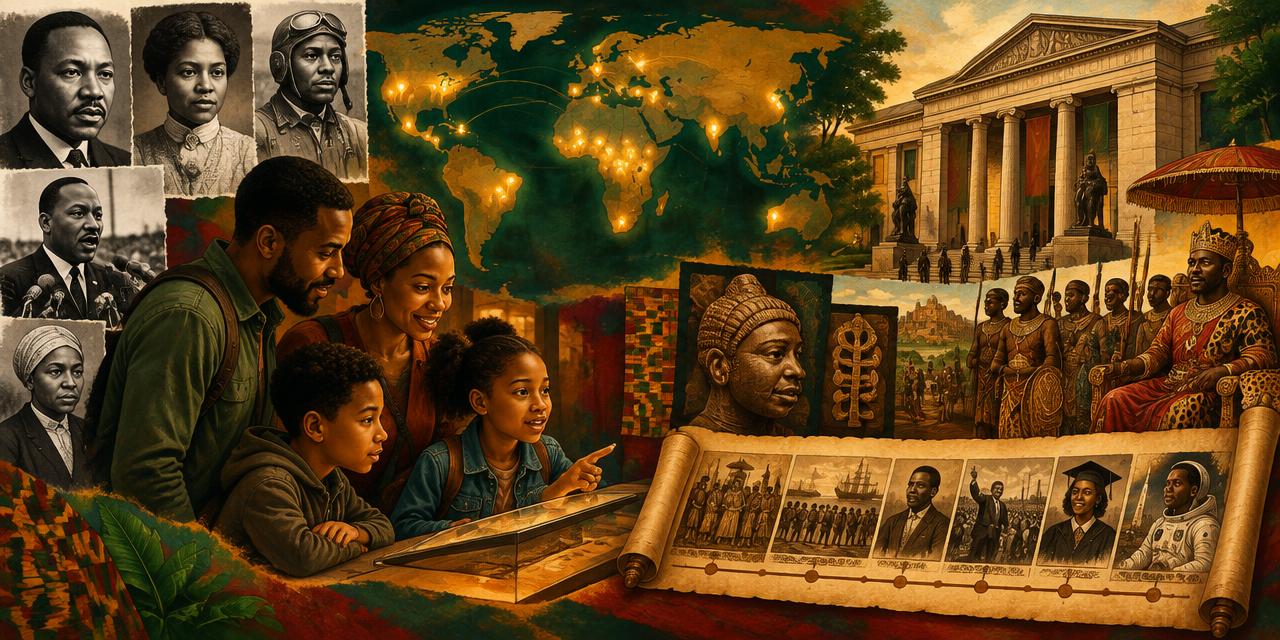
The timeline now opens with a painting of the global Black experience, from the Nile Valley and Mali to Haiti, Brazil, Europe and the civil rights movement. The blog has a new collage with Harriet Tubman, Toussaint Louverture, Zora Neale Hurston, Nelson Mandela and Angela Davis.
See the timeline →October 2026
About Us photo gallery
The About Us page now features portraits of Sojourner Truth, Zora Neale Hurston, Paul Robeson, Ella Baker, Rosa Parks and Martin Luther King Jr.
Visit About Us →October 2026
More museums in the Mid-Atlantic
New listings include the National Great Blacks In Wax Museum, the Louis Armstrong House, the Paul Robeson House, Mother Bethel's Richard Allen Museum, The Colored Girls Museum, the Banneker-Douglass-Tubman Museum, the Josiah Henson Museum, the Mitchell Center for African American Heritage and the National Museum of African Art.
Browse the museums →October 2026
New: Museums of the Black Experience
A guide to more than 100 museums, memorials and historic sites, covering African American history across the United States and the Black experience around the world. Names in other languages include English translations.
Browse the museums →October 2026
New paintings on the timeline
Original paintings now illustrate the Bornu Empire, the Kingdom of Kongo, the Oyo, Mutapa, Dahomey and Ashanti empires, the Siddis of India, Black Tudor England, Africans in Medieval Europe, the Central Sahel and Nile kingdoms and more.
See the timeline →September 2026
Jefferson, Hemings and the new DNA evidence
Our timeline entry on Thomas Jefferson and Sally Hemings now includes Annette Gordon-Reed's scholarship and the Smithsonian's new genome study of Jefferson's hair.
Read the entry →September 2026
Reconstruction and beyond: nine new entries
New and expanded entries on the Freedman's Savings Bank, the Buffalo Soldiers, the Colored National Labor Union, the Fisk Jubilee Singers, the Colfax Massacre, the Colored Farmers' Alliance, the American Negro Academy, the Niagara Movement and Oscar De Priest.
Explore the timeline →September 2026
New: Interactive Black History Map
Every timeline entry, now more than 250, is pinned to a place on a world map. Filter by historical period and click any pin to read more.
Open the map →September 2026
New: Global Black History Timeline
A timeline running from ancient Africa to today, covering Africa and the Atlantic, Caribbean, Latin American, European, Indian Ocean and US Black experiences.
Start the timeline →