
Christopher Nolan’s Oppenheimer opened to critical acclaim late last year. It details the work of J. Robert Oppenheimer. Widely regarded as the nation’s foremost theoretical physicists and father of the atomic bomb, Oppenheimer was born in New York and received his undergraduate training in Chemistry at Harvard University. He received a doctorate in physics from the University of Gottingen in in Germany in 1927. Afterwards, he joined the physics department at the University of California Berkeley becoming full professor in 1936. While at Berkeley he made significant contributions to theoretical physics, including quantum and nuclear physics, Born-Oppenheimer approximation for molecular waves, electrons and positrons, the Oppenheimer-Phillips process as well as work on quantum tunneling, neutron stars, black holes, quantum field theory and the interaction of cosmic rays. In 1942, he was recruited to the Manhattan Project. In 1943, he served as the Director of the Los Alamos Laboratory in Los Alamos, New Mexico. There he developed the nation’s first nuclear weapons and promoted atomic energy.

No less important than Oppenheimer were more than nineteen African American scientists, men and women, who also made important contributions to the development of atomic energy in the United States. They worked at the Oak Ridge in facility in Tennessee, and the Chicago Metallurgical Laboratory. Black laborers also worked at Oak Ridge and played a seminal role in the support work to produce the bomb. Its estimated that 7,000 Black laoborers worked at the site, although no more than 2,000 laborers worked there at any given time. These Black scientists, technicians and laborers played an important role in the work of developing the atomic bomb.
Historianspeaks is pleased to present this series, Beyond Oppenheimer: Black Scientists and the "Bomb," focused on African American participation in the creation on the atomic bomb. We will feature biographical information and discussion of the work of these scientists throughout Black History Month. We welcome your questions and comments.
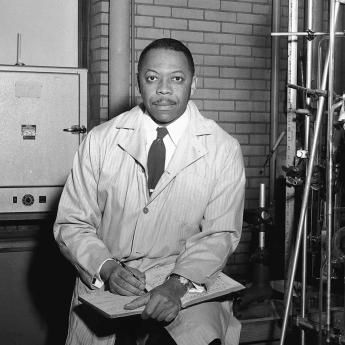
The second installment in this series focuses on Moodie Taylor, PhD. Taylor was a chemist who worked on rare earth metals. He worked at the Chicago Met Lab from 1943-1945.
Moodie Taylor was born in Nymph, Alabama in 1912. His family moved to St. Louis, where his father worked as a postal clerk. Taylor received his undergraduate training at Lincoln University in Jefferson City, Missouri. He graduated summa cum laude with a degree in Chemistry in 1935. After graduation, he worked as a chemistry lecturer at Lincoln University until 1941. In 1941, Taylor transferred to the University of Chicago where he received his M.S. in 1939 and a PhD in 1943.Taylor's graduate training focused on rare earth metals, which are byproducts of oxidized metals and have distinct features in addition to various important industrial applications. His 1943 University of Chicago dissertation was titled “Acid-Base Studies in Gaseous Systems: The Dissociation of the Addition Compounds of Trimethlyboron with Aliphatic Amines”

Taylor worked as an assistant chemist on the Manhattan Project at the University of Chicago's Met Laboratory from 1941-1943. Taylor conducted research on heavy and rare earth metals. He also studied the properties of metals important to the production of the bomb, namely plutonium. In 1946, Taylor received the Certificate of Merit from Secretary of War Robert Patterson for his services to the war effort. Speaking about the role of the scientist at the end of the war, he said: Nothing must come between the scientist and his field of research. There must be no prejudice; no tradition to perplex him; no vested interest to prevent his exploring every promising avenue he sees.” After the war, he briefly returned to Lincoln University. In 1948, Taylor joined the Chemistry Department at Howard University.
Taylor was awarded a grant by the American Academy of Arts and Sciences in 1956 to carry out research on acid-base reactions in gaseous systems. In 1960, he published a textbook, First Principles of Chemistry. The book soon became an important text for use in colleges and universities throughout the country. Taylor became the Chair of the Chemistry Department at Howard University in 1969. In 1972, the Washington Institute of Chemists presented him with the Honor Scroll in appreciation of his achievements during this period. As part of President Lyndon B. Johnson's attempt to elevate more Black scholars and attorneys to government jobs, Taylor was named to the U.S. Assay Commission in 1965. This commission was tasked with ensuring the nation’s metal currency met precise specifications.
After a successful career in chemistry, Taylor retired from Howard University as a Professor Emeritus in 1976. A few months later, on September 15th, 1976, in Washington, DC, he passed away at age 64.
Ask the Historian
Have a question about this story, or an idea for a future post? Send it here.