
.jpg)
.jpg)
Christopher Nolan’s Oppenheimer opened to critical acclaim late last year. It details the work of J. Robert Oppenheimer. Widely regarded as the nation’s foremost theoretical physicists and father of the atomic bomb, Oppenheimer was born in New York and received his undergraduate training in Chemistry at Harvard University. He received a doctorate in physics from the University of Gottingen in in Germany in 1927. Afterwards, he joined the physics department at the University of California Berkeley becoming full professor in 1936. While at Berkeley he made significant contributions to theoretical physics, including quantum and nuclear physics, Born-Oppenheimer approximation for molecular waves, electrons and positrons, the Oppenheimer-Phillips process as well as work on quantum tunneling, neutron stars, black holes, quantum field theory and the interaction of cosmic rays. In 1942, he was recruited to the Manhattan Project. In 1943, he served as the Director of the Los Alamos Laboratory in Los Alamos, New Mexico. There he developed the nation’s first nuclear weapons and promoted atomic energy.
.jpg)
No less important than Oppenheimer were more than nineteen African American scientists, men and women, who also made important contributions to the development of atomic energy in the United States. They worked at the Oak Ridge in facility in Tennessee, and the Chicago Metallurgical Laboratory. Black laborers also worked at Oak Ridge and played a seminal role in the support work to produce the bomb. Its estimated that 7,000 Black laoborers worked at the site, although no more than 2,000 laborers worked there at any given time. These Black scientists, technicians and laborers played an important role in the work of developing the atomic bomb.
Historianspeaks is pleased to present this series, Beyond Oppenheimer: Black Scientists and the "Bomb," focused on African American participation in the creation on the atomic bomb. We will feature biographical information and discussion of the work of these scientists throughout Black History Month. We welcome your questions and comments.
Our first installment in the series focuses on Edwin R. Russell. Russell, a Black research chemist, played a significant role in the creation of the atomic bomb during World War II, but his contribution have received little attention. Russell’s work made invaluable contributions to the project. He made significant advances in the manufacturing of uranium metal, the creation of gaseous diffusion techniques for uranium enrichment, and the alloying of plutonium through his research.
Edwin Russell was born in Columbia, South Carolina in 1913, He received his BA at Benedict College in South Carolina in 1935 and his MA at Howard University in 1937. During his time as a student at Benedict, he worked as a carpenter and bricklayer. While pursuing a PhD in Surface Chemistry at the University of Chicago, Russell was recruited to workon the Manhattan Project, at the Chicago Metallurgical Laboratory. Russell’s supervisor approached him about a special job at the Chicago Metallurgical Laboratory in Chicago. Russell later recalled: “ I began working for a week, when a man gave me a bucket full of black mud…..I had to find out how much of this five to six pounds of black gunk, how much of rare earths was present in that material.” Rare Earths were elements found in nature that could not be easily separated from one another. “There were no chemical methods by which you could analyze the material. There were no directions to go to, but I had to find it. It did not know that this material was called pitchblende….When the man came back, I found that in the five pounds there was twenty milligrams that was about enough to fit on the end of my finger” Russell joined a small and highly selective group of African American scientists and technicians employed at Chicago: “There were eight of us, on the dropping of the first bomb...The other seven, two of them were technicians and the other ones were scientists." Rusell also reflected on the state of scientific knowledge at the time and the challenges faced by those working on the project: "In the 1940s matter was thought to have been made up three particles…. a neutron—has weight but no charge, a proton with its positive charge was thought to be the heaviest and smallest part of the atom. It was the negatively charged electron that made the production of new elements possible.”
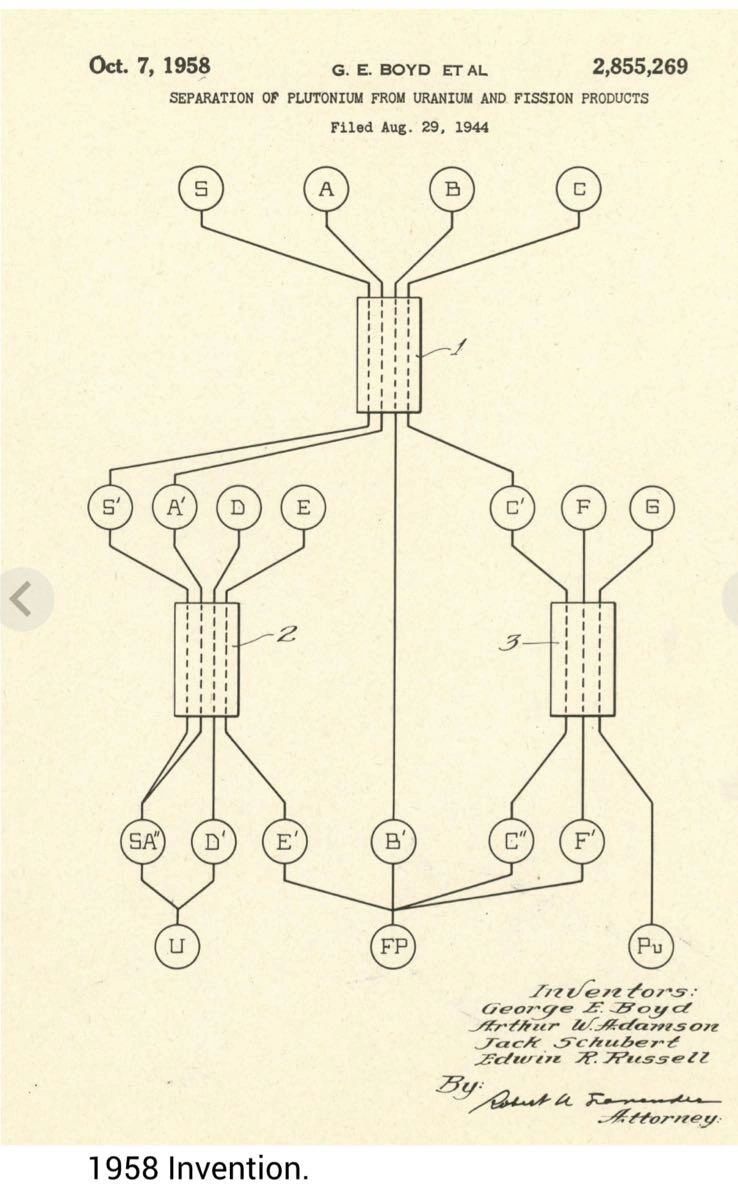
Russell worked on metallurgy and plutonium purification, creating materials to resist the heat produced by an atomic explosion. He made significant advances in the manufacturing of uranium metal, the creation of gaseous diffusion techniques for uranium enrichment, and the alloying of plutonium through his research. Russell also developed a method to separate and extract plutonium-239 from uranium ore. Russell isolated plutonium-239 using his extraction procedure, which employed the solvent extraction method to separate uranium-238 from uranium ore. His approach, which employed the solvent extraction technique, enabled the separation of uranium-238 from uranium ore, and the plutonium-239 that was produced because of this operation served as the primary component in the creation of an atomic weapon. Russell eventually obtained eleven U.S. Patents including two focused on the process of isolating plutonium (U.S. Patent 2,855,629, Oct. 7, 1958; U.S. Patent 2,992,249, July 11, 1961)
Following World War II, Russell served as Chairman and Professor in the Division of Science at Allen University, an HBCU in Columbia, South Carolina from 1947-1953. He entered the private sector as a Research chemist at E.I. DuPont’s Savannah Nuclear Laboratory in Aiken, South Carolina from 1953 until his retirement in 1976. While at DuPont, Russell worked on several projects related to the treatment of radioactive waste and wrote classified publications on nuclear energy. He also served as a contributing editor to the National Nuclear Energy Series, a member of the American Association for the Advancement of Science (AAAS) and the American Chemical Society (ACS). Russell died in 1996.
Ask the Historian
Have a question about this story, or an idea for a future post? Send it here.