
Bolaji Balogun, PhD, is a Leverhulme Trust Fellow at the University of Sheffield, United Kingdom. He was a lecturer at the Department of European Studies, Krakow University of Economics, Poland. Bolaji’s research interests include Blackness, Race, and Racialization in Central and Eastern Europe. His academic publications have appeared in prestigious journals such as Ethnic and Racial Studies, Sociology, and The Sociological Review. He is currently working on the first book-length monograph - Race and the Colour-Line: the Boundaries of Europeanness in Poland - that examines race and racism in Poland, to be published by Routledge and funded by The Leverhulme Trust.
Russians and Ukrainians, Putin assumes, are one people and therefore must have the same destination. It was this conviction of sameness that partly drove Putin’s invasion of Ukraine with a determination to forcefully drag sovereign Ukraine onto the assumed similar destination with Russia and Belarus. People across the world continue to condemn Putin’s invasion of Ukraine. Rightly so, such an assault on a sovereign state would continue to unite people of all backgrounds. Nonetheless, a major thread running through the crisis is the primacy of race that signified how White lives seem to matter more than Black and Brown bodies in Central and Eastern Europe.
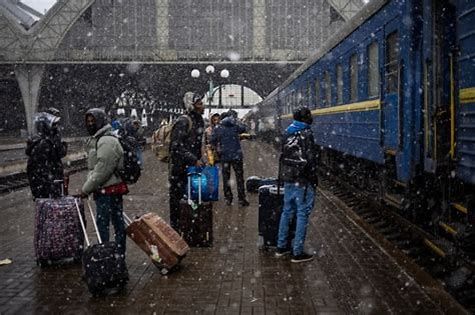
Central and Eastern Europe is often perceived as a homogenous region inhabited by only White populations. Contrary to this common perception of the region, there are several non-whites, non-European communities living in the region as citizens, residents, and students. The ill-treatment of some students from Africa, Asia, and the Middle East provided an important racialized dimension to the crisis. Whilst many people were fleeing Ukraine for Poland, some Black and Brown peoples were racially profiled, mainly by the Ukrainian border guards, blocking the people of colour from crossing Ukraine’s border with Poland or directing them to use a different border.
This subtle power of whiteness registered similar maltreatment of Ukraine’s Romani population being refused support when trying to flee the war. There is an important point to make here, one that cannot be stressed enough. The reception of refugees by both the Polish state and the public has been exceptional. But this Polish benevolence should not be steered by the politics of race, whiteness, and sameness, nor should it ignore the racialized experiences of people of colour in Poland, and must take into account Poland’s construction of wall along the Poland-Belarus border that barred Syrians, Afghans, and Iraqis from crossing into Poland.
Again and again, we continue to see the ways in which bordering of race, whiteness, and sameness are reproduced, especially through Eurocentric media coverage of the war that tends to prioritize White lives over Black and Brown bodies. In his response to Russia’s invasion of Ukraine that led to millions of people fleeing westward, Daniel Hannan, a former Member of the European Parliament, observed in The Telegraph that Ukrainian people “seem so like us”, pointing to the Europeanness and whiteness of the people and the notion of war as something that is remote to Europe. In this sense, war is reduced to “impoverished and remote populations” in the Middle East and Africa. Similarly, Charlie D’Agata, a foreign correspondent for CBS News, reported the invasion as an attack on civilization. Seen as such, Ukraine as a European nation is more “civilized”. In D’Agata’s view, Ukraine “isn’t a place, with all due respect, like Iraq or Afghanistan that has seen conflict raging for decades”. The comments by NBC news correspondent, Hallie Cobiella, made explicit the Eurocentric view of the war: “To put it bluntly, these are not refugees from Syria, these are refugees from Ukraine…”, Cobiella concludes, “They’re Christians, they’re white. They’re very similar.” The similarity identified here is predicated upon assumed specific features – Whiteness, Europeanness, “blue eyes and blonde hair” as David Sakvarelidze, Ukraine’s deputy chief prosecutor, emotionally put it to the BBC. At the heart of this, biological differentiation, that is the separation of Europeanness from non-Europeanness continues to be important to these commentators. Within this policing of boundaries of Europeanness, Ukrainian people are assigned the badge of whiteness, therefore, must share the same ‘European civilization’. Nonetheless, there is a sense of ‘European amnesia’ here, in which all the commentators failed to recall that it was the same ‘civilized’ Europe that gave the world the most barbaric experiences of the First and the Second world wars and the violence unleashed within the narratives of colonization outside Europe.
Ask the Historian
Have a question about this story, or an idea for a future post? Send it here.