
Renee Ragin Randall is a LSA Collegiate Postdoctoral Fellow at the University of Michigan-Ann Arbor in the departments of Comparative Literature and Middle East Studies. She researches and teaches on trauma and memory as well as world literature and the world literary economy. Prior to academia, she served as a Foreign Service Officer with the US Department of State with tours of duty in Washington DC and Saudi Arabia.
In times like this, when a country’s sovereignty is violated, its people targeted by a powerful military and subjected to acts of terrorism, particular slogans become rallying cries for a global expression of outrage and solidarity. “We are all Ukrainians,” a cry reverberating across Europe and the United States, is one of the latest examples.
It is a slogan that is morally reprehensible in its hypocrisy.
For people of color around the world, it is yet another in the long list of affronts predicated on white identity politics—fungible though “whiteness” may be.
The United States has been the Russia to countless Ukraines, hands dirtied in wars of naked ambition cloaked in the rhetoric of privilege and backed up by military might. Any cries of “we are all Iraqi,” however, were troublingly delayed, if not muted, in the Global North. Our government continues to declare war on the people of Afghanistan by freezing their assets and redistributing them to Americans. For decades, Israel has chipped away at Palestinian sovereignty and livelihood: a privilege gifted by colonial Britain. Meanwhile, Britain’s leader now calls for the world to protect the sovereignty and dignity of Ukrainians.
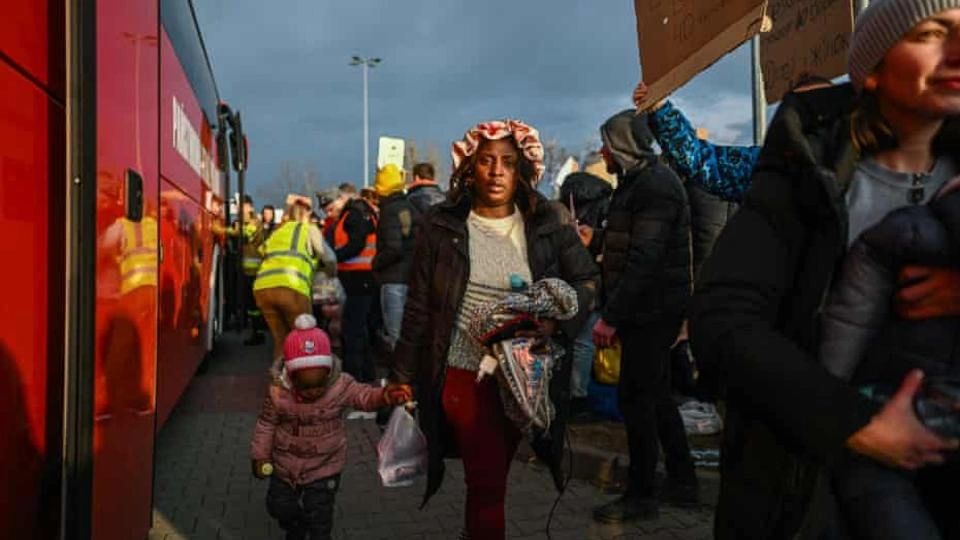
Few of the migrants who reach the US-Mexico border or brave the Mediterranean waters and trek continental Europe have been greeted by the outpouring of support from governments and private citizens shown to fair-skinned Christian Ukrainians. (And it must be said that this courtesy extends only to the “fair-skinned”: Ukrainians of African origin are being turned away as they do not look like the “civilized” victims for whom hearts are bleeding.) No prominent head of state has called upon the world’s governments to mobilize in defense of the Yemenis suffering from attacks by the Saudi Arabian military… a war which the United States government is actively funding. And in this country, the debate and even rage inspired by the simple affirmation that Black Lives Matter makes American outrage on behalf of Ukrainian lives seem particularly hollow.
People of color—whether in the Global South or North—know quite a lot about being, as it were, “Ukrainian.” We often live under militarized and precarious conditions—including in our own homes by our own countrymen. Despite this truth, we do not have the luxury of declaring ourselves “all Ukrainians.” We are not, and have never been, seen as the same kind of victim: one with a life worth defending or a death worth grieving. And, yet, by pointing this out, we will undoubtedly be considered callous, playing a zero-sum game of victimhood, playing the “race” card.
So let me be clear: people of color around the world have a moral obligation to denounce invasion, occupation, slaughter. The people of Ukraine are experiencing something terrible and unacceptable, and our sympathies—everyone’s sympathies—should be with them. But, for people of color, in particular, our sympathy cannot make us lose sight of the millions of other people who look like us, and whose struggle and resistance continues to be completely erased, time and again, by a politics which never counts our lives as worth this much effort to save.
Ask the Historian
Have a question about this story, or an idea for a future post? Send it here.