
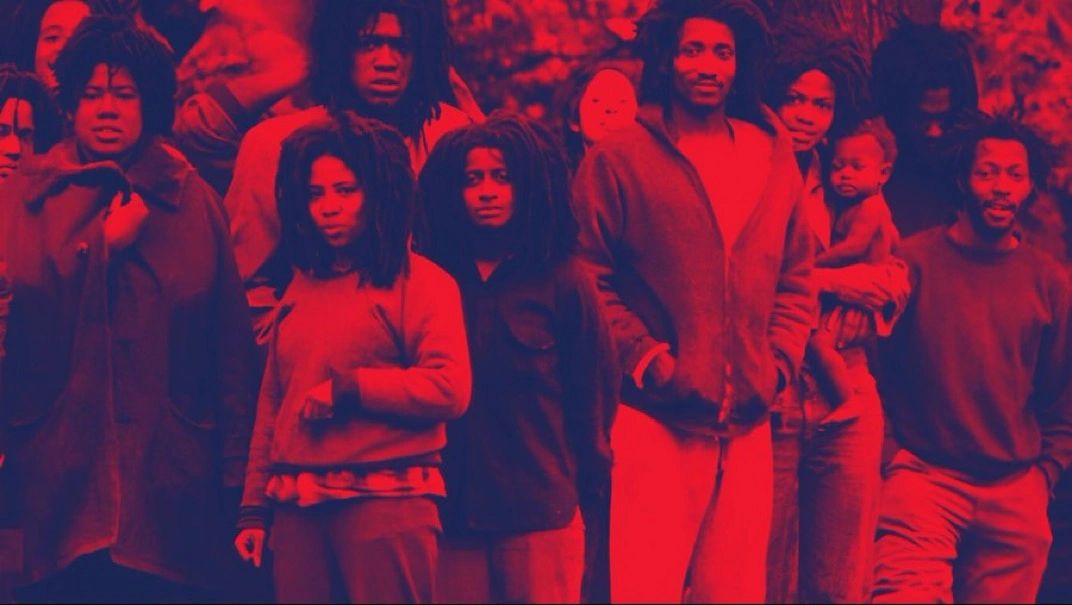
The conflict between MOVE movement, a communal organization and the Philadelphia City government and the Philadelphia Police department came to symbolize a struggle between two competing ideologies. On one hand there was MOVE, a communalist group dedicated to the maintenance of human life, committed to Black power and Africanist ideologies and anti-technology and pro-animal rights. On the other hand, the city of Philadelphia and its institutions dedicated to the maintenance of law and order, and committed to enforcing housing codes and sanitation policies geared to single family households. And most importantly, committed to zero tolerance of activist groups who challenged the status quo. The ways in which these visions clashed between 1972 and 1985 left an indelible mark on the MOVE movement and the city of Philadelphia.
While considerable attention has been given to the 1985 bombing of the MOVE compound, this was not their first encounter with Philadelphia authorities. In 1972, John Africa founded MOVE. The group was Black nationalist, pro-Africa and its members took the last name Africa. They also wore their hair in dreadlocks, promoted communal living and a return to a simpler pre-modern society dedicated to hunting and gathering. MOVE members were also anti-science, medicine and technology and were strong proponents of animal rights. MOVE devoted its time to protesting against a wide variety of animal and energy causes ranging from zoos to nuclear power on Three Mile island.
MOVE established a communal property in the Powelton Village section of West Philadelphia. MOVE’s views conflicted with and often came in to conflict with Philadelphia’s conservative law and order political establishment. Philadelphia’s mayor, Frank Rizzo, the former police commissioner of the city, was openly critical of activist groups and maintained a high level of scrutiny of these groups.
The antipathy between MOVE reached a boiling point in 1978. In 1977, Philadelphia reached an agreement with residents of the Powelton commune property to surrender their guns and vacate the property. A year later, MOVE members remained on the property. Police attempted to enter the property and were allegedly fired upon by residents. James J. Ramp of the SWAT unit was killed by a gunshot to the neck. Sixteen police officers and fire fighters were also injured in the incident. Prosecutors charged MOVE for the shooting and charged Debra Africa and eight other MOVE members with murder. Murder charges were brough against MOVE despite conflicting accounts of the incident. Evidence showed the shot that killed Ramp may have come from the opposite direction. This meant Ramp was killed by police fire rather than by MOVE members. Moreover, MOVE had already turned over mostly inoperative guns to police in May 1978. Despite this fact, prosecutors stated that there were operable guns in the house.
The MOVE 9 as they became known were charged with third degree murder and given a prison sentence of 100 years in prison. The MOVE 9 comprised of Chuck, Delbert, Eddie, Janet, Janine, Merle, Michael, Phil, and Debbie Sims Africa. Some of the members died in prison and others served lengthy prison terms exceeding 40 plus years
The 1978 incident set the stage for the 1985 MOVE bombing. In fact, it contained the same elements of the first standoff. MOVE was now in a compound at 6221 Osage Avenue in the Cobbs Creek Area of West Philadelphia. Neighbor complaints about trash, stench, and bullhorn announcements led to increased conflicts. Police obtained arrest warrants. These warrants charged MOVE members with parole violations, contempt of court, illegal firearm possession and terroristic threats. Mayor Wilson Goode, a Morgan State University and University of Pennsylvania graduate, led the charge. He was assisted by Police Commissioner Sambor. City officials evacuated neighboring houses and turned off water and electricity. More than 500 police officers participated in the action.
The assault on the MOVE compound began with a speech from city officials which began in part with the words: “Attention MOVE: This is America. You have to abide by the laws of the United States.” This statement highlights the tension between MOVE and the City of Philadelphia. Efforts to dislodge MOVE members from the compound were unsuccessful and led to a prolonged standoff. Police used tear gas and MOVE members repeatedly fired on authorities. It was estimated police utilized almost 10,000 rounds (bullets) in the assault.
Unsuccessful efforts to breach the compound led to the decision to use two one pound bombs on a look out structure perched atop the compound. Police dropped two FBI supplied Tovex devices into the roof structure. The fire that resulted killed eleven of the people in the house including John Africa, five adults and five children aged 7 to 13. Because the fire department claimed they could not douse the flames due to gunfire, the fire spread to 65 houses on Osage and Pine street.
The aftermath of the MOVE bombing led to the creation of the MOVE Commission. The commission’s report in 1986 was highly critical of the City of Philadelphia’s actions. The report condemned the use of a bomb in an urban neighborhood. Mayor Goode made a public apology. In 1996, a federal jury awarded $1.5 million to Ramona Africa and relatives of two people killed in the bombing. Those residents displaced by the bombing won a $12.84 million civil suit against the city in 2005. In 2020, the City Council of Philadelphia passed a resolution apologizing for its role in any decisions that led to the MOVE bombing. The council also established an annual day or observation, reflection and recommitment.
The MOVE organization tested the limit of citizen rights and city and state power. Its membership, drawing on revolutionary Black nationalism, eco activism and communalism, challenged the limits of societal control and city authority. MOVE’s membership which included the well known political detainee Mumia Abu-Jamal, John and Ramona Africa, refused to abide by city regulations and often confronted authorities through self defense. MOVE’s ideas about communalism and refusal to abide by sanitation, noise and housing codes led to conflict. Their unbridled independence and determination to live outside of established or accepted social mores was also another point of contention. In the end, regardless of how we might feel about a group’s lifestyle or beliefs, that does not authorize extreme levels of force utilized against them to bring about conformity. This was definitely the case with the City of Philadelphia and the bombing of MOVE. During the 25th anniversary of the MOVE bombing, the Philadelphia Inquirer produced a 10 part series highlighting the event as well as all the evidence in the case. The city’s attempts to apologize and remember this incident provide insights into what went wrong and how to make sure something like this never happens again.
Ask the Historian
Have a question about this story, or an idea for a future post? Send it here.