
The COVID-19 pandemic is one of the most challenging public crises in modern history. Beyond its devastating impact on the health sector, the pandemic is placing a tremendous strain on the nation’s institutions. The prison system is one among the many institutions the crisis has challenged dramatically. The prison industrial complex highlights one of the most problematic aspects of contemporary society. Housing a disproportionate number of poor Black and Brown people (man and women) it embodies the racial, gender and class challenges we face as a nation. It also brings the country’s health inequities into broad relief. The rapid spread of the coronavirus has impacted prison systems throughout the country. In fact, two of the country’s most significant systems: New York City and Chicago are ground zero for this unique health, social, cultural and racial challenge.
In New York City, the coronavirus is raging in the city’s correctional system. Recently, 700 individuals associated with the New York City Department of Corrections tested positive. The system houses 4,353 inmates. This means that the infection rate is 6.6% percent of the total. The first death in the system was Michael Tyson. Tyson was incarcerated at Rikers Island on a technical parole violation when he contracted the virus and died. Six correctional officers have also died. Another prisoner, Raymond Rivera suffered the same fate as Tyson. Jailed last summer on a minor parole violation, he waited for months for a decision on his release. By the time Rivera’s warrant was finally lifted, he was already in a hospital bed in Bellevue with the coronavirus. He died the next day.
Criminal justice advocates and public defenders as well as prisoners sounded alarm bells about the possibility of coronavirus in mid-March. Corrections officials were slow to action. The New York correctional system eventually suspended all prison visitations. In late March, under pressure, Mayor Bill DeBlasio and New York Governor Andrew Cuomo released 1,100 prisoners being held on parole violations. Advocates criticized this move as inadequate. They instead called for the release of a specific set of prisoners deemed vulnerable to infection.
Critics have intensified their criticism of the system as the pandemic rages. Their primary concern is the cumbersome and slow nature of the parole process. The legal and parole apparatus have slowed to a crawl. The release process occurs at a snail’s pace. At Rikers Island, parole revocation hearings were halted after a parole officer contracted the virus last month. The cases being heard are via telephone without the presence of the parolee. These cases are those in which the state has already agreed to release the prisoner. Others, arrested on parole violations, are still awaiting their day in court. And new entrants into the system simply wait for hearings without the benefit of legal representation. All remain in the system indefinitely and at risk of infection,
Concerns in the system are not only about infection, but also about personal protective equipment
The Corrections Officers Benevolent Association, the union that represents correctional officers in New York sued to procure more PPE for employees. The courts granted a temporary restraining order, which requires the city to provide some employees N-95 masks and respirators prior to each shift, as well as regular COVID-19 testing and to sanitize the workplace. Officials have also pledged to increase sanitary supplies.
In Chicago, the situation is even more dire than in New York. The prison system in Cook County is experiencing the largest coronavirus outbreak in the county. Two prisoners have died in the system. The first, Jeffrey Pendleton, died at Stroger Hospital on March 30th. The second, Lesile Peroni, died at Cook County Jail on April 9th. Although the system has released prisoners, it has not stemmed the outbreak, The situation escalated this week when prisoners posted signs in the jail’s windows pleading for help from the general public.
Illinois has more than 500 deaths in the prison system. More than 353 cases can be traced to the Cook County jail. These statistics include infections for 238 inmates and 115 staff members. The full extent of the crisis is unknown. The greater percentage of the 4,500 inmates in the jail have not even been tested.
The county sheriff, Thomas J. Dart has worked diligently to contain the outbreak. In addition to staying away from his own family, he has created two quarantine areas. The first area is to monitor inmates with the virus and the second is to monitor those with symptoms. Efforts are also underway to move inmates from double to single beds and open a testing facility at the jail. Staff are now subjected to temperature checks at the beginning of each shift and issued PPE.
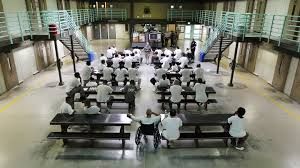
Many observers view prisons as veritable petri dishes of disease. Prisoners are often housed in older units with sometimes 4-6 prisoners in one cell on bunk beds. Bunk beds and poor ventilation enable disease to move throughout the facility. In many cases, hopelessly overcrowded and aging facilities, prisoners and staff in close proximity, unsanitary conditions in holding areas and, a staff that most likely transfer the virus from the prison to the general public form a recipe for disaster.
Prisoners around the country are taking matters into their own hands. In Monroe, Washington inmates vandalized the prison after officials revealed six inmates tested positive for COVID-19. Officials were forced to use non-lethal pellets and pepper spray to subdue the inmates. Similarly, prisoners in Lansing, Kansas staged a mini riot at a correctional facility in response to a report by officials that a dozen staff and 12 inmates had tested positive for COVID-19 at the facility.
Throughout the country, inmates and their families, advocates and prison officials are increasing sounding the alarm about their deteriorating accommodation conditions. The US Attorney General recently announced changes. He stated that the emergency in the Federal Bureau of Prisons means more inmates will be released into home confinement. The situation in American’s prisons is a cause for alarm. Local, state and federal agencies need to take more decisive action to curtail this state of emergency.
Ask the Historian
Have a question about this story, or an idea for a future post? Send it here.