
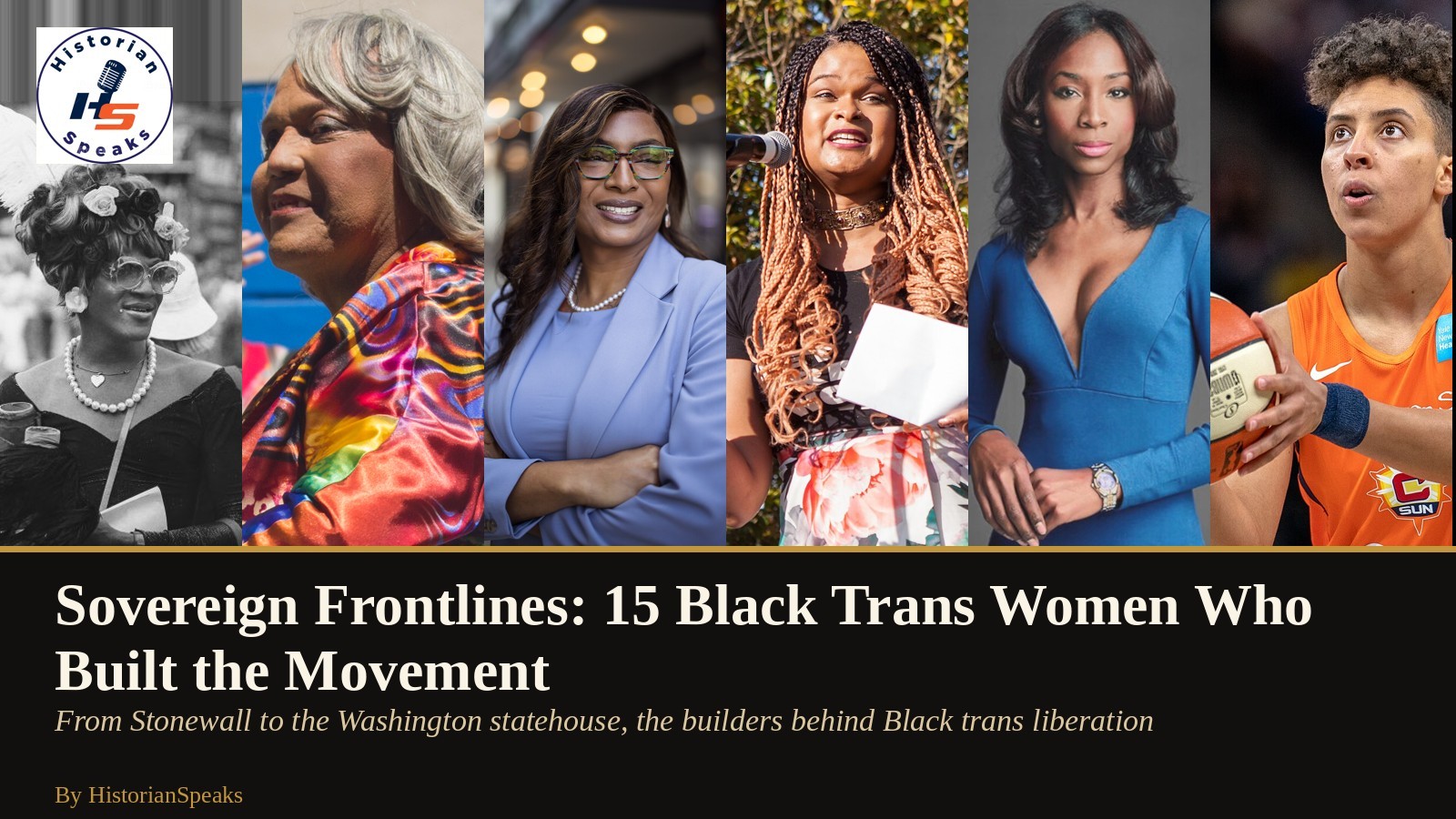
Every Transgender Awareness Week, the country receives a list of Black trans women it is asked to mourn. This year, we offer a different list: fifteen Black trans women who built things. They built shelters and cultural districts, abolition campaigns and housing cooperatives, media companies and tech pipelines. One of them, Jaelynn Scott, was just elected to the Washington State Legislature.
These are not portraits of victims or corporate "firsts." They are records of institution-building, the same work Black communities have always done when the state refused to protect them. From STAR House in 1970 to a statehouse seat in 2026, Black trans women have not waited for permission.
The profiles are arranged by the front each leader worked on. Read them as a map of a movement.
Front One: Street Survival and Mutual Aid
Marsha P. Johnson

Marsha P. Johnson. Photo: Hank O'Neal, 1970s, [Public domain](https://commons.wikimedia.org/wiki/File:Marsha_P._Johnson_1970s_%28cropped%29.jpg), via Wikimedia Commons.
Marsha P. Johnson (1945–1992) was on the front line at the Stonewall uprising in June 1969. A year later, with Sylvia Rivera, she co-founded Street Transvestite Action Revolutionaries, known as STAR, and opened STAR House on the Lower East Side, a shelter where homeless queer and trans young people could eat and sleep. Johnson paid much of the rent herself. Her body was found in the Hudson River in 1992; activists still demand a full accounting of her death.
Why she matters: STAR was mutual aid before the term was fashionable: the people the movement left behind built their own house.
Miss Major Griffin-Gracy

Miss Major Griffin-Gracy. Photo: Quinn Dombrowski, [CC BY-SA 2.0](https://commons.wikimedia.org/wiki/File:MissMajorCropped.png), via Wikimedia Commons.
Miss Major Griffin-Gracy (1940–2025) survived Stonewall, did time in New York prisons, and was in Attica in 1971 when the uprising there was crushed. She learned political education from Black prisoners there and carried it for the rest of her life. As executive director of the Transgender Gender Variant and Intersex Justice Project in San Francisco, she organized for trans women inside prisons and jails, and later opened the House of GG, a retreat for Black trans women in Little Rock, Arkansas.
Why she matters: Miss Major is the living link between the Black prison movement and today's trans abolitionists.
Front Two: Abolition and the Right to Self-Defense
CeCe McDonald

CeCe McDonald. Photo: Pax Ahimsa Gethen, [CC BY-SA 4.0](https://commons.wikimedia.org/wiki/File:CeCe_McDonald_at_SF_LGBT_Center.jpg), via Wikimedia Commons.
CeCe McDonald was attacked with racist and transphobic slurs outside a Minneapolis bar in June 2011. In the fight that followed, one of her attackers died. Prosecutors charged her with murder; she accepted a plea to second-degree manslaughter and served 19 months, much of it in a men's prison. The "Free CeCe" campaign, joined by Laverne Cox, turned her case into a national argument about who is permitted to defend herself.
Why she matters: Her case showed that, for Black trans women, survival itself can be prosecuted.
Toni-Michelle Williams
Photograph pending: no openly licensed portrait was available at press time.
Toni-Michelle Williams leads the Solutions Not Punishment Collaborative, or SNaP Co, in Atlanta, a Black trans-led organization that campaigns against policing and incarceration. SNaP Co helped persuade Atlanta to close its city jail to new detainees and to end cash bail for many low-level offenses, and it has pushed to decriminalize the survival economies that so many Black trans women depend on.
Why she matters: Williams proves that abolition in the South is a working program, not a slogan.
Front Three: Public Office
Jaelynn Scott

Jaelynn Scott. Photo: JPS10000, [CC0](https://commons.wikimedia.org/wiki/File:Jaelynn_Scott_(Seattle).jpg), via Wikimedia Commons.
Jaelynn Scott won Position 2 in Washington's 37th Legislative District, covering parts of Seattle and Renton, on November 3, 2026. She is the first openly transgender Black woman elected to a state legislature in the United States. "That's huge. And I don't want to dismiss that," she told KING 5. "I'm not here for myself." She has pledged to fight Initiative 638, the new limit on trans girls in school sports, along with rent protections, childcare costs and a review process for young people in juvenile detention.
Why she matters: Scott takes Black trans leadership from the street and the city council into the statehouse.
Andrea Jenkins

Andrea Jenkins. Photo: Tony Webster from Minneapolis, Minnesota, United States, [CC BY-SA 2.0](https://commons.wikimedia.org/wiki/File:Andrea_Jenkins_-_Minneapolis_City_Council_Vice_President,_Ward_8_(38891113634)_(cropped).jpg), via Wikimedia Commons.
Andrea Jenkins won a seat on the Minneapolis City Council in 2017, becoming the first openly transgender Black woman elected to public office in the United States. Her colleagues chose her as council president in 2022. Before office, she spent years as a council staffer and as an oral historian at the University of Minnesota, where she built the Transgender Oral History Project. She is also a published poet.
Why she matters: Jenkins opened the door that Jaelynn Scott has now walked through.
Front Four: Land, Housing and Place
Aria Sa'id

Aria Sa'id. Photo: Pax Ahimsa Gethen, [CC BY-SA 4.0](https://commons.wikimedia.org/wiki/File:Aria_Sa'id_20170629-6910_(cropped).jpg), via Wikimedia Commons.
Aria Sa'id co-founded the Compton's Transgender Cultural District in San Francisco's Tenderloin in 2017, the first legally recognized transgender district in the world. It is named for the 1966 Compton's Cafeteria riot, when trans women fought back against police harassment. Sa'id later founded the Kween Culture Initiative to support Black trans women in the Bay Area.
Why she matters: She turned a neighborhood's history into a legal claim on the land.
Ceyenne Doroshow
Photograph pending: no openly licensed portrait was available at press time.
Ceyenne Doroshow founded G.L.I.T.S. (Gays and Lesbians Living in a Transgender Society) in New York to care for trans sex workers and trans people leaving jails and immigration detention. During the pandemic in 2020, G.L.I.T.S. raised more than $1 million and bought a building in Queens to provide permanent housing for Black and brown trans people, free of landlords.
Why she matters: Doroshow answered housing discrimination by owning the house.
Front Five: Work, Technology and Sport
Angelica Ross

Angelica Ross. Photo: Miss Ross, Inc. crop by me, [CC BY 3.0](https://commons.wikimedia.org/wiki/File:Angelica_Ross_profile.jpg), via Wikimedia Commons.
Angelica Ross is best known for playing Candy on FX's Pose and for roles in American Horror Story. Off camera, she founded TransTech Social Enterprises in Chicago, which trains trans and gender-nonconforming people in design, coding and digital work, and connects them to paid jobs. In 2019, she became the first openly trans person to moderate a U.S. presidential candidate forum.
Why she matters: Ross treats a paycheck as a civil right and built the pipeline to it.
Layshia Clarendon

Layshia Clarendon. Photo: Lorie Shaull, [CC BY-SA 4.0](https://commons.wikimedia.org/wiki/File:Layshia_Clarendon_(cropped).jpg), via Wikimedia Commons.
Layshia Clarendon is the first openly trans and nonbinary player in WNBA history. A former first-team All-American at the University of California, Clarendon played for several WNBA teams, served as a vice president of the WNBA players' union, and in 2020 helped lead the league's dedication of its season to Black Lives Matter and to Breonna Taylor.
Why they matter: Clarendon brought Black trans and nonbinary life onto the court and into the labor movement of women's sports.
Front Six: Movements, Media and Memory
Raquel Willis

Raquel Willis. Photo: Pax Ahimsa Gethen, [CC BY-SA 4.0](https://commons.wikimedia.org/wiki/File:Raquel_Willis_at_Trans_March_San_Francisco_20170623-6535.jpg), via Wikimedia Commons.
Raquel Willis helped organize the Brooklyn Liberation march of June 14, 2020, when roughly 15,000 people dressed in white filled the plaza outside the Brooklyn Museum for Black trans lives. A former executive editor of Out magazine, she founded Black Trans Circles to build leadership among Black trans women in the South and Midwest, and wrote the memoir The Risk It Takes to Bloom (2023).
Why she matters: Willis showed that Black trans women can fill a public square on their own terms.
TS Madison

TS Madison. Photo: https://www.flickr.com/photos/dvsross/, [CC BY 2.0](https://commons.wikimedia.org/wiki/File:Ts_Madison_at_RuPaul's_Dragcon_2017_by_dvsross.jpg), via Wikimedia Commons.
TS Madison built an audience online on her own terms, years before television noticed. In 2022 she became the first Black trans woman to star in and executive produce her own reality series, The TS Madison Experience, and she has been a judge on RuPaul's Drag Race. Her candor about sex work, money and family has made her one of the most recognizable Black trans voices in the country.
Why she matters: Madison owned her platform before anyone offered her one.
Hope Giselle

Hope Giselle. Photo: SandyMeeks92, [CC BY-SA 4.0](https://commons.wikimedia.org/wiki/File:Hope_Giselle_Headshot_(cropped).jpg), via Wikimedia Commons.
Hope Giselle is an organizer, author and educator whose work focuses on Black trans women and civic power. She has worked with GET Phluid on diversity and inclusion, and her writing, including Blackness, Brilliance & Being, gives readers language for Black trans feminist life.
Why she matters: Giselle turns Black trans experience into tools others can use.
Imara Jones

Imara Jones. Photo: The Laura Flanders Show, [CC BY 3.0](https://commons.wikimedia.org/wiki/File:Imara_Jones_Laura_Flanders_Show_2018.jpg), via Wikimedia Commons.
Imara Jones is the creator of TransLash Media, the platform whose profiles inspired this tribute. A former economic policy official in the Clinton White House, Jones built TransLash into a home for trans journalism and created The Anti-Trans Hate Machine, a podcast that traces the money and organizations behind anti-trans laws.
Why she matters: Jones follows the money behind the bills that target trans lives.
Tourmaline

Tourmaline. Photo: Larry D. Moore, [CC BY 4.0](https://commons.wikimedia.org/wiki/File:Tourmaline_2025_Texas_Book_Festival.jpg), via Wikimedia Commons.
Tourmaline is an artist, filmmaker and historian. Her research recovered Marsha P. Johnson's political life from the archives, and her films, including Happy Birthday, Marsha! (2018, with Sasha Wortzel), put Black trans women back at the center of queer history. In 2025 she published Marsha: The Joy and Defiance of Marsha P. Johnson.
Why she matters: Tourmaline makes sure the movement remembers who built it.
The Work Ahead
These fifteen lives answer the claim that Black trans people are a "divisive" issue or a distraction from bread-and-butter politics. Housing, jobs, policing, prisons, wages and elections are the issues these women organized around. Washington voters passed Initiative 638 on the same night they elected Jaelynn Scott. Both results tell the truth about 2026: the attacks are real, and so is the power being built to answer them.
The task for allies this week is not to post a graphic. It is to fund G.L.I.T.S., SNaP Co, TransTech and Black Trans Circles; to support Black trans candidates; and to defend health care and school access in every statehouse.
Why your support matters
Liked this story? Get one like it in your inbox every week.
HistorianSpeaks is independent and reader-supported. No corporate owners, no paywall on the daily history. Every member keeps stories like this one coming.
Free
Newsletter
The weekly dispatch in your inbox.
Founding member
$9.99/month
Price locked for life, founder recognition and full Black Thread magazine access.
Become a founderAsk the Historian
Have a question about this story, or an idea for a future post? Send it here.