

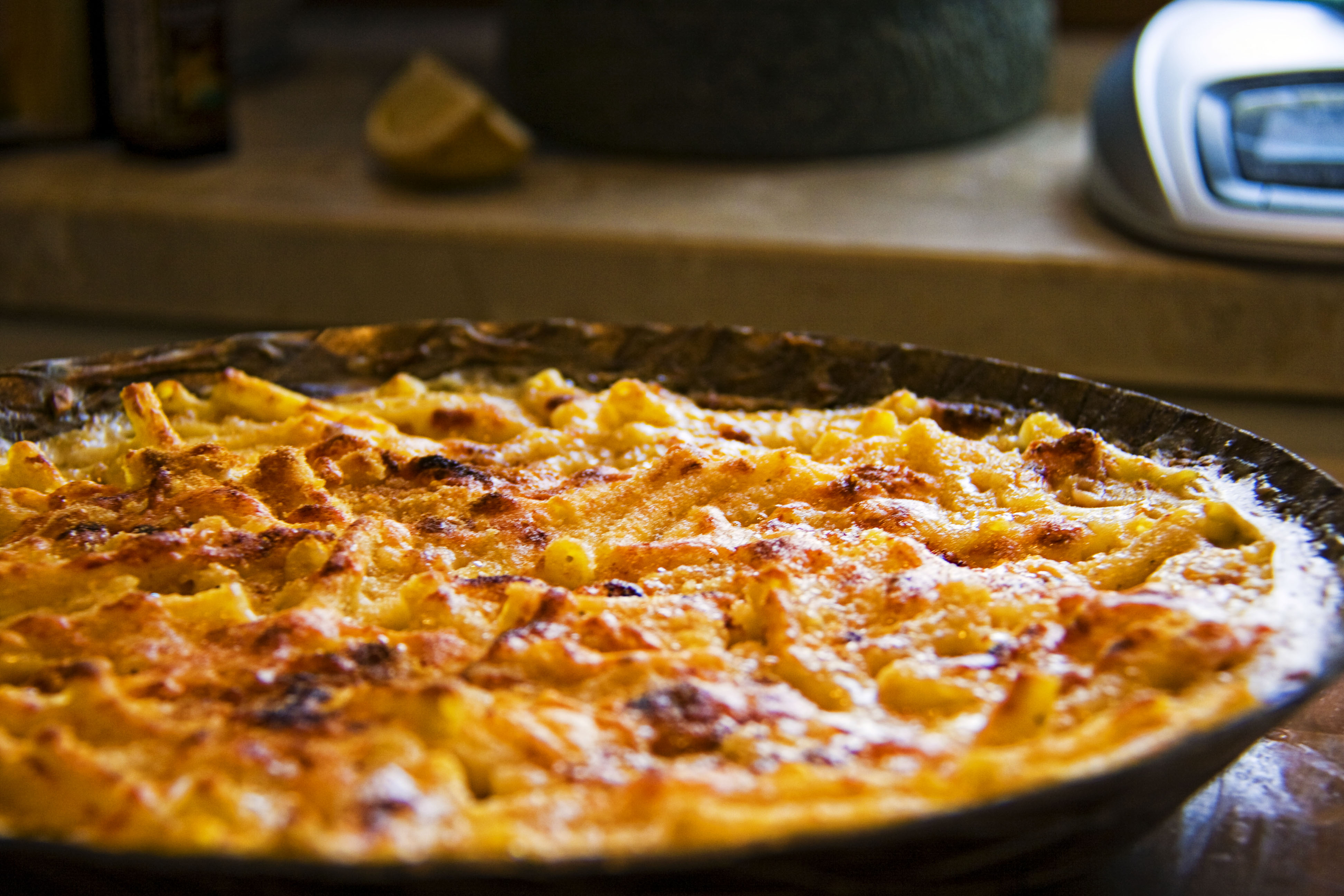
At Thanksgiving, macaroni and cheese is rarely just another side dish. In many Black households, its browned crust, rich center, and familiar place beside the turkey announce that the holiday has arrived. Recipes carry family memories: who grated the cheese, who guarded the oven, and whose version nobody dared criticize. Behind that pleasure lies a history of Black culinary knowledge too often credited to someone else.
James Hemings belongs in that history. But honoring him requires accuracy: he did not invent macaroni and cheese. Neither did Thomas Jefferson. Monticello’s own researchers explicitly reject both claims. Pasta baked with cheese was already known in Europe. Hemings’s importance is not that he created the dish from nothing, but that his expertise helped popularize it in America—and that an enslaved Black chef deserves recognition as a skilled historical actor.
A Chef, Not a Footnote
Born in 1765, Hemings entered Jefferson’s household through the inheritance of the Wayles estate. His mother, Elizabeth Hemings, and several of his siblings were also enslaved at Monticello. His father, John Wayles, was the father of Jefferson’s wife, Martha. These family connections did not protect him from bondage. They expose how closely slavery and the households of the founding generation were intertwined.
In 1784, Jefferson took Hemings to France. There, Hemings trained in French cooking and became chef de cuisine at Jefferson’s Paris residence. This was demanding professional work, requiring technique, judgment, and the coordination of elaborate meals. Calling him simply Jefferson’s servant obscures the expertise that made those meals possible. The diplomat’s celebrated table depended on the labor and intelligence of a man he claimed to own.
Monticello identifies Hemings as a Paris-trained chef who prepared meals for Jefferson’s elite guests in Virginia, New York City, and Philadelphia. Its researchers say he likely learned macaroni and cheese during his French training. That qualification matters: we should not turn a reasonable historical inference into an imaginary surviving recipe. Hemings left no memoir explaining exactly when he first cooked the dish.
Freedom Had a Price
Hemings negotiated for emancipation, but Jefferson made freedom conditional on transferring his culinary knowledge. He had to train another cook to replace him. His brother Peter learned the work, and James received his freedom in 1796. A skill that enriched Jefferson’s household became the bargaining instrument through which Hemings sought control over his own life.
This is not a comforting story about a generous employer rewarding talent. Hemings should never have needed permission to be free. His achievement lies in his expertise and his negotiation within a coercive system. Remembering that distinction keeps the celebration of his cooking from washing away the violence that structured his circumstances.
He continued his life as a free chef, but died in Baltimore in 1801. That date also corrects another familiar mistake. Accounts of macaroni served at Jefferson’s presidential table cannot automatically be assigned to Hemings: the frequently cited White House dinner took place in 1802, after his death. Giving him credit should never require inventing his presence at an event he could not have attended.
What the Records Reveal—and Conceal
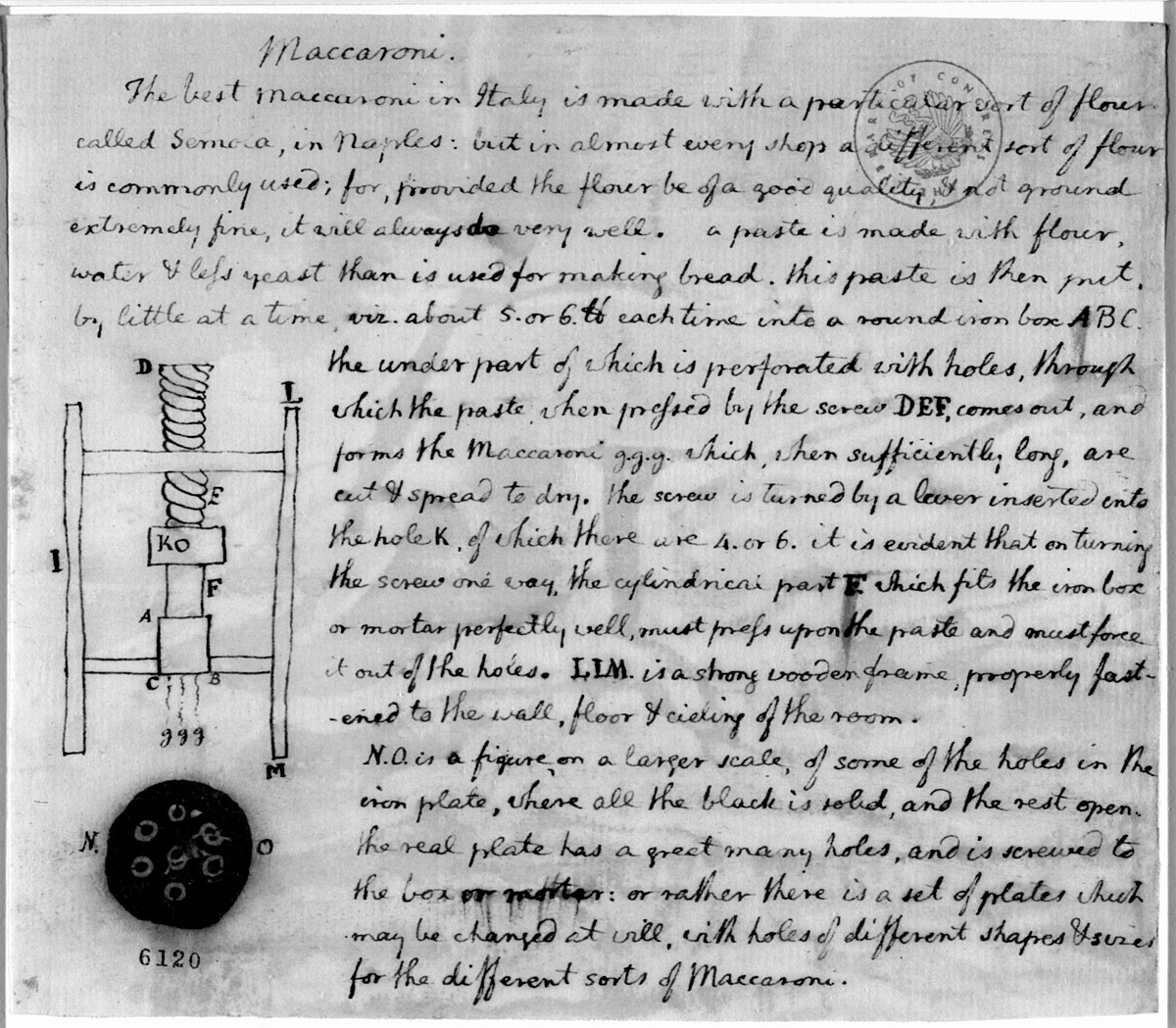
Jefferson’s surviving drawing of a macaroni machine is an arresting artifact. It shows the interest of a wealthy consumer in pasta-making technology. It does not establish that Jefferson invented the food, cooked it himself, or introduced it to a country where pasta had never been seen. Written ownership records and celebrated names can easily overshadow the people whose hands did the cooking.
The same caution applies to Monticello’s restored kitchen. Its larger kitchen was completed by 1809, after Hemings’s lifetime. Enslaved cooks Edith Fossett and Frances Hern worked there, continuing a tradition of highly skilled cooking. Historical images must distinguish their workspace from Hemings’s earlier career. A photograph can illuminate history, but an inaccurate caption can quietly rewrite it.
Nor can we prove that every Black family’s macaroni recipe descends directly from Hemings. Culinary traditions develop through many cooks, exchanges, ingredients, and generations. Recognizing his documented place in American food history does not require a single unbroken family tree for the dish. Black culinary achievement is larger than one origin story.
That distinction makes the story stronger, not weaker. Historical credit is not a prize awarded only to whoever cooked something first. It also belongs to those who mastered, adapted, taught, and sustained a cuisine, especially when unequal power made their contributions easier to overlook.
The Holiday Table Remembers
Food historian Michael Twitty offers a more intimate record. In his 2016 Washington Post recipe, he recalled his mother’s firm noodle-pudding version of macaroni and cheese, prepared for every holiday meal, including Thanksgiving. Dinner, he said, was incomplete without it. Here, the cook receives a relationship and a history rather than disappearing behind a generic reference to comfort food.
That is the recognition the holiday table deserves. Remember Hemings as a chef who mastered an international cuisine, taught others, and negotiated his freedom. Remember the Black cooks who sustained and transformed American foodways afterward. The point is not to crown a new inventor. It is to restore names, labor, and agency to a story whose familiar taste has too often outlasted its makers’ recognition.
Why your support matters
Liked this story? Get one like it in your inbox every week.
HistorianSpeaks is independent and reader-supported. No corporate owners, no paywall on the daily history. Every member keeps stories like this one coming.
Free
Newsletter
The weekly dispatch in your inbox.
Founding member
$9.99/month
Price locked for life, founder recognition and full Black Thread magazine access.
Become a founderShare Your Thoughts
Tell us what you think of this story. Comments go privately to the editor; your email is never published.
Ask the Historian
Have a question about this story, or an idea for a future post? Send it here.