
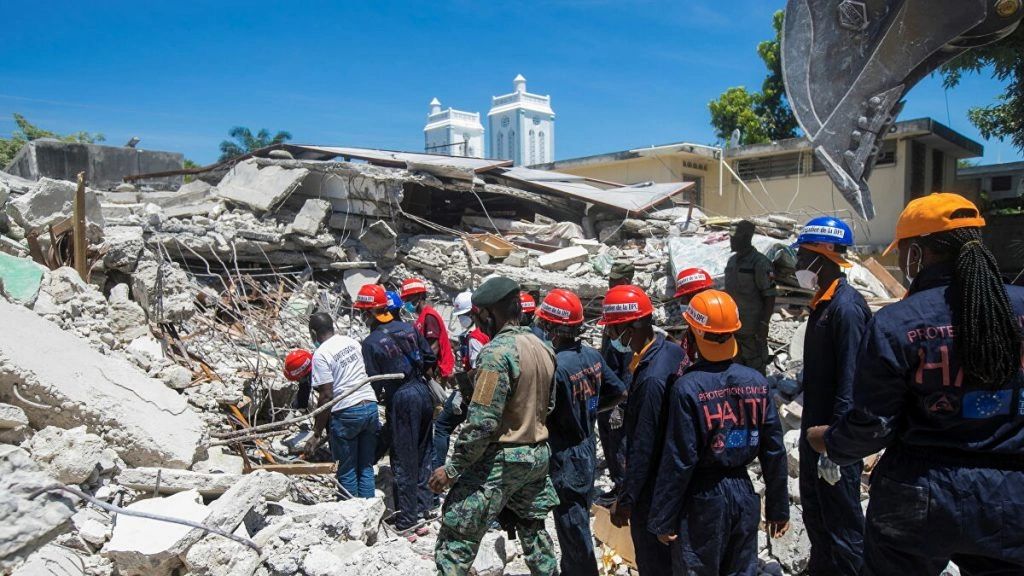
On Saturday, August 14th, a strong earthquake with a magnitude of 7.2 hit southwest Haiti. In the week since the earthquake, the casualties continue to mount. The death toll stands at 2, 189 people with more than 12, 268 injured. Rescuers are being hampered by a lack of resources and heavy rains, which are causing mudslides that block roads making them impassable for vehicle transport. At present, more than 600,000 people have been displaced. More than 750,000 homes damaged and destroyed. More than 135,000 families are impacted.
The Haitian Prime Minister Ariel Henry called on the country to unite. He is also appealing to Haitians: the private sector and the Diasporic community to work together to address the challenges presented by the earthquake. The earthquake has also sparked a humanitarian crisis. More than 600,000 people are in need on drinking water in the commune of Pestel. All the drinking water reservoirs were destroyed there.
Another challenge facing the country is that hospitals are overwhelmed. Hospitals in rural areas are not equipped with the beds or personnel to handle a large influx of patients. A hospital in Jermie, a hard-hit area in the South, lacks adequate beds for earthquake victims. More than 84 people were waiting for treatment. The facility is only equipped to treat ten people per day.
Governmental organizations are stepping in to assist in the rescue and recovery efforts. The U.S. Coast Guard is assisting, and the U.S. Department of Defense has formed a joint task force with United States Agency for International Development (USAID) to assist with disaster aid. Both the United Nations (UN) and the European Union (EU) have pledged millions of dollars for the relief effort. The Caribbean Disaster Emergency Management Agency (CDEMA) is also preparing to send members of its operational team to the country.
Haiti is facing a tripe crisis. It is still recovering from the recent assassination of its president Jovenal Moise in July. Amid a coronavirus pandemic, the island of 11 million has recorded more than 20,000 coronavirus cases and 570 deaths. It is also responding to the Tropical Storm Grace. The tropical storm and earthquake have wreaked havoc on school buildings in the southern region. More than 94 of 255 schools were destroyed. Moreover, according to UNICEF, more than 540,000 children have been impacted by the earthquake.
The earthquake has been devastating for all segments of the Haitian population. Gabriel Fortuné, a longstanding politician and former mayor of Les Cayes, was among those killed in the earthquake. According to the Haitian daily Le Nouvelliste, he perished along with numerous others when his hotel, Le Manguier, fell. Philippe Boutin, 37, who lives in Puerto Rico but visits his family in Les Cayes once a year, said his mother was praying in the morning when the tremors began, but that she was able to stay calm.
The prognosis for Haiti remains grim. One of the biggest challenges remains the distribution of food and supplies in rural areas. In Les Cayes, one of the southern cities hit hardest by the quake, frustration about the pace of relief is erupting into outright conflict. Fights erupted over limited supplies and gunshots were fired. Looting of supply trucks has also occurred in the region. Government help has been slow in coming and many private led efforts to provide food supplies have filled the void. This tragic situation is further compounded by gang violence, which is rampant throughout the country.
On Saturday, August 14th, a strong earthquake with a magnitude of 7.2 hit southwest Haiti. In the week since the earthquake, the casualties continue to mount. The death toll stands at 2, 189 people with more than 12, 268 injured. Rescuers are being hampered by a lack of resources and heavy rains, which are causing mudslides that block roads making them impassable for vehicle transport. At present, more than 600,000 people have been displaced. More than 750,000 homes damaged and destroyed. More than 135,000 families are impacted.
The Haitian Prime Minister Ariel Henry called on the country to unite. He is also appealing to Haitians: the private sector and the Diasporic community to work together to address the challenges presented by the earthquake. The earthquake has also sparked a humanitarian crisis. More than 600,000 people are in need on drinking water in the commune of Pestel. All the drinking water reservoirs were destroyed there.
Another challenge facing the country is that hospitals are overwhelmed. Hospitals in rural areas are not equipped with the beds or personnel to handle a large influx of patients. A hospital in Jermie, a hard-hit area in the South, lacks adequate beds for earthquake victims. More than 84 people were waiting for treatment. The facility is only equipped to treat ten people per day.
Governmental organizations are stepping in to assist in the rescue and recovery efforts. The U.S. Coast Guard is assisting, and the U.S. Department of Defense has formed a joint task force with United States Agency for International Development (USAID) to assist with disaster aid. Both the United Nations (UN) and the European Union (EU) have pledged millions of dollars for the relief effort. The Caribbean Disaster Emergency Management Agency (CDEMA) is also preparing to send members of its operational team to the country.
Haiti is facing a tripe crisis. It is still recovering from the recent assassination of its president Jovenal Moise in July. Amid a coronavirus pandemic, the island of 11 million has recorded more than 20,000 coronavirus cases and 570 deaths. It is also responding to the Tropical Storm Grace. The tropical storm and earthquake have wreaked havoc on school buildings in the southern region. More than 94 of 255 schools were destroyed. Moreover, according to UNICEF, more than 540,000 children have been impacted by the earthquake.
The earthquake has been devasting for all segments of the Haitian population. Gabriel Fortuné, a longstanding politician and former mayor of Les Cayes, was among those killed in the earthquake. According to the Haitian daily Le Nouvelliste, he perished along with numerous others when his hotel, Le Manguier, fell. Philippe Boutin, 37, who lives in Puerto Rico but visits his family in Les Cayes once a year, said his mother was praying in the morning when the tremors began, but that she was able to stay calm.
The prognosis for Haiti remains grim. One of the biggest challenges remains the distribution of food and supplies in rural areas. In Les Cayes, one of the southern cities hit hardest by the quake, frustration about the pace of relief is erupting into outright conflict. Fights erupted over limited supplies and gunshots were fired. Looting of supply trucks has also occurred in the region. Government help has been slow in coming and many private led efforts to provide food supplies have filled the void. This tragic situation is further compounded by gang violence, which is rampant throughout the country.
Ask the Historian
Have a question about this story, or an idea for a future post? Send it here.