
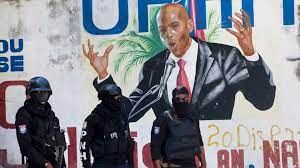
In the early morning hours of Wednesday July 7th, a group of gunmen raided the home of Haitian President Jovenal Moïse and his wife in Port-au- Prince, Haiti. Moise was shot 12 times and his left eye gouged out. Bullet wounds were observed in his forehead and torso. He was killed in the attack and his wife severely injured. The Haitian First Lady Martine Moise was flown to Florida for emergency treatment and is in stable condition. The couple’s adult children hid from the gunmen and all three are in safe locations. The assassination of the Haitian president sent shock waves around the world. The Haitian government has called for calm and asked for help from the United States government and military to secure key installations and assets.
Information on the assassination and those involved is beginning to trickle in. Video surveillance shows armed men dressed in black entering the property. A man is seen being forced to lay down. Another man is heard on a loudspeaker shouting : “DEA operation, everybody stay down. “Haitian authorities believe this was a ploy to distract attention from the real identity of the assassins. The gunmen tied up members of the domestic staff, and ransacked the home during the attack. Authorities have reported that 28 assassins were involved in this shooting. 26 of them were Colombians, and 2 Haitian Americans. The Haitian Americans are dual citizens of Haiti and the United States: James Solages and Joseph Vincent. These suspected assassins were tracked down on Wednesday near the crime scene in Port-au-Prince. Haiti National Police Director Leon Charles stated three of the suspects were shot on the day of the police raid and eight of the suspects are on the run. Charles has also reported that seventeen of the men involved in the assassination were detained on Thursday.
Late Thursday, Colombia’s government confirmed at least six of the suspects, including two men initially killed by Haitian police, were retired Colombian military personnel. The United Nations Security Council condemned the assassination in the strongest terms in an official statement. Global leaders have also expressed concern regarding the developing situation in Haiti.
Prime Minister Joseph placed the country under ‘state of siege.’ Under the state of siege, Haitian security forces have unlimited power to arrest and detain anyone associated with the assassination. . Haitian authorities are determined to punish the assassins. Haitian authorities believe all the men involved in the attack were mercenaries paid to kill the president.
Despite the killing and capture of several suspects, the motivations behind the attacks are unclear. Opposition leaders have accused Moïse of trying to consolidate his power, including approving laws limiting the power of courts to audit government contracts and the creation of an intelligence agency that responds only to the president. He has faced large-scale violent protests in recent months as opposition leaders rejected his plan to hold a constitutional referendum on proposals to strengthen his presidency. The opposition demanded his resignation and claimed that his term legally ended in February 2021.
Moise reported in February a plot to kill him and overthrow his government had been foiled. The claim was not taken seriously because it was viewed as deflecting attention from his unpopular policies and growing discontent in the country. Moise was accused by critics of being autocratic, heightening poverty, and supporting gangs in the country. The investigation is ongoing. Although there has been a long history of instability in Haiti, only one Haitian president has been assassinated, President Vibrun Gulliame Sam in 1915. Sam’s assassination led to a U.S. occupation of the nation from 1915-1934.
Ask the Historian
Have a question about this story, or an idea for a future post? Send it here.