

Update — October 13, 2026 (evening). This article left two questions open; both are now answered.
Arrests in Italy. No reliable national arrest or custody count has emerged for Italy's protests. The only documented law-enforcement action we have found is the brief detention of one student during an attempted occupation of a Turin high school on October 13; the student was released after about two hours and no charges were reported (Il Nazionale, October 13, 2026). Coverage of the Genoa occupations has reported no detentions. Italy's next test dates are a national student strike on October 16 and a general strike on October 30, both already called (la Repubblica Genova, October 12, 2026); we will check again after each.
Belgium's toll, confirmed. Reuters has documented 107 arrests in Liège on October 7, linked to property damage and arson during the spontaneous student unrest (Reuters, October 7, 2026). In Brussels on October 9, a union-led march of roughly 30,000 to 50,000 people met tear gas near the Gare du Midi, where buses and barricades were set on fire (Reuters; Il Sole 24 Ore, October 9, 2026). On October 12, police carried out identity checks and searches of students in central Brussels as a public-sector strike continued (ANSA, October 12, 2026).
The Rome video. We can now date the tent protests in Rome: students pitched tents at Sapienza University on October 12 and moved them to Piazza Montecitorio on October 13 against soaring rents, under the banner "Cara Italia, quanto ci costi?" — an appeal students say was inspired by Spain's housing camps in Madrid's Puerta del Sol (Il Sole 24 Ore video, October 13, 2026). The publisher-hosted video below was supplied by Stephen G. Hall; its exact filming and upload dates remain unverified, so the caption is unchanged, and the verified Montecitorio video is linked here.
---
Developing story — current as of October 10, 2026. This piece will be updated as the protests move.
On September 17, 2026, teachers at Lycée Saint-Exupéry in Créteil, a working-class suburb southeast of Paris, walked off the job. The school had no regular teachers for mathematics, French, history and other core subjects. The next morning their students stood with them, and by the end of the week barricades of garbage bins had appeared at school gates across the Paris region. Three weeks later, the movement those teenagers started has crossed France's borders.
Our earlier essay, "The Students Are Rising," followed the French students themselves. This third piece follows the movement outward, country by country, and asks what the spread tells us about how Europe treats the children of its banlieues, its immigrants and its working poor.
France: The Flashpoint
France remains the center of the storm. On October 6 more than 266,000 people marched nationwide for education funding, and on October 8 the education ministry reported 375 schools fully or partially closed (France 24). Students barricaded the Hélène Boucher high school in northeastern Paris before riot police answered with tear gas; a rally at Place de la Bastille that evening met tear gas and a water cannon.
The state's response has been arrest on an extraordinary scale. By October 10 the Ministry of Justice counted 6,877 arrests, 86 percent of them minors, with 2,376 people facing formal charges and 21 held in custody. The government also put the damage at about €30 million (The Front Page).
One injury changed the national mood. A 15-year-old boy lost his hand to a police-fired stun grenade, and France suspended the use of those grenades at student protests (News9live). Prime Minister Sébastien Lecornu has promised to act on the students' demands, and President Emmanuel Macron convened an emergency government meeting, yet the blockades continue.
The grievances are concrete: overcrowded classrooms, absent teachers who are never replaced, crumbling buildings, long school days, and deep inequality between schools in rich and poor districts. Students also attack Parcoursup, the university admissions platform they see as opaque and unequal (RBC-Ukraine). Those inequalities fall hardest on the suburbs where many Black and North African families live, which is why this movement belongs to the long history of Black and immigrant youth demanding that France honor its promise of equality.
Belgium: The First Border Crossed
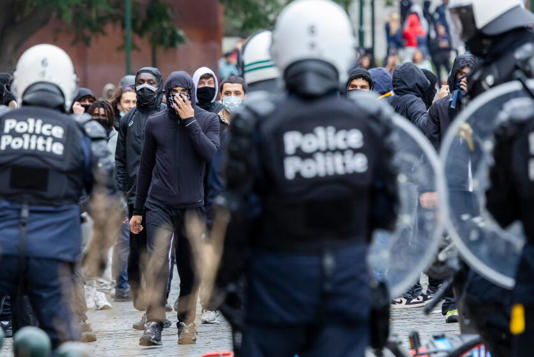
The movement first jumped the border into francophone Belgium. In Liège, hundreds of students, inspired in part by their French neighbors, took to the streets over rising education costs, crowded classrooms and scarce study materials. Belgium's official BE-Alert system warned shopkeepers, "Major unrest is underway. Close your businesses," and the city's main station briefly closed (Reuters via New York Post). Police have made at least 139 arrests in Liège since October 1 (Sigmalive).
On October 9 the protests reached Brussels, where between 30,000 and 50,000 demonstrators, joined by trade unions, marched against budget cuts — police gave the lower figure, labor unions the higher (The Front Page). Belgium's response has mirrored France's: water cannon, tear gas and mass arrests.
Italy: Occupations, Not Barricades
Italian students have chosen an older tactic, the school occupation. High-school students have occupied schools in Rome and Turin, protesting inadequate funding, deteriorating buildings and the rising cost of living (WION). So far the Italian actions have been far less violent, and we have found no reliable national arrest count.
Greece: Walkouts and Demands
In Greece, students have called demonstrations and walkouts demanding greater public investment in education (Times of India). Greece's student movement has deep roots, from the 1973 Polytechnic uprising against the military junta to the 2008 youth revolt, and its schools still carry the scars of a decade of austerity.
Ireland, Germany and Austria
In Ireland, university students have demonstrated over tuition fees and the cost of student housing. Smaller protests or planned actions have also been reported in Germany and Austria (Sigmalive). Each reflects local concerns, but all share the same complaint about public money for education.
Germany: Related Youth-Debate Context
Austria: University Demonstration in Vienna
One Movement or Many?
Reporters agree on a point worth stressing: this is not a single, coordinated European movement (Times of India). It has no headquarters and no common manifesto. Each country's students are fighting their own governments over their own budgets. What links them is a shared experience. Governments under debt pressure are cutting public spending, and schools, especially those serving poor and immigrant communities, are where the cuts are felt first.
Black Students and the Fight to Be Heard
This history also has a distinctly Black student tradition. In April 1960, young activists gathered at Shaw University in Raleigh, North Carolina, after the sit-ins that began in Greensboro that February. With Ella Baker’s encouragement, they established the Student Nonviolent Coordinating Committee, or SNCC. Their organizing challenged segregation and placed young Black people at the center of the struggle for equal citizenship (SNCC Digital Gateway).
Education itself became a battleground. At San Francisco State, the Black Student Union and the Third World Liberation Front led a strike from November 1968 to March 1969, demanding changes in who could attend college and whose histories would be taught. The struggle helped establish the nation’s first College of Ethnic Studies (San Francisco State Magazine). These were not simply protests about a place in an existing classroom; they challenged the exclusions built into the institution.
Europe’s current protests have different origins and demands, and a historical comparison is not evidence that they form one coordinated movement. But that Black student tradition offers a useful lens: when young people demand teachers, resources and recognition, they are also asking whose futures a society considers worth investing in.
History offers a warning and a lesson. In 1968, students in Paris lit a fire that spread across Europe and the Americas. In 2005, the deaths of two teenagers, Zyed Benna and Bouna Traoré, in Clichy-sous-Bois set off weeks of uprisings in the French suburbs. Each time, governments answered with police first and reform later, if at all. The question for 2026 is whether Europe's leaders will treat the arrest of thousands of children as a solution or as a sign of how badly they have failed them.
What to Watch
- Whether France's government puts real money behind Lecornu's promises.
- Whether Brussels' union-backed march turns Belgium's protests into a broader labor fight.
- Whether Italian occupations and Greek walkouts grow into mass street protests.
- Whether the movement reaches Portugal, Spain or the Netherlands.
Why your support matters
Follow the global Black story. One dispatch a week, free.
HistorianSpeaks is independent and reader-supported. No corporate owners, no paywall on the daily history. Every member keeps stories like this one coming.
Free
Newsletter
The weekly dispatch in your inbox.
Founding member
$9.99/month
Price locked for life, founder recognition and full Black Thread magazine access.
Become a founderAsk the Historian
Have a question about this story, or an idea for a future post? Send it here.