
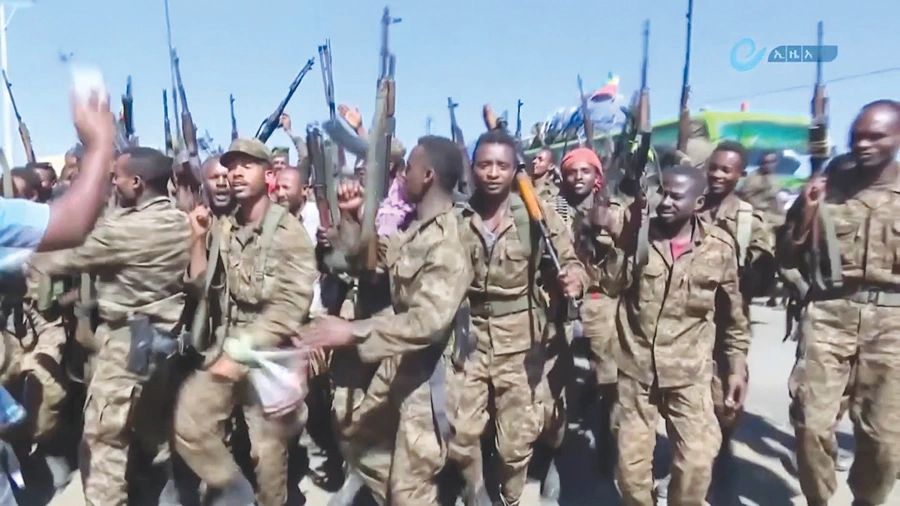
Tigray crisis: Millions at risk of famine.
The war between Tigrayan rebels known as the Tigray People’s Liberation Front (TPLF) and the Ethiopian army continues to escalate characterized by endemic violence and widespread famine. Both sides have come under intense scrutiny from the international community, and more than 10,000 people have died in combat. The war has left 5.2 million people in need of humanitarian assistance. There seems no end to this escalating crisis, which costs continue to mount in deaths and malnourished bodies.
Since the conflict expanded to Afar and Amhara in June 2021, the Ethiopian army has launched an offensive to regain territory seized by Tigrayan forces. The United Nations has pointed out that the government’s offensive has led to the suspension of humanitarian assistance to Tigray. Recently a UN spokesperson stated “Stocks of relief aid, cash, and fuel are running very low or are completely depleted. Food stocks were already depleted by late August.”
According to the United Nations, 2.3 million children are being deprived of humanitarian assistance. The Ethiopian army controls access to Tigray either delaying or restricting altogether humanitarian access to war ravaged areas. This lack of access makes it almost impossible for aid agencies to address child malnutrition, medical needs, water, and fuel shortages. Blockades of supply routes to Tigray coupled with the government’s suspicion that aid might assist enemy fighters These beliefs have severely hindered substantive relief efforts. A UN official remarked that “to date, and since July 12th, only 335 trucks have entered the region – or about 9 percent of the required 3,900 trucks.”
Famine has spread to Afar and Amhara. Estimates show that 1.7 million people in these regions need assistance. The Tigray Regional Water Bureau reports that of 36 villages, only 4 have partially functioning water sources. Of the more than 260 health centers in Tigray, only 31 are fully operative, and 7 are partially operative. The region is beset by child malnutrition, and fuel and water shortages
Despite this, the two opposing forces are busy blaming one another and have not taken responsibility for exacerbating starvation, malnutrition, and disease in these regions. The government is trying to improve its image by easing barriers to accessing impacted areas. It has reduced checkpoints from 7 to 3. Despite these changes, aid workers continue to complain about barriers to assisting famine victims.
In addition to the lack of humanitarian assistance and famine, the intensity and brutality of the conflict has led many to conclude both sides have engaged in war crimes. More than 1300 rapes have been reported. In addition to rape other reported abuses include unlawful killings, torture, sexual and gender-based violence, and forced displacement of civilians. Most of the violence is committed by Ethiopian and Eritrean forces, but the UN reports an increase in abuse initiated by Tigrayan forces. According to Patrick Youssef, regional director of the International Committee of the Red Cross in Africa, the situation in Ethiopia is extremely dire, and they are continuing to operate within the limits of a rapidly evolving situation.
In the midst of social and economic deprivation, the conflict has taken another frightening turn. This week, Ethiopian Prime Minister Abiy Ahmed promised to bury the government’s foes with blood as Tigrayan forces advance on the capital Addis Ababa. Abiy Ahmed pledges to make the glory of Ethiopia high again by burying the enemies with their blood and bones. On the same day, a moment of silence was carried out with a candle-lit ceremony to pay homage to those killed in the conflict. The government labeled the TPLF as a terrorist group and ordered the arrest of anyone who was suspected of having collaboration with “terrorist groups.”
The Tigray conflict has irreparably damaged the credibility of the Ethiopian government. It also raises serious questions about the intent and goals of the TPLF. The conflict is literally decimating the country and precipitating a major humanitarian and human rights crisis. The sooner this conflict comes to a negotiated end, the better for all parties involved. Only the warring parties can bring an end to this unprecedented tragedy.
Ask the Historian
Have a question about this story, or an idea for a future post? Send it here.