
Travis Armstrong, Ed.D
Dr. Travis Armstrong is the community outreach coordinator of the Foot Soldier’s Journey organization led by his cousin, Thomas Armstrong, who is an original Mississippi Freedom Rider of 1961. The organization’s purpose is to provide civic education and engagement to educate organizations about the lessons of the civil rights movement era and to inform on the contemporary civil rights issues of today. Dr. Armstrong also serves on several committees including the Mississippi Department of Archives and History and the Prentiss (MS) Normal and Industrial Institute Partnership Team. Armstrong retired from the United States Air Force in 2014 after 23 years of active duty service and served in Operations Southern Watch, Enduring Freedom, Iraqi Freedom and in Europe, Asia, and the continental United States. He specialized in combat troop deployment services and designed, produced, and implemented instructional development programs for the Air Force Human Resources career field, serving over 44,000 personnel.
W.E.B. Dubois proclaimed that “public education for all at public expense was, in the South, a Negro idea.” While DuBois’ proclaimation was true, African Americans in the south were often victims of white supremacist tactics of double-taxation, outright theft of their tax dollars, and/or mob violence, and intimidation. This was certainly true in the state of Mississippi. In 1924, this was evident by the fact that Mississippi had three public high schools for Black children compared to 1,020 public high schools for whites. The white high schools were valued at $13,338,623. Little changed over time. According to the 1935-1937 Biennial Report for the State Superintendent for Public Instruction, the PWA and WPA expended $8,000,000 in Mississippi for building white schoolhouses while only $400,000 was spent on building Negro schoolhouses.
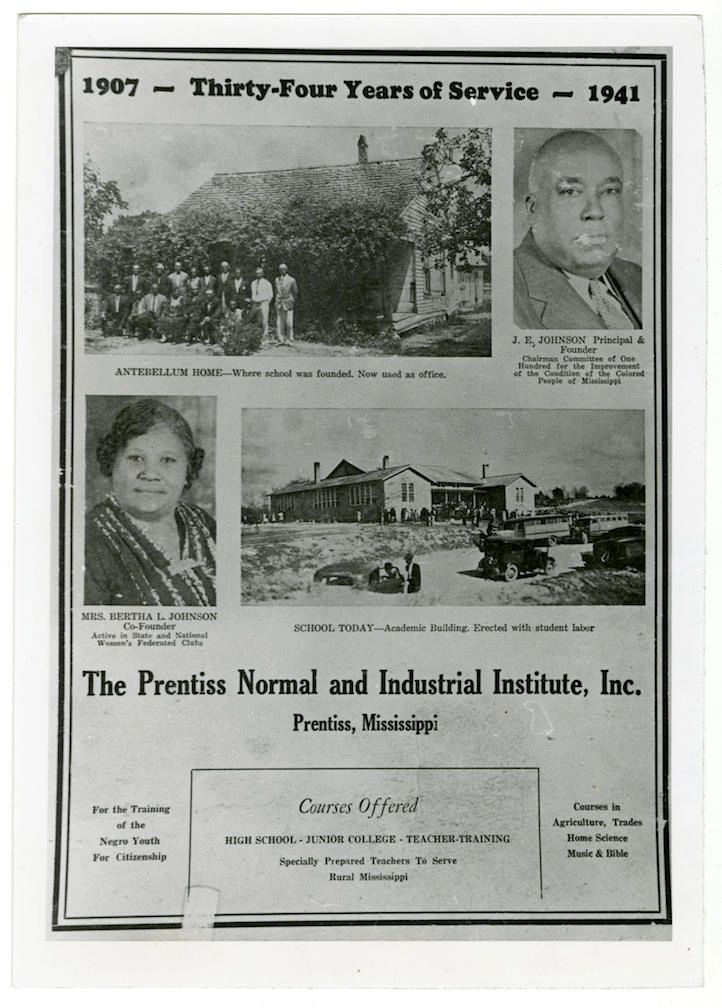
Despite many setbacks and obstacles, African Americans carved out educational training establishments despite little to no public funding. One of the most prominent was Prentiss Normal and Industrial Institute (PNII). Organized in June 1907 by Jonas Edward "J.E." Johnson (1873-1953) and his wife, Bertha LaBranche Johnson (1882-1971) in newly established Jefferson Davis County, Mississippi, PNII is one of the oldest educational institutions for Blacks in the state. It began when the Johnsons borrowed $600 from the Bank of Blountville to acquire a forty-acre site southeast of downtown Prentiss, Mississippi. Financial support for the school included land donations, subscriptions, and planting crops such as cotton. At the pinnacle of its operation, 700 plus students were enrolled, the schools had 44 faculty members, and contained twenty-four buildings on five-hundred acres. The 1907 House, which served as the central hub, living quarters, and first classrooms, was originally constructed in the 1820s by enslaved Africans on the Tobias Magee Plantation. The school patterned its educational principles after Mr. Booker T. Washington, the founder and President of Tuskegee Institute in Tuskegee, Alabama. Bertha Johnson, a Tuskegee Institute graduate under Washington, adopted his attitude toward Black vocational education.
From the beginning, PNII was on the front lines of education, race relations, and the advancement of civil rights. The 1907 House exemplified PNII’s self-reliant concept similar to its sister institutions Hampton and Tuskegee with the aim "to dignify toil by putting brain into it, and thus take from labor the stigma that was placed on it by slavery." Jonas Johnson’s influence reached far and wide. Mr. Johnson was the co-founder of the Committee of One Hundred, a statewide Black leadership conference organized in 1923 "to represent the colored people of Mississippi in inter racial relations…and to work for the general improvement of the Negro race in Mississippi." The committee’s co-founder, Mr. Isaiah Montgomery, was formerly enslaved on Jefferson Davis’ brother’s Hurricane Plantation. Mr. Montgomery subsequently founded the all-Black town of Mound Bayou, Mississippi in 1887, and was elected as a Mississippi State representative shortly after Reconstruction.
Less than a decade later, Mr. Johnson was recognized for the school's academic success by his appointment as the director of the Negro Department of the Mississippi Centennial. Mrs. Johnson's contributions were just as far-reaching, laying the foundation for her academic work and service to African-American communities. As one news reporter wrote, "Mrs. Johnson is probably the best-known Negro woman, nationally, within the Magnolia State. Since being handed her diploma from Mr. Booker T. Washington, she has never let one day pass since that time without having made life just a bit sweeter for somebody else. She has worked side-by-side with her husband since they founded the Prentiss Normal and Industrial Institute, one of the best thought-of schools in the state." Spreading the cause of equal and civil rights, in 1943, Mrs. Johnson gave a speech to the white Women's Missionary Society on the contributions of the Black race to the nation. She challenged and appealed for the cause of freedom and democracy for all by articulating "in all fields of civilization and culture the Negro American has played a prominent part. America is known as the land of equal rights and opportunities for all, irrespective of race, color, or creed."
PNII’s student body included Black military veterans who attended under the G.I. Bill of Rights. In 1947, Prentiss Institute received surplus structures that could be converted into vocational accommodations (shoe shop, laundry, laboratories, classrooms, etc.) for a portion of their student population that included 75 veterans at that time. This took place one year prior to President Harry Truman’s 1948 Executive Order 9981, desegregating the U.S. military. Additionally, PNII formed a partnership with Heifer International in 1951. As part of its first full-fledged project in the United States, Heifer International provided Prentiss Institute with 15 purebred heifers to distribute to local families, regardless of race. The former Heifer executive director, Mr. Thurl Metzger recalled "The Heifer Project was involved in a small part of the struggle for equal opportunity. We were there before the civil rights legislation."
Following Mr. Johnson's death in 1953, his wife assumed the presidency of the college. The Jefferson Davis County School Board created its high school for Blacks in 1959 and named it J.E. Johnson High School in honor of Johnson's decades of service to education and equal and civil rights. During the 1960s the infamous anti-democratic white supremacist state agency, Mississippi Sovereignty Commission, labeled Prentiss Institute a "beehive of activity" for the National Association for the Advancement of Colored People (NAACP), and closely followed activities at PNII. PNII did provide accommodations to Civil Rights leaders including Medgar Evers, the Mississippi NAACP field secretary, who came to the school to investigate voting rights abuses in the county and to assist in developing voter registration and training. In May 2016, the 1907 House was included in the U.S. Department of Interior/National Park Service National Register of Historic Places period of significance spanning from 1907 to 1971. The Mississippi State Bureau/tribal government certified that the 1907 House met the requirement to be considered significant at the statewide level in areas of education, ethnic/Black heritage, and social history/civil rights for its role as a leading school for African Americans and the state's Civil Rights movement. After years of financial struggle, the school finally closed in 1989. Today, it operates as a museum and testimony to the Johnson family’s vision and perseverance.
Ask the Historian
Have a question about this story, or an idea for a future post? Send it here.