
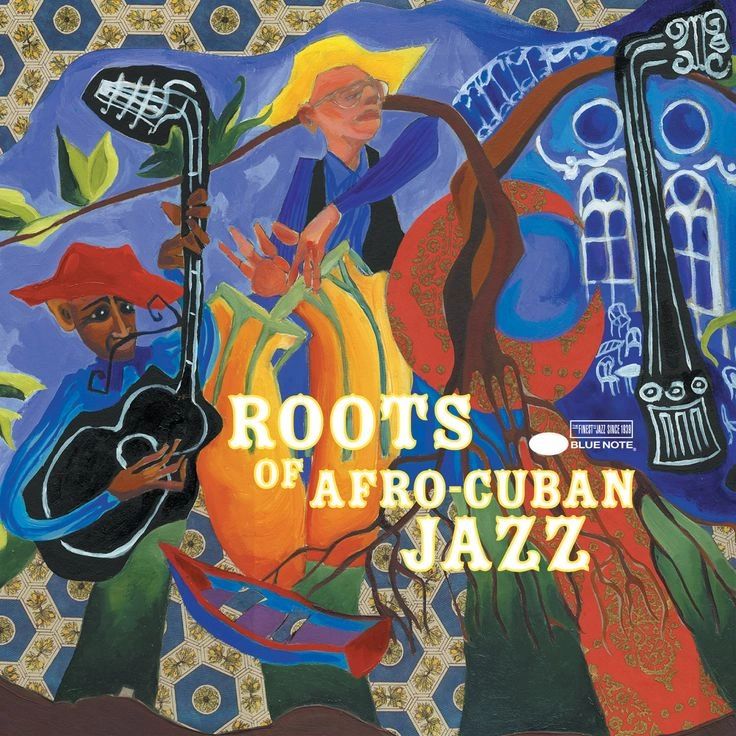
Afro-Cuban jazz originated in the 1940s when Black jazz musicians in New York City began to draw on the rhythmic styles of Cuban musicians who'd made their way into the city's music scene.
- Broad Latin influence: Latin influence was already prevalent in the form of certain Latin American rhythmic traditions, such as the habanera beat (the backbone of congo and tango music). A similar beat, the tresillo, found its way into the early jazz of New Orleans and was referred to by Jelly Roll Morton as the "Spanish tinge."
- Specific Cubin influence: The Cuban influence of Afro-Cuban jazz traces back to two traditions: son Cubano, a folk style from rural Cuba, and son montuno, a cosmopolitan adaptation of son Cubano. Concurrently, mambo—Cuban dance music popularized in Havana by bandleader Pérez Prado—also spilled over into American culture.
- Afro-Cuban music and jazz combine: In the 1940s, Afro-Cuban rhythms entered the mainstream of American jazz. Cuban musicians Mario Bauzá and Frank Grillo (aka Machito) brought the band Machito and his Afro-Cubans to New York. Around the same time, Dizzy Gillespie—a star of the bebop movement—joined forces with Cuban percussionist Chano Pozo and wrote tunes like "Mangó Mangüé" and "Manteca," which became hits. Gillespie and Ponzo's amalgamation of Cuban music with bebop became known as "Cubop" in jazz circles.
- Mainstream success: By the 1950s, Afro-Cuban music powered many jazz hits. "Afro Blue," composed by Cuban percussionist Mongo Santamaría, became the first true jazz standard built on a 3:2 clave pattern. The music became increasingly mainstream, and eventually non-Cuban musicians ran with the form. For instance, many Americans discovered Afro-Cuban jazz via Tito Puente, the Grammy-winning percussionist who came from a Puerto Rican family.
- Afro-Cuban jazz in Cuba: Eventually Afro-Cuban jazz also took hold in Cuba itself. Thanks to the efforts of Cuban musicians like Chucho Valdés and Paquito D'Rivera, the tradition lives on in Cuba as well as the United States.

Characteristics
Four elements characterize Afro-Cuban jazz.
- 1. Afro-Cuban jazz instrumentation: True to its name, Afro-Cuban jazz combines instruments from both the American and Cuban traditions. A typical Afro-Cuban jazz ensemble might include saxophone, trumpet, trombone, clarinet, flute, piano, and bass from the American tradition. From the Latin music tradition, it often includes congas, bongos, timbales, claves, and various shakers. An American-style drum kit is optional but not mandatory.
- 2. Afro-Cuban jazz rhythms: Traditional Afro-Cuban jazz is based on either the 3:2 son clave pattern or the 2:3 son clave pattern. These patterns are themselves West African in origin and were brought to the new world by African slaves. They made their way into Black Cuban culture and eventually into the dance music of Cuba. Popular examples of son clave in Afro-Cuban jazz include Dizzy Gillespie's "A Night in Tunisia," Cal Tjader's “Ritmo Uni,” Machito's “Minor Rama,” Paquito D'Rivera's “Son for Maura,” and Arturo Sandoval's “Dear Diz.”
- 3. Afro-Cuban jazz harmonies: Some traditional Cuban styles like mambo and son Cubano have complex rhythms but very simple folk harmonies. In line with other jazz styles, Afro-Cuban jazz pushes the harmonic envelope. Instead of basic triads, the music favors four and five-note chords. It includes high-level harmonies like secondary dominant chords and entire progressions based on those secondary dominants. It also includes chromatic melodies inspired by those chords.
- 4. Afro-Cuban jazz improvisation: In the spirit of all jazz music, the actual song form of an Afro-Cuban jazz tune is a jumping off point for extended improvisation. The key distinction is that the improvisation also extends to the traditional Latin percussion instruments. This means that a saxophone solo might be followed by a bongo and conga solo, or a trumpeter might "trade eights" with a timbale player. As time has gone on, Afro-Cuban jazz—and Latin jazz more broadly—has pushed ever-expanding boundaries, and its rhythms now pervade avant-garde jazz as well as more traditional styles.
*Afro-Cuban Jazz Guide: A Brief History of Afro-Cuban Jazz - 2024 - MasterClass (this description is drawn verbatim from this site)


NOTE--This informational blog is compiled by (with the exception of the introduction and photograph) and reprinted with permission from Abdul Akalimat, PhD
General Historical Current
General
Origin background https://www.youtube.com/watch?v=Q5s6cxl0OYM
The birth of Afro-Cuban Jazz https://www.youtube.com/watch?v=CZI0bJbY3sY
The roots of Afro-Cuban Jazz https://www.youtube.com/watch?v=dit-Pv5XWms
Afro-Cuban jazz explained https://www.youtube.com/watch?v=8BShjpnliKc
Afro-Cuban Jazz https://en.wikipedia.org/wiki/Afro-Cuban_jazz
Master Class https://www.masterclass.com/articles/afro-cuban-jazz-guide
The International Jazz Day All-Star Global Concert https://www.youtube.com/watch?v=gvQJpexv5HI
Historical
Chano Pozo http://tinyurl.com/47frr96v https://www.youtube.com/watch?v=A-FeF6X4Y1Y https://www.youtube.com/watch?v=-KLD1VZi9TE
Cándido https://www.youtube.com/watch?v=G5RDweqCtXs https://www.youtube.com/watch?v=XGRY_xUHRxQ https://www.youtube.com/watch?v=PSoFoqCpEME
Machito https://www.youtube.com/watch?v=3FqIANyRwLo https://www.youtube.com/watch?v=4IsJzGKwRd8 https://www.youtube.com/watch?v=KrEJXPjmHT4
Chico O'Farrill http://tinyurl.com/t6p5yszx http://www.arturoofarrill.com/about-arturo/about-chico
Mongo Santamaria http://tinyurl.com/38d8hps4 https://www.youtube.com/watch?v=10_pgU8Eb9E
Mario Bauza https://www.youtube.com/watch?v=bYfa9kTNYU8 https://www.youtube.com/watch?v=YJApCK4q4B4 https://www.youtube.com/watch?v=x1NH2nawCIY https://www.youtube.com/watch?v=IujAxx7rjEE
Daniel Ponce https://www.youtube.com/watch?v=03RWLS16H7M https://www.youtube.com/watch?v=2SYhbB0__Pg
Current
IRAKERE https://www.youtube.com/watch?v=9lrOl9kVVLE
Chucho" Valdés https://www.youtube.com/watch?v=_Y3SanbW-JE https://www.youtube.com/watch?v=NdSXBL8w3J0 https://www.youtube.com/watch?v=kcwbmbZGKQc
Gonzalo Rubalcaba https://www.youtube.com/watch?v=Sz3Qu_e2RoI https://www.youtube.com/watch?v=sikTYRBMKf8 https://www.youtube.com/watch?v=LArZaDpMmoM
Arturo Sandoval https://arturosandoval.com/ https://www.youtube.com/watch?v=p1V3QRT6roA https://www.youtube.com/watch?v=6A3SX9LOGQs
Eliel Lazo https://www.youtube.com/watch?v=CY2NJG9vgQc https://www.youtube.com/watch?v=bZHdPwFuy9A https://www.youtube.com/watch?v=dRDbbifZplw
Paquito D’Rivera https://www.youtube.com/watch?v=WYHQCBE5AVQ&list=RDEMcbxHMTu1szdWc4ydsEdgNQ&index=16 https://www.youtube.com/watch?v=iU0WkjCQ640 https://www.youtube.com/watch?v=ydrv5T1WAHs&list=RDEMcbxHMTu1szdWc4ydsEdgNQ&index=22
Daniel Ponce https://www.youtube.com/watch?v=lQp6MDwze1Y https://www.youtube.com/watch?v=sj98jS8DwJw https://www.youtube.com/watch?v=03RWLS16H7M
Zaccai Curtis https://www.zaccaicurtis.com/ https://www.youtube.com/watch?v=zLYhCzrcpAk https://www.facebook.com/litchfieldjazzfestival/videos/please-enjoy-the-full-concert-zaccai-curtis-afro-cuban-jazz-quartetcubop-featuri/519244880050158/
Roberto Fonseca https://www.youtube.com/watch?v=Ov1h0FRhJIY https://www.youtube.com/watch?v=vtNpZQMYBcU https://www.youtube.com/watch?v=Gu1wF5Q8d9o
Rodrigo Garcia Ameneiro https://www.youtube.com/watch?v=Y7Ad6rLz51s https://www.youtube.com/watch?v=4-GmtlcDicU
Carlos Averhoff https://www.youtube.com/watch?v=44f1knGci7A
Ignacio Berroa https://www.youtube.com/watch?v=C6YQXbGCN00 https://www.youtube.com/watch?v=o-jca7u-U6U https://www.youtube.com/watch?v=gNpx1yFzaUU
Attachments area
Ask the Historian
Have a question about this story, or an idea for a future post? Send it here.