
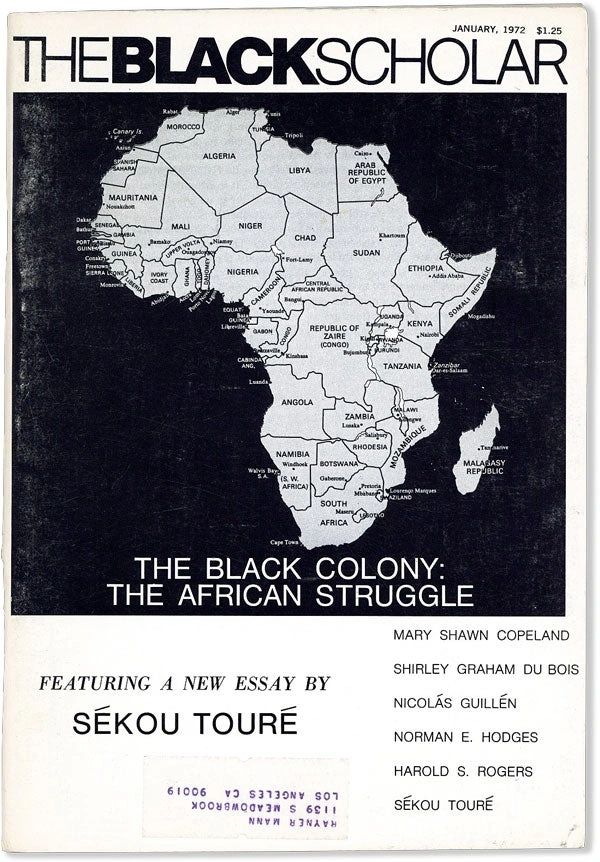
*Founded in the San Francisco Bay Area in 1969 by Robert Chrisman and Nathan Hare, THE BLACK SCHOLAR (TBS) is the first journal of Black studies and research. TBS is the first modern Black studies and research journal and is currently the leading such journal in the United States. Founded on the premise that Black writers, scholars, activists and artists could participate in dialogue within its pages, TBS‘s primary mission has been to chronicle, analyze, and debate the conditions and the emancipatory efforts of Black people, across class, nationality, gender, generation, sexuality, and ideology. Due in part to the impact of the journal, Black Studies, Africana Studies, Diaspora Studies, and other subdisciplines have become legitimate spaces of scholarly inquiry. However, there are still few public intellectual spaces that are dedicated to the new multiplicity of Black perspectives (or perspectives on race) that have emerged through these disciplines and that engage with the new issues and concerns facing Black communities worldwide. THE BLACK SCHOLAR is one of those spaces. Our rich mix of the scholarly and the artistic, the professional and the public/non-specialist, remains rare, as is our openness to different forms and techniques of political engagement.
In June 2012, TBS relaunched with new editors, and new active and advisory boards. It is now peer reviewed and published, since 2015, four times a year through Routledge (Taylor & Francis).
The current revitalization of TBS‘s aims is largely an updating of its initial vision, though motivated to participate in a global Black intellectual and cultural world that has changed significantly since the journal’s founding. TBS continues to engage and cultivate differential Black political conversations and cultural expressions from across the Black world while maintaining its core commitment to tough-minded thinking and an emancipatory project. Finally, and perhaps more importantly, we imagine ourselves as the forum for ideas and conversations that have yet to emerge.
TBS is grateful for the financial and institutional support of Boston University.
Authors can read more in our submission guidelines.
Our 50+ year archive can be browsed here.
Print ISSN: 0006-4246
Online ISSN: 2162-5387
4 issues per year
* The Black Scholar - Journal of Black Studies and Research
NOTE--This informational blog is compiled by (with the exception of the introduction and photograph) and reprinted with permission from Abdul Akalimat, PhD
You are invited to a free, two-day, online conference, April 6th-7th, which features scholars and activists debating Black radicalism and the contributions of the Black Scholar Journal to global and local struggles for social justice. (this conference has passed but the site still contains important information)
To register, go to Eventbrite:
Round Tables:
- JoNina Abron-Ervin, Herb Boyd, Akinyele Umoja (moderator: Russell Rickford)
- Sam Anderson, Horace Campbell, Jimmy Garrett, Gerald Lenoir, Jamala Rogers (moderator: Dan Berger)
- Abdul Alkalimat, Melba Boyd, Bill Fletcher Jr, Stan West (moderator: Armond Towns)
Paper presenters and topics:
- Ray Black, Black Masculinity in TBS
- Ori Burton, Black Radicalism/Archival Praxis
- Mohamed Elnaiem, National liberation and decolonization
- Julian Glover, Theories of Black genders and sexualities in TBS
- Nicholas Grant, Anti-apartheid solidarity in TBS
- Christopher Lee, Black engagement with Vietnam/Asia in TBS
- Fred Moten, TBS Interviews and the poetics of the interview form
- Joe Parrott, Global Third World/Tricontinental issues in TBS
- Olufemi Taiwo, Sr., The erasure of African knowledge in global discourse
- Armond Towns, Media in Black studies, TBS, and contemporary society
- Daniel Widener, Internal colonialism, third world alliances, TBS as a Black and Thirdworld space
- Komozi Woodard, Malcolm X and Revolutionary Women: 21 Sisters in the Making of Black Liberation
Ask the Historian
Have a question about this story, or an idea for a future post? Send it here.