
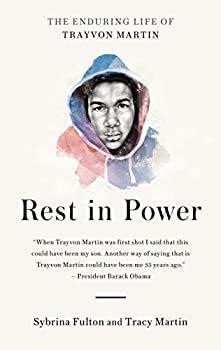
Editor's Note--I wrote this review of Sybrina Fulton's and Tracy Martin's Rest in Power: The Enduring Legacy of Trayvon Martin while serving as the Program Coordinator and Professor of History at Alcorn State University in Lorman, Mississippi. I presented it at a forum on Trayvon's life and death at Alcorn in 2017. I never published this review, but now on the tenth anniversary of his death, I am republishing it here. The tenth anniversary of Trayvon Martin's death is February 26, 2012. Rest in Power Trayvon Martin!!!!
Stephen G. Hall, PhD

I am Sybrina Fulton. I am Tracy Martin. These sentences appear repeatedly in the opening sections of a powerful mediation on the life of Trayvon Martin titled Rest in Power: The Enduring Legacy of Trayvon Martin. Those familiar with the case of Trayvon Martin, a seventeen-year-old Florida youth murdered by George Zimmerman in Sanford, Florida in 2012., recall the ways in which his death sparked a movement highlighting extrajudicial murder. By extrajudicial murder, I am referring to the rash of murders of unarmed African Americans in the years since 2012. The list is long and we should remember their names, not only for poetic effect, but in the real ways associated with respect for the dead and an abiding interest in social justice and fair play: Trayvon Martin, Jordan Davis, Mike Brown, John Crawford, Ezell Ford, Akal Gurley, Tamir Rice, Eric Harris, Walter Scott, Freddie Gray, William Chapman, Jonathan Sanders, Samuel DuBose, Tanesha Anderson, Jamar Clark, Korryn Gaines, Sandra Bland, Philando Castile, Eric Garner, and many more.
.jpg)
Interestingly, the names cited are on the tips of our tongues, in our songs and chants, embedded in our collective angst and righteous discontent. Yet, the names Sybrina Fulton and Tracy Martin are also known and important. They are the survivors, the living, the parents of Trayvon Martin. Their story is one less told and even less known, but it is essential to understanding the meaning and unlocking the relevance of all the names previously mentioned. Their story, their son's death ignited, or more accurately, reignited a struggle for social justice as old as the nation itself. It is the outgrowth of the external constraints of a nation built on slavery and social injustice. It is inscribed in the desire of people of goodwill without regard to race, class, color and creed who challenged narratives of injustice and offered powerful counternarratives which disrupted normalized narratives of inequality and racism. Its powerful resonances can be found in every movement for social justice in this country ranging from the antislavery/abolitionist movement to the current Black Lives Matter movement. The merger of individual lives and collective realities lies at the core of this book. The ability to use a life to dramatize a collective condition. It speaks to the ways our lives are lived in the present but informed by the past to shape the future.
The strength of Rest in Power lies in its creative framing and ability to deconstruct power, to, in short, speak truth to power. Often this statement takes on a knowingness, a sense that speaking to power is precise, known, and preformulated. But what if power is something different than what you imagine. Suppose the inner workings are unknown and unseen, It operates differently, it looks and acts in unpredictable ways. How do you speak to it? What do you say? What should you expect? In short, as a colleague of mine at Duke University, how do you interact with the unseen. How do you touch, feel and mold it to your purposes? How do you seek redress for being wronged? When power takes on racial connotations. What do you hold onto? How do you separate individual actions from institutional conditions and realities? Rest in Power advances these and other questions creatively, intelligently and in doing so, challenges our sense of the boundaries between lived experience, collective action and the legacies of the living and the dead.
Rest in Power is an important mediation of the meanings of life and death. Most importantly, it is the story of individual and collective struggle. The individual struggle of two parents, Sybrina Fulton and Tracy Martin to cope with the unimaginable horror and grief surrounding the murder of their son and the story of a movement for social justice revolving around their son Trayvon Martin. These two stories are two distinct realities, but they seamlessly merge and meld into one story in the book. Taken as a whole, these two elements of the book, individual lives and collective action embodied in movement culture give the book it's power and poignancy. It becomes the catalyst which propels the murder of Trayvon Martin from an individual, random and faceless fact to a representative reality with power to define our collective sense of right and wrong, fairness, equality and social justice. It gives us the ability to see and understand the unseen and by doing so imagine and actualize collective projects dedicated to meaningful change.

Much of the literature on the civil rights movement has heralded the power of what historian John Dittmer has termed "ordinary people." Shifting the focus from the Martin and Malcolm's to the silent and often unheralded people who quietly. patiently and persistently changed the racial landscape of America. Sybrina Fulton and Tracy Martin are no exception to this rule. They are, by their own accounts, reluctant warriors. Sybrina, a resident and graduate of Florida Memorial University (a HBCU in Southern Florida), worked as a county clerk and later as a relocation manager for underprivileged residents in the city. Tracy Martin, a product of East St. Louis, was a truck driver. Both Sybrina and Tracy were completely unprepared for the role into which they were thrust. Yet, the power of their story lies not in the linear and episodic, the sense that the story is predictable and known, but in the unpredictable and unseen. This sense of unpredictability permeates every page of the text.
We are introduced to the separate but intertwined narratives of Sybrina and Tracy in separate renderings of their stories. This approach is very useful. Rather than disrupting the narrative flow of the text, it actually allows for the individual personalities of Sybrina and Tracy to inform the rendering of their story, while connecting their individual stories to their unified vision for understanding and eventually building a collective response to the death of their son. Despite being divorced, their voices as parents are married together in an unbreakable matrimony of love and determination to craft a deeply complex and compassionate story. In doing so, the reader travels with these two parents on an uncharted journey through joy, pain, grief, strength, resilience and determination and confidence.
We are treated as readers to an unvarnished examination of parenting. They are determined to humanize their son, so their presentation of his life is an honest attempt to grapple with the complexities of child rearing. Child rearing is never a one-way street. It involves parental guidance and youthful pushback. It involves radical changes as a child becomes a teenager and then begins to evolve into a young adult. Determined to assert independence or convinced that all the answers are obvious and known, it can result in youthful rebellion. Trayvon' story involved all of these stages and more. Sybrina describes his youth as that of a "mama's boy." He was close to his mother, always doting on her and determined to assert himself as protector. As the teenager years arrived, Trayvon developed friends and associations which tended to distance him from his mother. A school transfer in his junior year of high school led to acting out and a ten-day suspension for fighting, possession of marijuana and unruly behavior. These circumstances would set in motion a series of events that would lead to his death.

Tracy Martin, Trayvon's father, maintained a close relationship with his son. Sharing joint custody with his mother, he often spent weekends with his Trayvon. A baseball Africando and a volunteer coach at the Optimist Club, Martin worked to instill pride, confidence, and a respect for hard work in his son. These values were also shared by Trayvon's mother. His suspension in high school raised hard questions about Trayvon's choices. The family thought it best for him to spend time in Sanford with Tracy's girlfriend.
Trayvon's murder in the Pleasant Lakes Community in Sanford came as an unexpected jolt to Trayvon's parents. His death of the hands of George Zimmerman, a neighborhood watchman who confronted Martin struggling and ultimately killing him less than 100 yards from his caretaker's condominium. Not surprisingly, Sybrina' narrative addresses the very real issue of blame. Tracy's decision to send Trayvon to Sanford certainly played into his death or did it. The emotion, brutal honesty and ability to confront the unseen but deeply felt make this book a masterful rendering of a deeply human tragedy.
Both Sybrina and Tracy had to work through their individual fear, shock and disbelief regarding the death of their son. They had to literally move from inaction and inertia to action and engagement. Both took different paths to collective awareness and engagement. Sybrina felt overwhelmed and retreated into herself. She avoided family, friends and the public. Her daily routine included waking, brushing her teeth, showering and then returning to bed for hours, days and weeks after her son's funeral. Tracy immersed himself in finding more about George Zimmerman, who he refers to throughout the book as simply "the killer." This quest, driven partially, by guilt and in other ways by a desire to understand the unseen. To understand the circumstances regarding the murder of his son.

.jpg)
This transition from individual understanding to collective action inaugurated the construction of a movement. Movements are not built overnight; they are a slow and steady constructions. They are often connected as opposed to disconnected from movements which have proceeded them. Contrary to popular opinion, the present is informed by the past. This is evident throughout Rest in Power. Sybrina and Tracy are clearly aware of the connections between their son's case and that of earlier cases of either false imprisonment or murder of African Americans in the 20th century. This is certainly the case with the Scottsboro Boys, nine African American males falsely accused of raping two white women in rural Alabama during the Great Depression. Their trial and numerous retrials altered American jurisprudence and dramatized the insidious nature of race as a regional and national construct. The Scottsboro mothers with the help of the Communist Party traveled domestically and internationally to dramatize and publicize the treatment and fate of their sons. The case also launched the career of Rosa Parks who organized rallies and demonstrations to generate public interest in the case. She would later play an important role in the Montgomery Bus Boycott in 1955-1956. The same was true of Mamie Till, mother of Emmett Till, who was allegedly murdered for whistling at a white woman. His badly mutilated and decomposing body was retrieved from the Tallahatchie River. His mother was determined to present his life as a instructive lesson and insisted on an open coffin funeral.

Likewise in the case of Trayvon Martin, the public outrage regarding his death gradually grew. Initially, news outlets local and national virtually ignored the story. Momentum increased in the case, especially after Trayvon's parents retained Parks and Crump, a Tallahassee, Florida based law firm devoted to civil rights. Its principals were graduates of Florida A&M and Florida State School of Law. Their work was complimented by a publicist who began to send press releases regarding Trayvon's death and the appalling fact that no arrest had been made in the case. Painstakingly, Trayvon's parents reconstruct the genealogy of how their son's death morphed from an insignificant death to a movement. Black talk radio such as the Tom Joyner and Michael Basden talk shows began to discuss the incident. Local and national columnists and commentators such as Jonathan Capehart from the Washington Post and Charles Blow, New York Times columnist began to write about and publicize the tragic events in Sanford. Civil rights leader Jesse Jackson, Al Sharpton, Ben Zealous, Marc Morison and Jamal Bryant led matches, demonstrations and rallies calling for Justice for Trayvon. The movement Hoodies for Trayvon materialized and Phillip Agnew, a graduate of FAMU, organized the Dream Defenders. They staged a protest featuring a march from Tallahassee to Sanford. Trayvon's story not only resonated in Florida and around the nation, but it also made its way to the White House. In a news conference. President Obama stated that, as an African American parent, he had deep sympathy for the parents of Trayvon Martin. Perhaps, most important he asserted that if had a son, his resemblance would be that of Trayvon. These organizational and presidential statements coupled with a Change.org petition calling for the immediate arrest and prosecution of George Zimmerman brought significant pressure and effected the arrest of George Zimmerman.


Rather than allaying the fears and settling the issue of their son's death, Zimmerman' arrest and subsequent trial revealed another set of troubling issues. Issues related to press coverage, the judicial system and the legislative system, which seemingly, in the minds of Trayvon's parents, privileged the defendants rather than the victim's rights. The parents were concerned about everything firm the portrayal of Trayvon by Mark 0'Meara and the fact that the prosecution failed to call any character witnesses for Trayvon. The idea was that the prosecution was sloppy. The day-to-day grind of the trial resurrected the memories of Trayvon's death and recreated in agonizing detail the minutiae of the crime. Rest in Power is very persuasive in capturing the sense of uncertainty and anguish in the struggle to secure justice for the unseen, and the struggle to make Trayvon relatable, visible and legible to a jury of their peers. The imperfect nature of the process, the internal and external dynamics of the legal system ranging from the narrowness of the deposition in defining the parameters of testimony to the choice of judge and jurors and the weight of personal prejudice and external critics makes this a seemingly impossible task.

While the outcome of the Martin case is known, apparent and visible. The power of this story is enduring. Enduring not in its singularity or uniqueness but for its commonality. Trayvon Martin's death not only exploded the myth of the post racial state as a viable construct, but it exposed the structural manifestations of institutional racism long at the core of the Republic. The explosion in extrajudicial murders since Trayvon's death is sobering. Yet the enduring legacy of his life is our awareness of the unseen, the invisible. Its effects have rippled through the lives of many families and spawned a cohesive movement in the Black Lives Matters movement. Not unlike first person accounts of the civil rights movement ranging from Anne Moody's Coming of Age in Mississippi to Melba Pattillo Beal's Warriors Don't Cry to the searing accounts of national tragedies such as Spike Lee's 4 Little Girls, which details the bombing of the Sixteenth Street Baptist Church in chronicles and Timothy Tyson's The Blood of Emmett Till, Rest in Power captures the tenor of our times. It simultaneously connects us to the unpredictability of the present while anchoring us firmly to the meanings of the past. Although the future cannot be known for it is unseen, we know our individual lives and experiences can be molded and melded into collective action which drawing on our strength and resilience can create an enduring legacy to speak truth to power. How we utilize our individual lives to create change and generate collective action is our enduring legacy. Trayvon Martin's parents used this energy to create collective action so their son can Rest in Power. Trayvon's legacy was created through the synergy of individual lives and collective action. We must be its keepers and guardians.
Ask the Historian
Have a question about this story, or an idea for a future post? Send it here.