
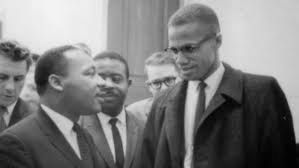
The recent deaths of Civil Rights icons, C.T. Vivian and John Lewis bring into focus the importance of one’s legacy. These icons represent the best of creative struggle, committed resistance and the humanist spirit. The lives of these men embody the links of creative struggle between previous and present generations. As we eulogize their lives, we gather strength, courage, and a renewed commitment to resistance to discrimination and white supremacy. Like these men, and just as relevant for our times and this moment, is the eulogy and life of Malcolm X. His complexity as a historical figure and journey towards racial reconciliation and the many lessons his life holds are uniquely relevant to our current moment,
Malcolm X’s life was powerfully captured in Ossie Davis’ 1965 eulogy. It humanized the great leader and emphasized the meaning and significance of Malcolm’s work for contemporary times. In death, as in life, Malcolm X was a complex historical figure. He was our “Black shining Prince,” firmly situated in the milieu of the 1950s and 1960s, but relevant to generations unborn.
A fiery Black nationalist leader, Malcolm X moved seamlessly from a life as a pimp, hustler, and drug dealer to a minister, leader, activist, Pan Africanist, and humanist. This transformational aspect of Malcolm’s story demonstrates his ability to transcend environment and repurpose his life. Ironically, the starting place for this transformational understanding of Malcolm X begins with his death.
Malcolm’s assassination represents one of the crucial testaments to his life’s work: his ability to embody and transcend a moment. Davis’ eulogy is a remembrance and an instructive guide. He wanted us to know Malcolm and appreciate the complexity of his life and message. He challenges listeners to reflect on Malcolm’s character, demeanor, and demonization by the media, government, and his detractors in the Nation of Islam. The eulogy is as much about Malcolm as it is about Black people. As such, it sends a clear message about identity, self-definition, and the possibilities of the future. All these issues defined the life of Malcolm X and Black communities, past and present.
Not unlike contemporary African Americans, Blacks in the 1960s were grappling with what Dr. Martin Luther King called the “marvelous new militancy” of Black Power. The transformative power of identity is not lost here. Davis noted that Malcolm was no longer a "Negro" — the word was “too small, too puny.” Malcolm was an "Afro-American." This identity transcended the national boundaries of the United States and looked outward to Africa and the African diaspora.
Given the fact that Malcolm’s mother was from Grenada, this was not surprising. Similarly, African Americans today are grappling with how to think about the complexities of African American identity against the backdrop of emigration from the Caribbean and Africa after 1965. So much of what we consider African American is, and has always been, influenced by African-descendant people from other parts of the globe. It’s more important than ever to expand the definition of African American to embrace the experiences of all African-descendant people who were born in the Americas or reside here. As writers on this blog have shown, the protests following the death of George Floyd that reverberated around the world are not new or episodic. They reflect a long history of Black global engagement and they dramatize an interconnected set of race, class and gender dynamics related historically to imperialism and colonialism as well as xenophobia and nationalism. In the Americas, communities of color have also ways been informed by these global actors These communities stretch back to Prince Hall, Edward Wilmot Blyden, Marcus Garvey, Shirley Chisholm, and Nipsey Hussle informing and creating lasting African American traditions.
Self-definition is another important theme in the eulogy. Davis urges listeners to understand Malcolm’s life, encouraging them to be critical, self-reflective, and introspective instead of accepting Malcolm’s standard story or common interpretation. Davis is critical of representations of Malcolm as violent, hateful, or that encourage people to “revile him.” This inward look can be extended to Black communities. Black activists have been in the forefront of calls for change in Black communities ranging from improved public health to educational initiatives. The challenge is to create transformational possibilities. At the local level, Jackson, Mississippi Mayor Chokwe Antar Lumumba and Birmingham, Alabama Mayor Randall Woodfin are just two officials who are crafting unique solutions to positively impact urban Black communities.
Malcolm’s life and Davis’ eulogy demand that listeners take control of one’s objective reality, direct community resources toward education and empowerment, and define one’s agenda without outside interference.
Lastly, the Davis eulogy looks toward the future. So much of Black social and political philosophy is future-focused. Malcolm, in the final year of his life, imagined a world premised on Pan African solidarity. He favored strong community institutions and refused to be pigeonholed into integrationist or nationalist binaries. He reached out and embraced any Black leader who was interested in Black liberation. He embraced a universal nation of religious faith and practice based on humanity rather than color. These messages resonate today.
We must build upon Malcolm's efforts to shape a bright and hopeful future, which celebrates diversity and common humanity. We must persevere and move forward — undaunted by the temporary unpredictability and instability of the Trump era.
Davis accurately predicted that the years following Malcolm’s death would be tumultuous after the long winter of our discontent. He stated, “And we will know him then for what he was and is — a Prince — our own Black shining Prince! — who didn’t hesitate to die, because he loved us so.”
Malcolm X was more than a symbol. Black people are his heirs, called upon to make his life’s aims and vision a reality. As we reflect on the lives of leaders and community advocates like C.T. Vivian and John Lewis, we also need to look to Malcom X. Embracing the complexity of our identity, to define ourselves, and remaining future-focused are the greatest testaments to his legacy.
Ask the Historian
Have a question about this story, or an idea for a future post? Send it here.