
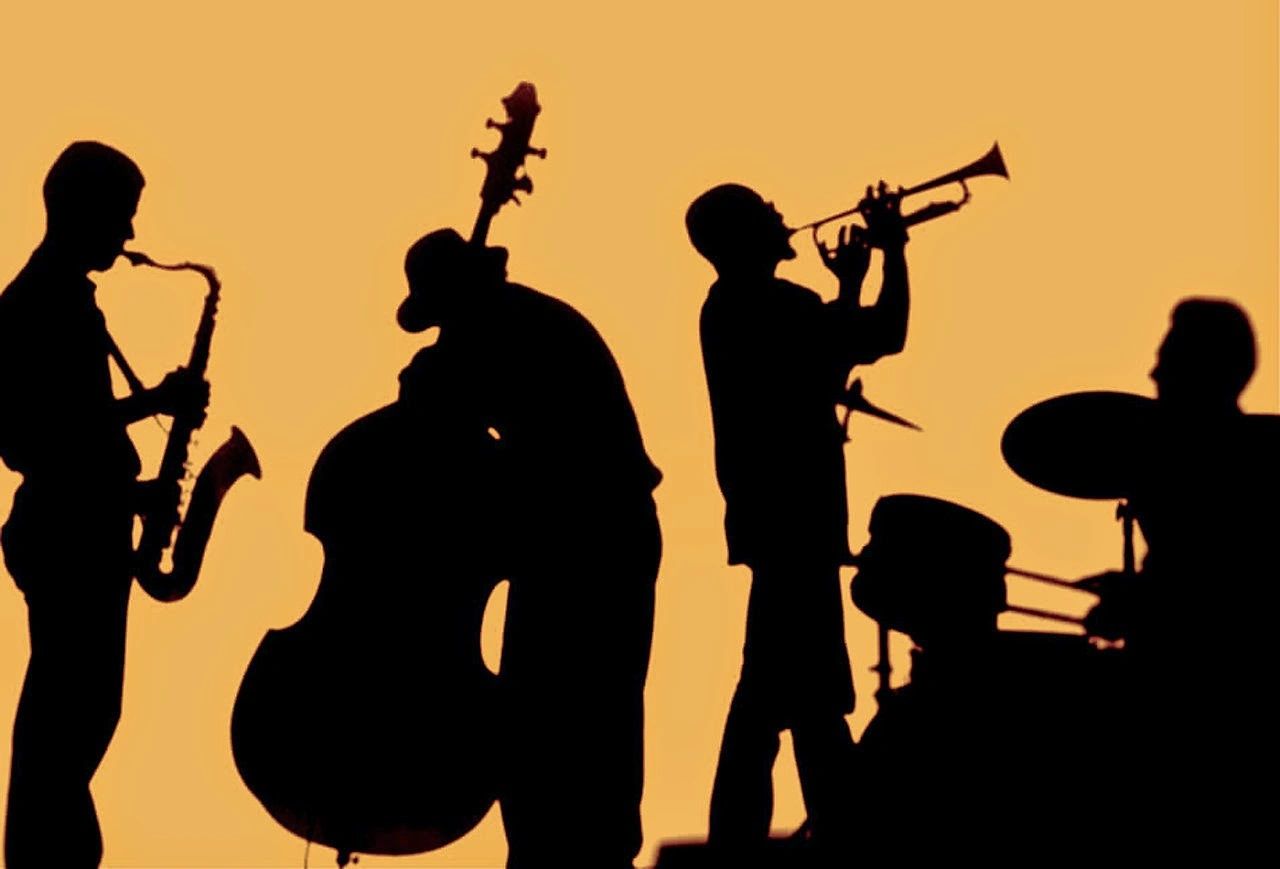
*What is Jazz?
Jazz is a kind of music in which improvisation is typically an important part. In most jazz performances, players play solos which they make up on the spot, which requires considerable skill. There is tremendous variety in jazz, but most jazz is very rhythmic, has a forward momentum called "swing," and uses "bent" or "blue" notes. You can often hear "call--and--response" patterns in jazz, in which one instrument, voice, or part of the band answers another. (You can hear Ella Fitzgerald and Roy Eldridge do "call and response" in Ella's Singing Class.) Jazz can express many different emotions, from pain to sheer joy. In jazz, you may hear the sounds of freedom-for the music has been a powerful voice for people suffering unfair treatment because of the color of the skin, or because they lived in a country run by a cruel dictator.
THE NATURE OF JAZZ
Jazz musicians place a high value on finding their own sound and style, and that means, for example, that trumpeter Miles Davis sounds very different than trumpeter Louis Armstrong (whose sound you can hear in Louis's Music Class.) Jazz musicians like to play their songs in their own distinct styles, and so you might listen to a dozen different jazz recordings of the same song, but each will sound different. The musicians' playing styles make each version different, and so do the improvised solos. Jazz is about making something familiar--a familiar song--into something fresh. And about making something shared--a tune that everyone knows--into somethingpersonal. Those are just some of the reasons that jazz is a great art form, and why some people consider it "America's classical music."
THE GROWTH OF JAZZ
Jazz developed in the United States in the very early part of the 20th century. New Orleans, near the mouth of the Mississippi River, played a key role in this development. The city's population was more diverse than anywhere else in the South, and people of African, French, Caribbean, Italian, German, Mexican, and American Indian, as well as English, descent interacted with one another. African-American musical traditions mixed with others and gradually jazz emerged from a blend of ragtime, marches, blues, and other kinds of music. At first jazz was mostly for dancing. (In later years, people would sit and listen to it.) After the first recordings of jazz were made in 1917, the music spread widely and developed rapidly. The evolution of jazz was led by a series of brilliant musicians such as Louis Armstrong, Duke Ellington (listen to Ellington in Duke's Music Class), Charlie Parker, and Miles Davis. Jazz developed a series of different styles including traditional jazz, swing (listen, for example, to Benny Carter, who got his start in swing music, in Benny's Music Class) bebop, cool jazz, and jazz?rock, among others. At the same time, jazz spread from the United States to many parts of the world, and today jazz musicians--and jazz festivals--can be found in dozens of nations. Jazz is one of the United States's greatest exports to the world.Jazz music is one of the most original forms of music created by African Americans. The music originated from ragtime and blues.
What is Jazz? | National Museum of American History (si.edu)
NOTE--This informational blog is compiled by (with the exception of the introduction and photograph) and reprinted with permission from Abdul Akalimat, PhD
Art Tatum https://www.youtube.com/watch?v=VXJb14qufe4
Thelonious Monk https://www.youtube.com/watch?v=FT9VeJBcEBM
Duke Ellington https://www.youtube.com/watch?v=xa6uaE2oYj4
Count Basie https://www.youtube.com/watch?v=MePwFLcQFYs
Mary Lou Williams https://www.youtube.com/watch?v=IcLwQn9PDE4
Bud Powell https://www.youtube.com/watch?v=q78h2XvjEc8
Ahmad Jamal https://www.youtube.com/watch?v=3Rik_kplZlQ
Oscar Peterson https://www.youtube.com/watch?v=RRJYcLWNXfc
McCoy Tyner https://www.youtube.com/watch?v=In2bZujQOMI
Sun Ra https://www.youtube.com/watch?v=TulrAocqafI
Errol Garner https://digital.nepr.net/music/2013/10/23/erroll-garner-no-one-can-hear-you-read/
Shirley Horn https://www.youtube.com/watch?v=Q8VyB6uUk-s
Tommy Flanagan https://www.youtube.com/watch?v=UWASNHG-hH8
Barry Harris https://www.youtube.com/watch?v=IHQiIvRoMWA
Muhal Richard Abrams https://www.muhalrichardabrams.com/
Horace Silver https://www.youtube.com/watch?v=5nCwMFS12_U
Red Garland https://www.youtube.com/watch?v=mSTIrAcyp3I
Dorothy Donegan https://www.youtube.com/watch?v=Y6O5Sp2j7sA
Wynton Kelly https://www.youtube.com/watch?v=u5qSayYcdP8
Hank Jones https://www.youtube.com/watch?v=92ZRDq8Y9Nw
Cecil Taylor https://www.youtube.com/watch?v=Atu8dab3atc
Hazel Scott https://www.youtube.com/watch?v=zVPFhSJjMGo
Alice Coltrane https://www.youtube.com/watch?v=U5WHDcOk1hI
Fats Waller https://www.youtube.com/watch?v=JoNUIVQUg8Y
Teddy Wilson https://www.youtube.com/watch?v=qNrsOYF1qqw
Willie "The Lion" Smith https://www.youtube.com/watch?v=q3b1xt3V4H8
Billy Taylor https://www.youtube.com/watch?v=TNI6sm0By9s
Ramsey Lewis https://www.youtube.com/watch?v=ZJaMM0McjAw
Herbie Hancock https://www.youtube.com/watch?v=vVq5FTXPAAM
Chucho Valdes https://www.youtube.com/watch?v=_Y3SanbW-JE
Toshiko Akyioshi https://www.facebook.com/watch/live/?ref=watch_permalink&v=279044516594655
Abdullah Ibrahim https://www.youtube.com/watch?v=nb31DFIfpao
Kenny Barron https://www.youtube.com/watch?v=1oiI1tLNG4c
Hampton Hawes https://www.youtube.com/watch?v=u_QvKhZd7Qc
Les McCann https://www.youtube.com/watch?v=2lxeV6WbkPI
Phineas Newborn https://www.youtube.com/watch?v=8iS8w71Z5kA
Ask the Historian
Have a question about this story, or an idea for a future post? Send it here.