
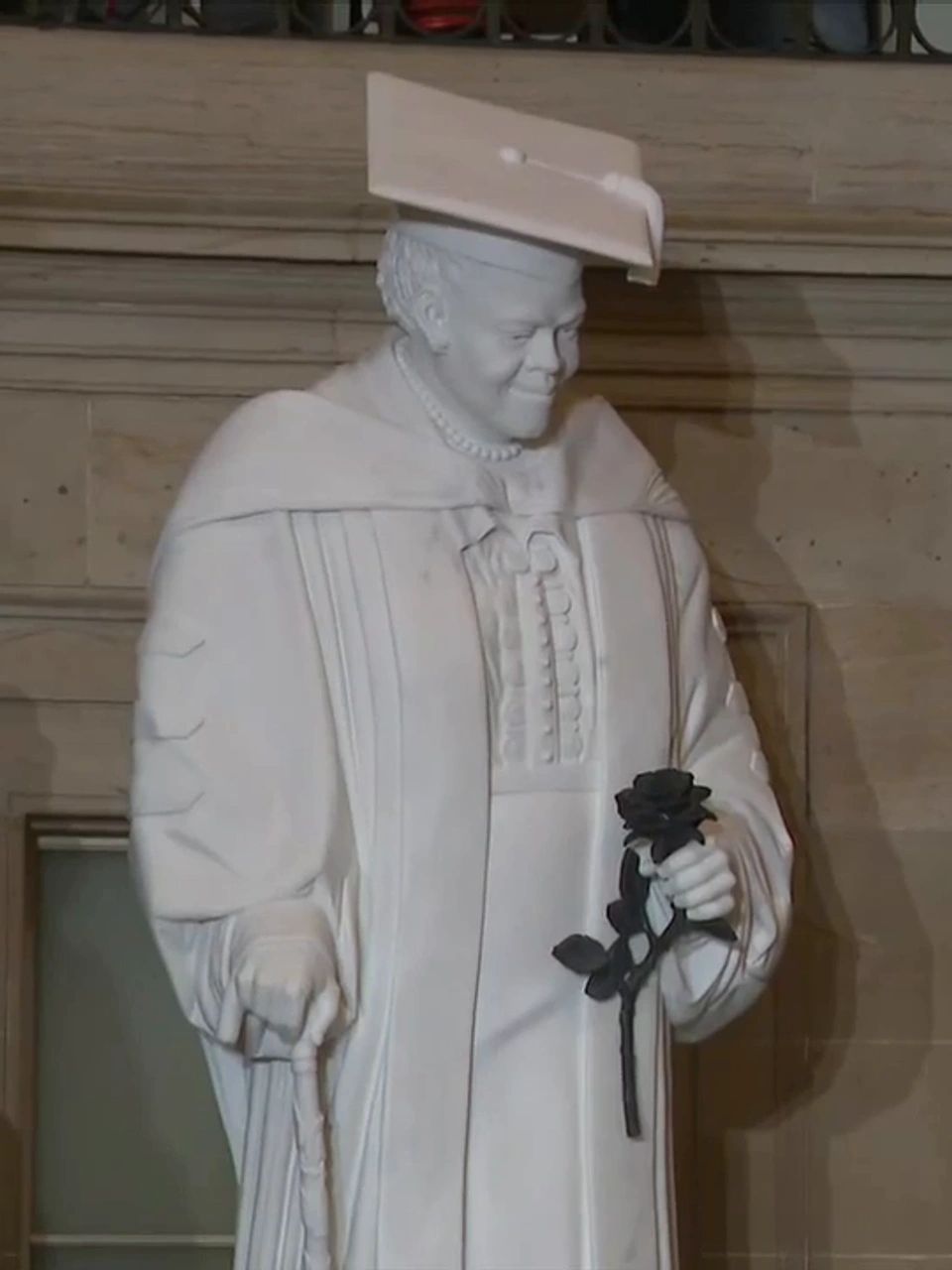
The battle over monuments and how to commemorate the past and whom to remember. This debate over the past note only takes place in the public square but in the most hallowed halls of the Republic. Statuary Hall In the U.S. Capitol has long been the repository for Confederate luminaries. The hall contains two statutes from each of the 50 states. This fact has been obvious but largely hidden in plain view. This reality is slowly starting to change. The recent erection of a statute of Mary McLeod Bethune is a positive step forward. Bethune is a well known educator, civil rights advocate, and woman’s rights activist. She is best known as the founder of Bethune Cookman College in Daytona Beach, Florida. In addition to her role as an educator, she was an important advocate for women’s rights. She was an active member and founder of the National Council of Negro Women ( NCNW). She also played a central role in Franklin Delano Roosevelt’s Black Cabinet. The cabinet consisted of an informal set of advisors and lower level administration members who advised Roosevelt on Black matters. Bethune served as director of Negro Affairs in the National Youth Administration.

Some of Bethune’s other notable accomplishments include co-founding the United Negro College Fund in 1944. She also served as Vice-President of the National Association for the Advancement of Colored People ( NAACP). She also participated in the U.S delegation with W.E.B DuBois, and Walter White at the founding conference of the United Nations in San Francisco in 1945. Bethune’s statute was commissioned by the State of Florida. This is the first statute of an African American commissioned by a state. Statutes of African Americans exist, but they were commissioned by Congress. Other statutes of African Americans include Rosa Parks and Frederick Douglass.
Bethune’s statute stands 11 feet tall. It was sculpted by Nilda Comas, a sculptor of Puerto Rican descent. The statute features Bethune in academic robes. She appears in a mortarboard cap with tassel and a long robe. The robe is a doctoral robe to symbolize the many honorary doctorates Bethune received from various institutions of higher learning. In her left hand she holds a black marble rose. It was made with marble from Spain. The rose symbolizes Bethune’s interracial, international and inter-religious affiliations. Her right hand sits squarely atop a walking stick. Bethune collected walking sticks. It represents her participation in several facets of the federal government and confident bearing. At the statute’s base, we see her last will and testament and Bethune's powerful admonition to future generations: “I Leave You.” The words of the admonition are as follows: "I leave you hope. I leave you the challenge of developing confidence in one another. I love you a thirst for education. I leave you a respect for the use of power. I leave you faith. I leave you racial dignity. I leave you a desire to live harmoniously with your fellow man. I leave you finally, a responsibility to our young people."
Ask the Historian
Have a question about this story, or an idea for a future post? Send it here.