
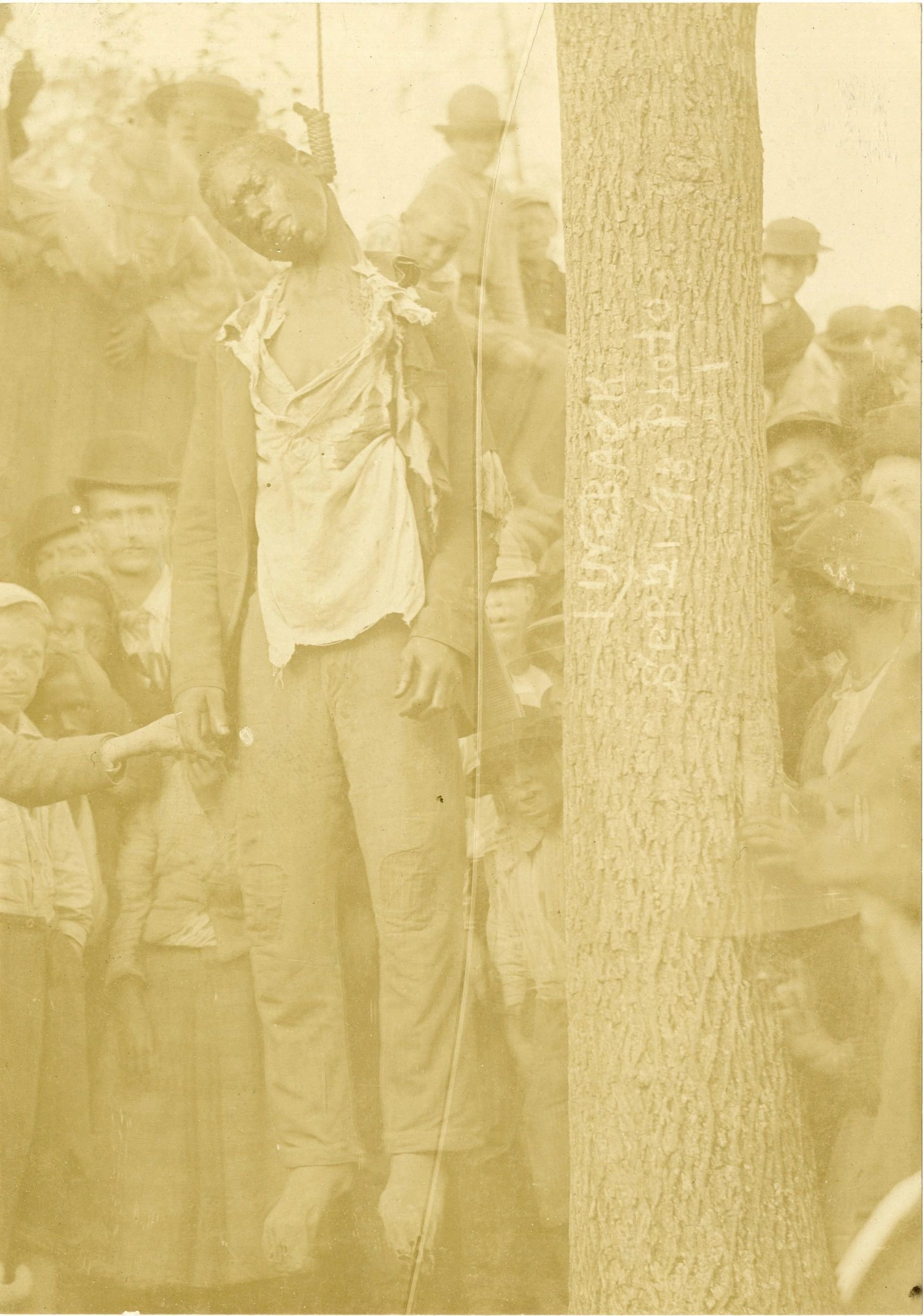
WALTER F. WHITE, Why I Investigate Lynchings______ American Mercury January 1929*
Walter White, born of African-American ancestry and raised in Atlanta, investigated lynchings and race riots for the National Association for the Advancement of Colored People (NAACP). From 1931 until his death in 1955 he served as the organization’s executive secretary (director). 0
Nothing contributes so much to the continued life of an investigator of lynchings and his tranquil possession of all his limbs as the obtuseness of the lynchers themselves. Like most boastful people who practice direct action when it involve[s] no personal risk, they just can’t help talk about their deeds to any person who manifests even the slightest interest in them.
Most lynchings take place in small towns and rural regions where the natives know practically nothing of what is going on outside their own immediate neighborhoods. Newspapers, books, magazines, theatres, visitors and other vehicles for the transmission of information and ideas are usually as strange among them as dry-point etchings. But those who live in so sterile an atmosphere usually esteem their own perspicacity in about the same degree as they are isolated from the world of ideas. They gabble on ad infinitum, apparently unable to keep from talking.
In any American village, North or South, East or West, there is no problem which cannot be solved in half an hour by the morons who lounge about the village store. World peace, or the lack of it, the tariff, sex, religion, the settlement of the war debts, short skirts, Prohibition, the carryings-on of the younger generation, the superior moral rectitude of country people over city dwellers (with a wistful eye on urban sins) ⎯ all these controversial subjects are disposed of quickly and finally by the bucolic wise men. When to their isolation is added an emotional fixation, such as the rural South has on the Negro, one can sense the atmosphere from which spring the Heflins,* the Ku Kluxers, the two-gun Bible-beaters, the lynchers and the anti-evolutionists. And one can see why no great amount of cleverness or courage is needed to acquire information in such a forlorn place about the latest lynching.
Professor Earle Fiske Young of the University of Southern California recently analyzed the lynching returns from fourteen Southern states for thirty years. He found that in counties of less than 10,000 people there was a lynching rate of 3.2 per 100,000 of population; that in those of from 10,000 to 20,000 the rate dropped to 2.4; that in those of from 20,000 to 30,000, it was 2.1 per cent; that in those of from 30,000 to 40,000, it was 1.7, and that thereafter it kept on going down until in counties with from 300,000 to 800,000 population it was only 0.05.
Of the forty-one lynchings and eight race riots I have investigated for the National Association for the Advancement of Colored People during the past ten years, all of the lynchings and seven of the riots occurred in rural or semi-rural communities. The towns ranged in population from around one hundred to ten thousand or so. The lynchings were not difficult to inquire into because of the fact already noted that those who perpetrated them were in nearly every instance simple-minded and easily fooled individuals. On but three occasions were suspicions aroused by my too definite questions or by informers who had seen me in other places. These three times I found it rather desirable to disappear slightly in advance of reception committees imbued with the desire to make an addition to the lynching record. One other time the possession of a light skin and blue eyes (though I consider myself a colored man) almost cost me my life when (it was during the Chicago race riots in 1919) a Negro shot at me, thinking me to be a white man.
Wiki https://en.wikipedia.org/wiki/Lynching_in_the_United_States
Civil Rights and Restorative Justice Project https://crrj.org/
Map https://lynchinginamerica.eji.org/explore
NAACP https://naacp.org/find-resources/history-explained/history-lynching-america
Ida B. Wells wiki https://en.wikipedia.org/wiki/Ida_B._Wells writings https://www.gutenberg.org/ebooks/author/5765 Family photo https://photoarchive.lib.uchicago.edu/db.xqy?one=apf1-08624.xml
Lynching in America https://lynchinginamerica.eji.org/ https://www.truthinphotography.org/lynching-postcards.html
Lynching data by year https://law2.umkc.edu/faculty/projects/ftrials/shipp/lynchingyear.html
National Memorial for Peace and Justice https://legacysites.eji.org/about/memorial/ https://en.wikipedia.org/wiki/National_Memorial_for_Peace_and_Justice
Memphis Lynching Site Project https://lynchingsitesmem.org/
Documentary https://www.youtube.com/watch?v=hPdh46k7b38
Post Cards https://tinyurl.com/37t4xrz2
1891 Robert Clark (Virginia) https://www.youtube.com/watch?v=rPFZ99Xg3II
1900 Avery Mills (North Carolina) https://en.wikipedia.org/wiki/Forest_City_lynching
1910 Allen Brooks (Texas) https://en.wikipedia.org/wiki/Lynching_of_Allen_Brooks
1920 Three Men (Minnesota) https://www.youtube.com/watch?v=sz57-ucGK28
1930 James Cameron (Indiana) https://www.pbs.org/video/wpt-documentaries-lynching-marion/
1942 Cleo Wright (Missouri) https://en.wikipedia.org/wiki/Lynching_of_Cleo_Wright
1947 Henry Peg Gilbert (Georgia) https://www.youtube.com/watch?v=PZRvRb4XaK4
1955 Emmett Till (Mississippi) https://www.youtube.com/watch?v=YYvJiEGTOYw
1964 Chaney, Goodman, and Schwerner (Mississippi) https://www.youtube.com/watch?v=N57vzrSEDCw
1970 Jackson State (Mississippi) https://en.wikipedia.org/wiki/Jackson_State_killings
1981 Michael Donald (Alabama) https://en.wikipedia.org/wiki/Lynching_of_Michael_Donald
1990s?
2000s?
2010s?
2020s?
#WalterWhite #NAACP #Lynching #ThomasSmith
Ask the Historian
Have a question about this story, or an idea for a future post? Send it here.