
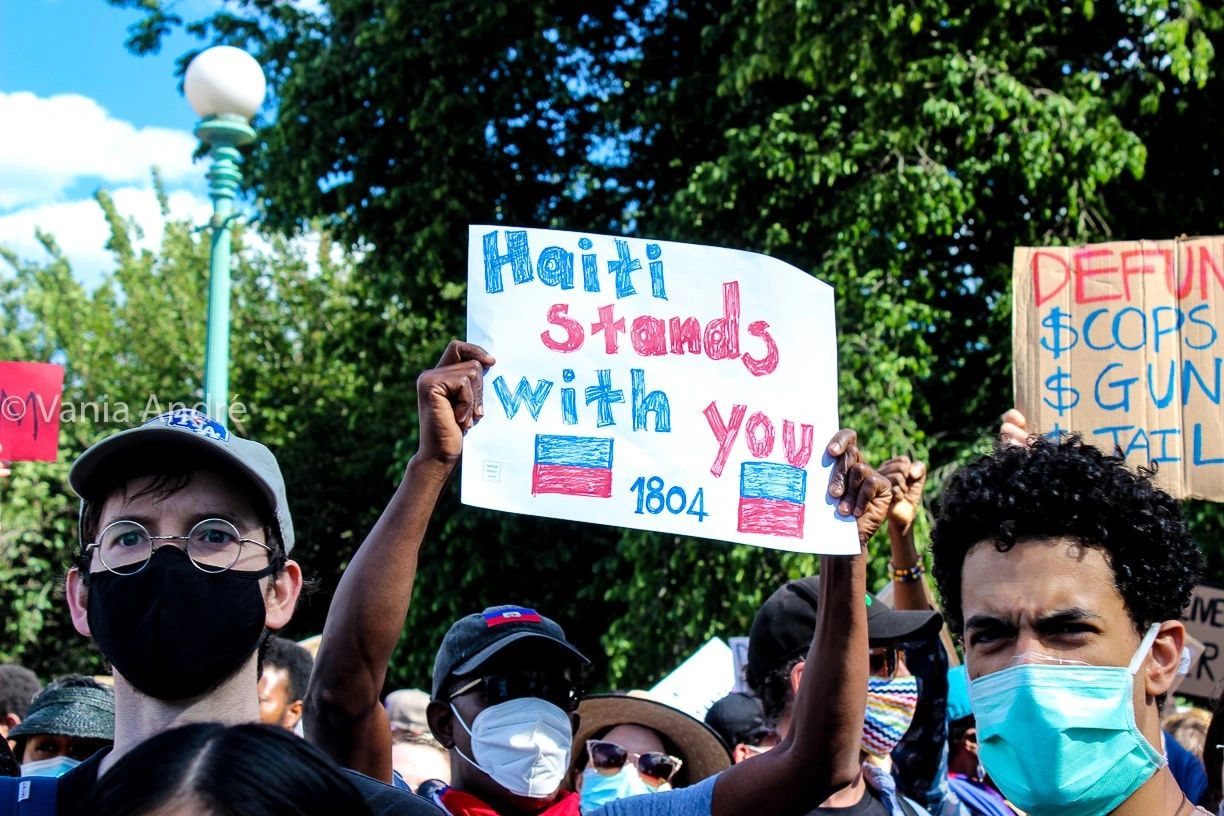
Grégory Pierrot, PhD is Associate Professor of English at the University of Connecticut at Stamford. He is the author of The Black Avenger in Atlantic Culture (UGA Press, 2019) and co-editor with Marlene L. Daut and Marion Rohrleitner of the forthcoming An Anthology of Haitian Revolutionary Fictions (UVA Press).
The murder of George Floyd at the hands of Minneapolis police officers on May 24, 2020 led to global outrage and protests soon followed. Initially centered on the systemic racism undergirding US police brutality, the movement spread to include broader questions of institutional racism throughout US society, present and past. The Black Lives Matter movement is steeped in historical awareness. Michelle Alexander’s The New Jim Crow and Ava DuVernay’s 13th document how we arrived at our current situation. The abuses of today have roots in the atrocities of yesterday. The fact that people can so easily downplay or reject the idea of institutional racism, is because they rely on the idealized versions of Western history presented in schools and by mainstream media. Peppering them with multicultural tokens—a Harriet Tubman lesson here, an MLK celebration there—has allowed them to pretend that the white supremacist perspectives forming this history’s foundation are universalist. But BLM has developed thanks to a different set of popular networks of knowledge, education and information. In the way it has used these for organizing, in its decentered approach to action, BLM does historical work that challenges the narrative of white supremacy. In the way it has spread to other African diasporic communities facing similar issues around the world, BLM evokes another global Black uprising: the Haitian Revolution (1791-1804), in which the French Caribbean colony of Saint-Domingue threw off the yoke of slavery and gained independence. At the turn of the 19th century, Haiti showed the world that the struggle for Blackness and the struggle for universal freedom were one and the same. In riding a “Common Wind” much like the one that once carried news of the Haitian Revolution, BLM is setting the global Black agenda of the 21st century.
In 1791, The French colony of Saint Domingue, site of the most atrocious displays of the slave system, witnessed its enslaved and free population of African descent rise up in arms against white colonizers. The subsequent decade of conflict saw these revolutionaries led by the formidable military leader and statesman Toussaint Louverture take on and defeat Spain, Great Britain, and France. Although Louverture was treacherously captured and died in captivity in France, the movement was unstoppable. On January 1, 1804, the Indigenous Army with General Jean-Jacques Dessalines at its head declared independence, renaming their nation Haiti.
The Haitian Revolution changed the face of the world. It changed the demographics, economy, and geography of the United States, inspired revolts throughout the slaveholding Atlantic. Independent Haiti also directly supported revolutionin South America. Its moral, symbolic and political impacts were arguably even greater. Haiti was the first country in the world to abolish slavery outright. As such, it became a haven for all people of African descent. In the eyes of slaveholders around the Americas, Haiti now stood for the terrifying possibility that the enslaved might not just revolt, as they had for centuries, but also overthrow colonial order and institutions and build their own. Indeed, in declaring all Haitian citizens Black, the Constitution of 1805 made Blackness itself a political statement and Haiti a beacon of freedom and revolution. Two hundred years later, as we still find ourselves needing to state that Black Lives Matter, the Haitian Revolution is a reminder that such statements pack the potential for global, radical change.
Historian Julius S. Scott detailed how news about the Haitian Revolution traveled far and wide on what he called “the Common Wind,” communication networks connecting Black diasporic communities across the Atlantic world, beyond and in spite of hostile white surroundings. Rebel slaves, runaways, sailors carried news and models of freedom, their very persons constituting and circulating the medium and the message of Black freedom beaming from the Caribbean. The 21stcentury versions of these networks of information and political action are at the heart of BLM, living in the cellphones of Ramsey Orta and Darnella Frazier and thousands of nameless others, in the group chats, forums and online discussions that undergird the BLM movement in the US, in Canada, in Great Britain, in France, in Belgium, all the places where people have risen to oppose antiblackness. Records may forever be inaccessible to future historians of the movement, yet in their capacity to educate and mobilize, these communication networks evoke Scott’s Common Wind and demonstrate how BLM puts the spirit of the Haitian Revolution to work in novel ways. Eschewing the obsolete top-down organization of traditional political groups, BLM has already achieved enormous goals: consider notably the dizzying speed at which Southern states have been taking down Confederate statues in the past weeks. Symbolism and representation matter, but they can also be a distraction: the Haitian Revolution continues to teach us that while the world white supremacy made can adapt to changing symbols, it continues to find the very fact of Black politics unthinkableand terrifying. In the revolution as in BLM, it is the prospect of actual equality carried by the people that unsettles oppressors. Freedom is the promise carried by the common wind that once blew from Haiti and has now risen all over the US: it has already toppled statues; it has the potential to again change the world.
Ask the Historian
Have a question about this story, or an idea for a future post? Send it here.