
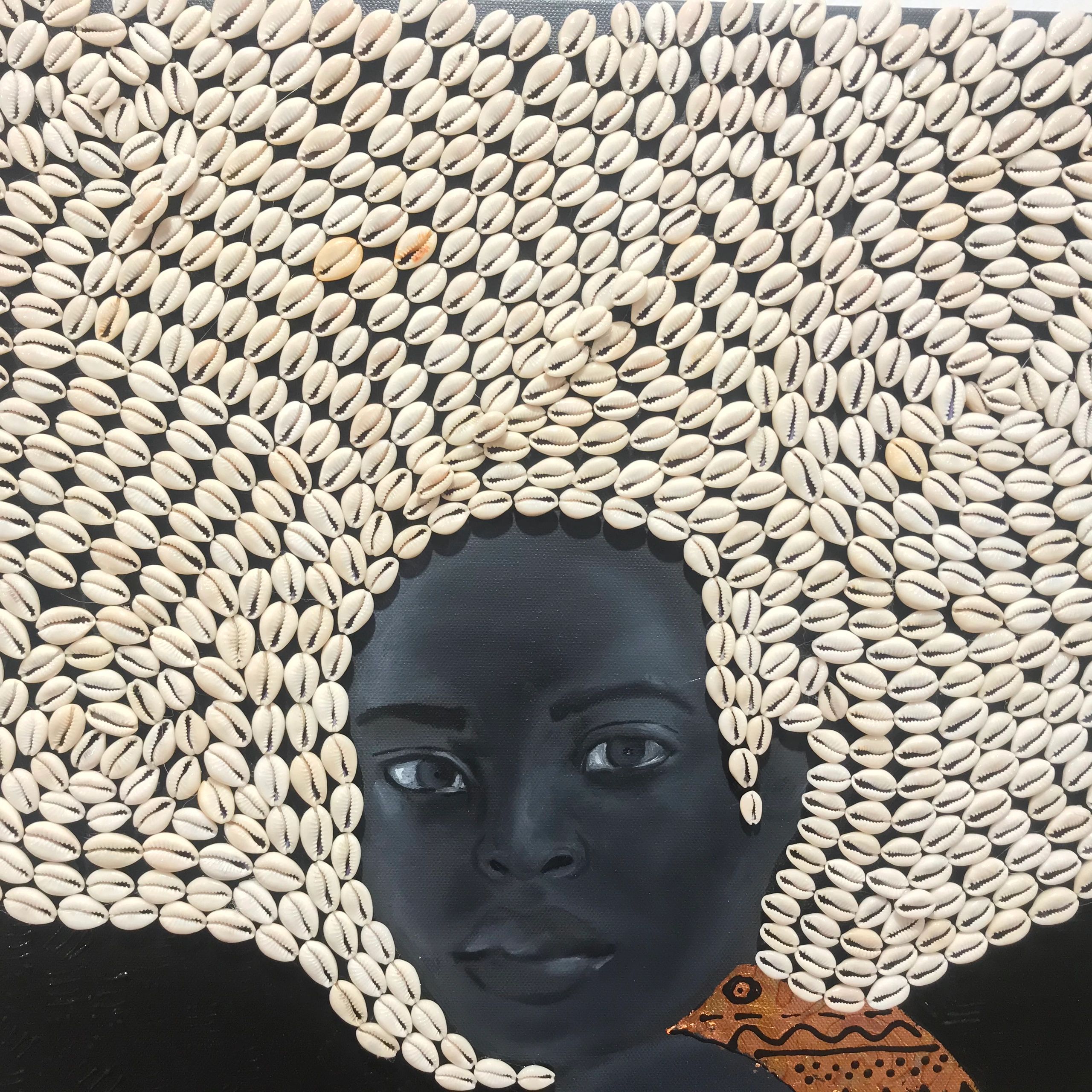
April Sunami is an award-winning visual artist primarily focusing on mixed-media painting and installation. Sunami’s work has been exhibited internationally, including at the National Theatre in Accra, Ghana, and during the Cuba Biennale in Mantanzas, Cuba. Her work has been featured in various juried group exhibits, galleries and museums including the Columbus Museum of Art, the National African American Museum and Cultural Center and a solo exhibit at the Southern Ohio Museum in Portsmouth, Ohio. Her work is also represented in private, corporate and public collections throughout the United States.
HISTORIANSPEAKS: Can you begin by telling our readers a little about yourself. How did you become interested in art, where were you trained and how many years have you been doing this type of work?
SUNAM: I am a mixed media painter based in Columbus, Ohio. My work focuses on Black women subjects. I have been making art my entire life. I went to college to study studio art and fell in love with art history. I have a Bachelor’s and Master’s Degree in Art History. Throughout the period, I continued my practice of making, exhibiting, and selling art for 15 years.
HISTORIANSPEAKS: Could you talk about your work in mixed media? Can you tell us what this form of art entails?
SUNAMI: I think about mixed media as a tool to help tell the story of the subjects I feature. I am constantly evolving and experimenting with what things I can incorporate into my work. Most things that I use in my paintings have some symbolic resonance. For instance, I love using cowrie shells not only because they possess a rhythmic beauty, but they also were used historically as currency in coastal parts of West and East Africa and Asia. For me, they are a connection between my West African ancestry and the New World. The ocean and the event of the Middle Passage serve as the bridge between the past and the present. I also love using broken mirrors in my work as an invitation to the viewer to see themselves in the work.
HISTORIANSPEAKS: Do you believe “all art is political,” if so, what does that phrase mean to you and how is it expressed in your work. If not, why?
SUNAMI: Definitely. I do not believe there is ever art for art’s sake. All art that is created is informed by the culture in which it is made. It reflects an acceptance, rejection, or interrogation of what exists. As an artist, I look to challenge the narrative of the invisibility of Black women and the patriarchal gaze that has existed in art history for millennia.
HISTORIANSPEAKS: How does your artistic creation contribute to deepening our understanding of race, class and gender dynamics in contemporary American society?
SUNAMI: I think of myself as one of many contemporary cultural producers contributing to the ongoing discourse on race, identity, representation, and womanhood. So much of my work is motivated by the portrayal of Black women outside of the lens of the white supremacist power structure. It is important that my subjects are portrayed as active agents. I remember years ago being told by a gallerist that people do not like when the subjects in portraits gaze back at the viewer. I deliberately continued to create portraits where the gaze is inverted toward the viewer. This is not meant to be an adversarial exchange, but it instead forces the viewer to recognize the humanity and complexity of the subject.
HISTORIANSPEAKS: Do you have a favorite or most significant work? If so, what is it and why?
SUNMANI: I am a tough critic of my own work, and I never seem to achieve the idea of the perfect painting in my head. There are a few paintings where I do feel like I got close to what I envisioned. In 2015, I was involved in an exhibition highlighting international women artists titled “Dare to Be Heard” curated by Stephanie Rond. For this show, I created an altarpiece in which the central image was formed of 3000 Smith and Wesson bullets. It was a lamentation piece for Black mothers whose sons were murdered by the police. There were lit candles that flanked and marked the passageway to the piece. It was an emotionally heavy and spiritual piece. When I saw three people walk away crying from the work at the opening it really cemented the sentiment that it was my calling on this earth to connect with people through art.
HISTORIANSPEAKS: Does your work explore Africa and the African Diaspora (including the experiences of African descended people in the Americas, Europe and Asia)? How does this work broaden our sense of Black experience in the global world?
SUNAMI: Absolutely, early on in finding my voice as an artist I was interested in exploring the history and culture of what was so often omitted in my studies in art history. Much of my work strives to amplify the stories and histories that I did not hear growing up. Throughout high school and college there was a gap in my education that ignored the history of Africa before European colonization. I had to independently research much of what I know now. Many of my paintings are named after queens and warriors of ancient African kingdoms and Yoruba deities. I cannot speak for what my work does for anyone else but for me it’s personal. It solidifies a sense of history and pride in knowing my ancestors prior to being enslaved in this country had a rich and illustrious past.
HISTORIANSPEAKS: This is Black History Month. What message to you have for aspiring artists exploring the Black experience using art as a medium?
SUNAMI: I have so many things that I wish I could pass onto aspiring artists. First, I would encourage those who want to be a professional artist to do the work and know your worth. Stop selling your time and talent short and working for free. Art is so many things, but it is also a profession. Respect it as such. My next message for Black artists during this time is find your voice and share it no matter what. Your art is a light in this world, and it is your obligation to let others see it.
Ask the Historian
Have a question about this story, or an idea for a future post? Send it here.