
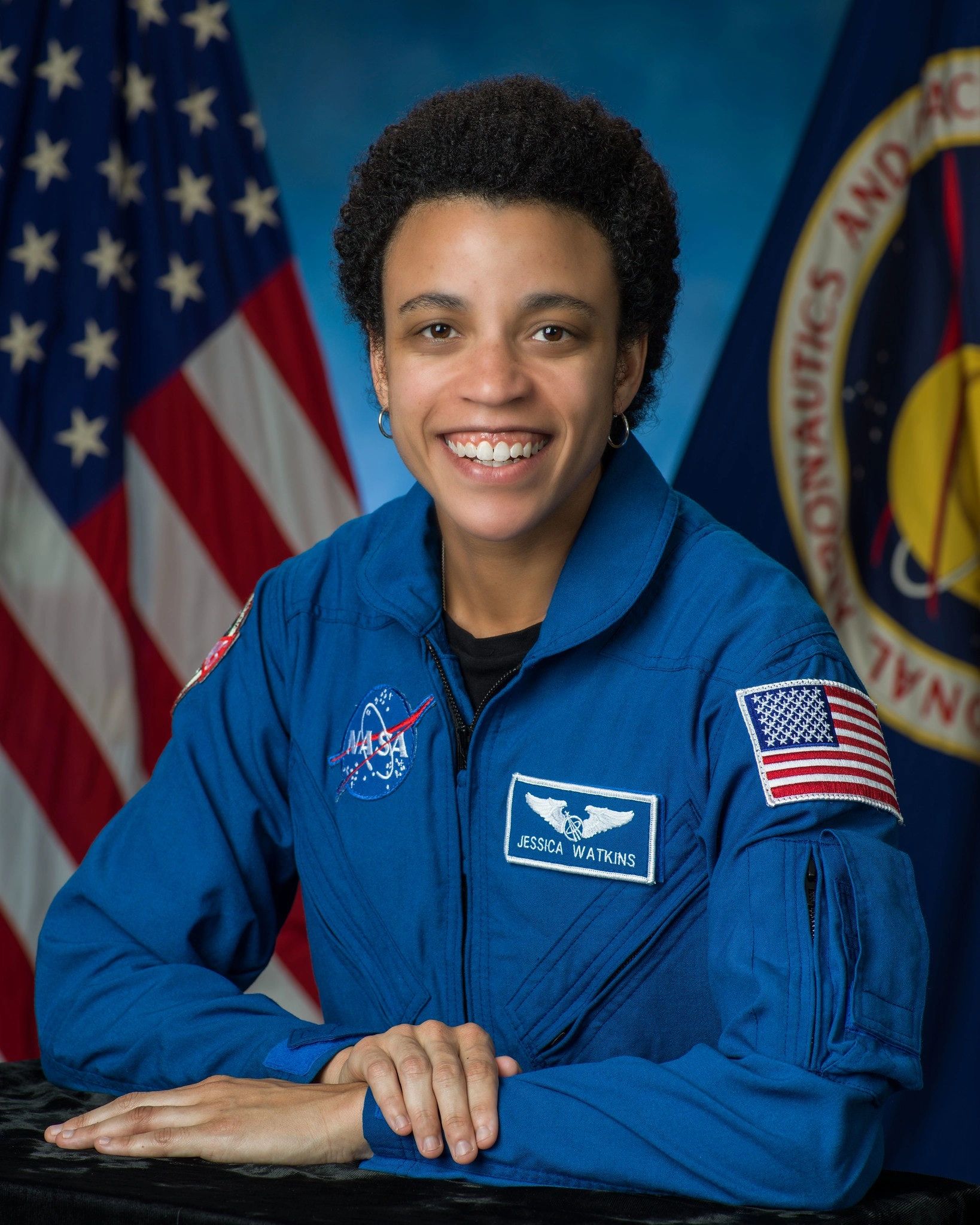
Black participation in the space program has been longstanding. Two of the most outstanding examples of these contributions include the pathbreaking work of Ronald McNair aboard the ill-fated Challenger expedition in 1986 and Dr. Mae Jemison. Jemison was the first Black woman to travel into space on the Space Shuttle Endeavour. Jemison served on the STS-47 mission, which orbited the Earth for eight days on September 12-20, 1992. Like McNair and Jemison and countless others, Jessica Watkins a geologist and astronaut, is the largest pathbreaker in space. Watkins is the first Black woman to be assigned to a long duration mission to the International Space Station (ISS). She was chosen as the final member of the Space-X Crew-4, which launched in April 2022. During her first mission to space, she will serve as mission specialist. This is a six-month mission during which the crew will stay aboard the space station. They will conduct experiments and work in a microgravity environment.
Watkins was born in Gaithersburg, Maryland, in 1988. Her family subsequently moved to Lafayette, Colorado. She received a bachelor’s degree in geological and environmental sciences from Stanford University. She obtained a Ph.D. in geology at the University of California.
She showed a keen interest in rugby and remained actively involved in the Stanford’s rugby team throughout her undergraduate career. Also, Watkins is a former rugby player for sevens in the American women’s national team. She played for the USA Eagles and became the team’s top scorer during the 2009 World Cup.
Jessica Watkin’s career with NASA began during her undergraduate years. She was the chief geologist for the NASA Spaceward Bound Crew 86 at the Mars Desert Research Station in 2009. One of her earliest contributions to NASA was her involvement in planning Mars Curiosity Rover.
The budding astronaut did her graduate research on emplacement mechanisms of large landslides on Mars and Earth. In addition, she has also worked in NASA's Ames Research Center for the Mars Phoenix Lander.
In 2017, NASA enlisted Watkins to join the Astronaut Candidate Class, where she trained for two years as an astronaut. She is among the members of the SpaceX Crew-4 Mission. Jessica is leading as a mission specialist for the International Space Station’s ongoing mission. She is among the 12 people selected from 18,000 applicants for the program.
Watkins is the first black woman on the International Space Station crew traveling 227 miles above the Earth’s surface. It is seen as a groundbreaking step toward building a more inclusive America.
Watkins and her co-workers submitted a paper to the Journal of Geophysical Research in 2017. It discusses the formation of sedimentary rocks on Mars based on the evidence collected by the Curiosity Rover. In plain words, the paper concluded that “rocks are formed after sediments are "exhumed and recycled back into the crust through renewed burial."
Jessica held a Q&A session from space with students and faculty of Caltech on August 9, 2022.
When asked if she had any advice for aspiring astronauts, she replied, "Find something you're interested in. The one thing that all my classmates and crewmates have in common is that we don't have the same background. We all came from different experiences and different career paths that led us to this point, so there is no one single path that will get you here.”
As a member of the Artemis team, they are preparing for the upcoming lunar missions. "I certainly would be absolutely thrilled to be able to be a part of the effort to go to another planetary surface, whether it be the Moon or Mars,” she said in a statement. Watkins may be the first woman to set foot on the moon in the years to come.
Ask the Historian
Have a question about this story, or an idea for a future post? Send it here.