
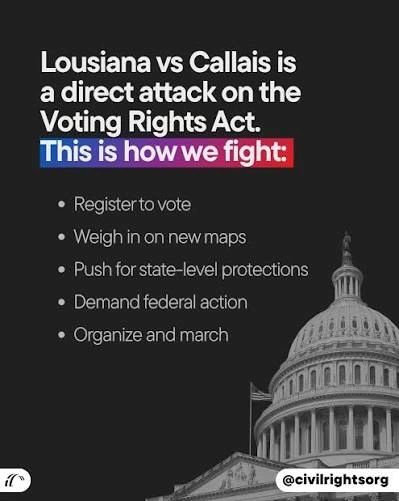
The recent Supreme Court ruling in Louisiana v. Callais on April 29th dealt a significant blow to voting rights protections in the Voting Rights Act of 1965. A conservative court ruled 6-3 that a redistricting map (SB8) was unconsititutional under the Fourteenth Amendment's Equal Protection clause.
Background
Following the 2020 census, the Lousiana legislature drew a congrssional map with one majority Black disrict. A federal judge in Robinson v. Ardoin found the map violated Section 2 of the Voting Rights Act. This was the case because the map failed to create an additional majority-minoirty district. In order to prevent the imposition of a court orderd map, the legislture created another majority black district.
The map was challenged in Callais v. Landry before a three judge federal court. It found the map violated the Equal Protection clause. The case was appealed to the Supreme Court.
Meaning and Outcome
This case leads to the undermining of the Voting Rights Act of 1965 (VRA): The Supreme Court has made it extremely difficult to chalenge racially discriminatory voting maps.
The Supreme Court ruled Section 2 of the VRA does nor require states to create additional majority-minority districts to remedy racial vote dilution unless a much higher burden of racially discriminatory behavior can be documented.
The court also ruled that Lousiana's map was "unconstitutional racial gerrymandering" because the VRA did not mandate the creation of a second district. There was , according to the court, no comeplling reason to use race to justify drawing new lines.
One of the most problematic outcomes is this ruling is that it opens the door for states to deploy more extreme redistricting maps to dilute minority voting and political power.
#Louisianav.Callais #VotingRights #VotingRightsActof1965
Ask the Historian
Have a question about this story, or an idea for a future post? Send it here.