
Mab Segrest, PhD is author of Administrations of Lunacy: Racism and the Haunting of American Psychiatry at the Milledgeville Asylum, just released from The New Press. She lives in Durham, NC.
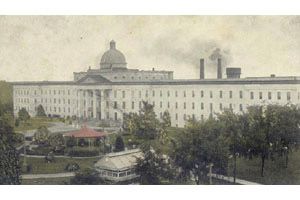
In July of 1911, Dr. Peter Cranston, physician at what was then called the Georgia State Sanitarium, began the interview protocol with African American patient Mary Roberts (not her real name):
Why were you sent to this place?
I wanted to be examined to see if I was crazy.
What had you been doing to make them think you were crazy?
I was at home praying.
Were you very much excited at that time?
Yes sir. I would pray, shout and sing and then sometimes I would cry.
Mary Roberts’ case history, among many I found at the Georgia Archives, has much to teach us about the roots and implications of the COVID-19 health disparities now disproportionately falling on African Americans. In COVID-19, the past mirrors the present because we as a country have not escaped what African American scholars have termed the “afterlives of slavery,” the repetitions of a paradigm that continues tragically to shape US history.
The recent partial release of COVID’s racial demographics have highlighted the vulnerability of African Americans to contracting the virus and dying from it. A recent National Geographic article calculates: nationally, African Americans represent 13% of the US population but represent 33% of US COVID-19 deaths. Urban differences are more severe: Wisconsin--6.7% Black population, 36% of COVID fatalities; Memphis/Shelby County--50% African American population, 71% of fatalities; Michigan-- 14.1% Black population, 35.6% of COVID deaths; Georgia--32.4% Black population, 55.9% of COVID deaths. These statistics illuminate the chorus of grief across social media for Black relatives and friends suddenly gone.
In Michigan, a white state senator wore a Confederate motif on his mask as armed OPEN demonstrators watched from the gallery. US Surgeon General Jerome Adams walked back his controversial advice to fellow African Americans about "drugs, tobacco and alcohol” and his injunctions to keep “big momma” and “pop pop” safe.
Mary Roberts would not have been surprised.
Thirty-four when she was committed, Mary Roberts was 5’4”, 121 pounds: “Face symmetrical. Hair black. Eyes hazel. Nose straight. Teeth regular… Expression bright.” But her praying, singing, shouting, and crying had disturbed the authorities back home, and her ability to remain “exalted on the ward” perturbed her doctors. Struggling to apply new diagnostic categories developed in Germany to Georgia patients, the Sanitarium staff never did decide which of its two major diagnoses fit her most accurately: dementia praecox or manic depression. Their focus was rather on what one of them wrote of as “negro characteristics,” such as being “overactive,” “easily excited,” “high strung” and sometimes violent. Yet Mary Roberts’ medical exam reveals that she had eleven pregnancies in twelve years, with only two babies surviving. Her spiritual expression, beginning so shortly after the onset of childbirth and child death, surely included her grief for these losses. Nor was the grief only hers.
Between 1900 and 1930, tragic and preventable infant and maternal diseases were the third major killer of southern Blacks. Sociologist E. Franklin Frazier explained: “It has been well-nigh impossible in the South to get communities to adopt health programs when it was thought that the Negro would share the benefits." Southern infant and maternal mortality would not improve substantially until the 1935 Social Security Act, a part of the New Deal that brought federal resources to Georgia (by 1940 fifty-five of the state’s 169 counties had local public health units, serving 61 percent of the population). But that progress would not hold.
In the New York Times, Linda Villarosa recently summarized the “life and death crisis” of Black mothers and babies in the US today. In 1850, the U.S. government first began to keep records of infant mortality in the first year of life. They showed a Black-white divide of 340 to 217 deaths per 1000 for African American babies compared with white babies. From 1915 to the 1990s, infant mortality rates fell 90 percent, a reduction “unparalleled by other forms of death,” because of vast improvements in nutrition, clinical medicine, access to health care, educational levels, and standards of living. By 1960, the United States ranked eleventh among developed countries in the rate of infant mortality.
But in the twenty-first century, driven probably by mass incarceration and severe cuts in social safety nets, the tide of infant mortality turned again, driven largely by the deaths of Black babies. By 2018, the United States ranked thirty-third out of thirty-six among the wealthiest nations in infant mortality rates. Black infants are now more than twice as likely to die as white infants in the first year—11.3 for African Americans and 4.9 for whites per thousand—a wider racial disparity than 1850, when first records were kept. In fact, “a Black woman [today] with an advanced degree is more likely to lose her baby than a white woman with less than an eighth grade education,” according to experts. Black mothers are in danger too—by hypertensive disorders of high blood pressure and cardiovascular disease that lead to preeclampsia and the seizures of eclampsia itself.
And these numbers for mothers and daughters cannot be attributed to “heredity” or “poverty” but what is to many a “shocking idea”: the toxic psychological stress of “societal and systemic racism” with its longstanding biases in health care. Dr. Arline Geronimus, professor at the University of Michigan School of Public Health, first linked this stress and Black infant mortality with what she called “weathering" that “triggered the premature deterioration of the bodies of African American women as a consequence of repeated exposure to a climate of discrimination and insults.” These multigenerational results of “weathering” are the “pre-existing conditions” through which Black people are more vulnerable.
That our current conditions in the infant mortality that caused Mary Roberts such grief are worse than during slavery gives us one barometer of our extreme racial climate, and the COVID-19 deaths show its continuing brutal cost.
Ask the Historian
Have a question about this story, or an idea for a future post? Send it here.