
Jason Miller, PhD is a curator of the "George Floyd Protest-Police Brutality Videos on Twitter Database. He is a mathematics professor in California. He grew up in a suburb of St, Paul Minnesota. You can follow him on Twitter @jasonemiller.
HISTORIANSPEAKS: Could you provide our readers with some background information on the creator and curator of the “George Floyd Protest- Police Brutality Videos on Twitter Database?
MILLER: The creator of this collection is T. Greg Doucette, a lawyer working in North Carolina. He has been professionally interested in police brutality for years. He hosts a podcast on the topic. This is something he is best positioned to talk about, of course.
I "met" him on Twitter where I stumbled across his account somehow. I think I chose to follow him because of the wit of his writing, and he represented a more conservative perspective than people in my circles. It is one way I keep my social networks from being an echo chamber. Then last fall, his Twitter stream was dominated by news and intrigue surrounding a scandal at the University of North Carolina (where I earned my Ph.D.). It involved the Board of Governors, the Sons of Confederate Veterans, the United Daughters of the Confederacy, a statue of a Confederate soldier named "Silent Sam" that used to sit on campus, and a shady deal of dubious ethics and legality that blew up. He helped it blow up. You can read about that story (and T. Greg) here.
HISTORIANSPEAKS: What was the impetus for compiling a database on police brutality at the George Floyd Protests?
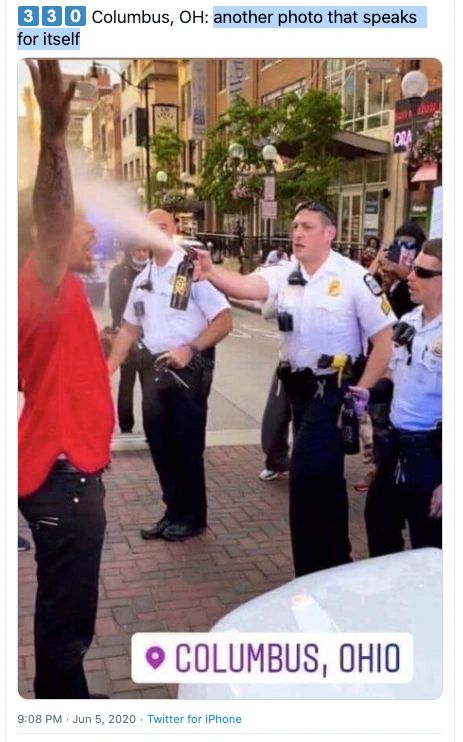
MILLER: Police brutality makes us angry. I think T. Greg saw the brutality directed at George Floyd protestors as so widespread and blatant that he had to witness using Twitter. So, he started a thread of video evidence he deemed authentic. I think he started the thread on May 29th. When I saw it, I knew I needed to help him somehow. He did not know me from Adam, but I did not let that stop me. I knew he and our neighbors needed my assistance.
You see, we all know that Twitter has a reach that is impressive. But it is a closed social media platform. When we use it, the content we put there gets locked in. When I earned my Ph.D. in the late 90s, the open source software movement was gaining steam, and there was a phrase going around: "Information wants to be free." It meant that people should be able to access information freely. (Free as in libre, liberation; not free as in 'free beer'.) I wanted to help T. Greg make his information as little freer by putting it in a Google spreadsheet that anyone could browse and copy. A spreadsheet makes data searchable and sortable. Having his information in that format would help people find stories that resonated with them.
That is how the spreadsheet started. It did not take long for people to step in and start using the information. They copied the spreadsheet. They built applications that use the data in the spreadsheet. They copied the videos to Google Drive and torrent streams and other locations I do not know about so the videos will not disappear. I also use the spreadsheet to record the efforts I know about; there are a couple at the top of the main sheet (i.e., a visualization tool, and a location of a Google Drive with all the digital artifacts from the thread), and there are more on a separate sheet. Check them out.
HISTORIANSPEAKS: Could you tell readers about what quantitative and qualitative assumptions you are using to construct and curate the database
MILLER: T. Greg has a process he goes through to verify the evidence he posts is authentic. His process works well, and I trust it. So, I spend extraordinarily little time double checking it. Sometimes he asks me a question. "Is this video in Brooklyn or Las Vegas?" or "Do you think this video is in Seattle?" and I do some online research to come up with my best, educated guess for him. But I think he can call on lots of people to do things like that too
There are no other quantitative and qualitative assumptions we make as we work, outside of authenticity and veracity. I do not think we view ourselves as doing research. We are witnessing. Some people have called us activists, and I think that is charming.
HISTORIANSPEAKS: What trends and patterns, if any were you able to observe in police response to protests around the nation?
MILLER: Like I said, above, we are not approaching this as a research project. It takes all my energy to keep up with T. Greg's posts, logging them in the spreadsheet, responding to others who reach out with requests or questions, and trying to put the videos on YouTube to make them accessible through that channel. I think T. Greg might say the same thing. There's not time or energy to think about patterns. We will let the sociologists and historians’ sort through are artifacts T. Greg has amplified through Twitter.
The one exception to that, and it is one that T. Greg has remarked on, is the scope of the police brutality. In the past, instances of police brutality are reported as isolated incidents, and it is relatively easy for police unions and local leaders to write the incidents off as the result of one bad cop. Move on, nothing to see here. But in the last two weeks, we have seen an unprecedented number of incidents. This behavior is not isolated. It is clearly systemic.
Recent polls suggest that a large majority of Americans see it.
HISTORIANSPEAKS: What do these incidents tell us about the nature of policing and law enforcement interactions with protestors?
MILLER: There's a police officer in Savannah, Georgia, names Patrick Skinner who has a philosophy for policing that has grown out of his experience as a CIA field operative. It is basically "we're all neighbors." He wrote a nice piece in the Washington Post the other day. He is arguing that America needs to get beyond this warrior mindset in law enforcement. Police officers are not warriors. They are not at war with their neighbors. But that is the way we see them acting every day. That is what society tells them it wants from them. We are getting what we asked for. I hope law enforcement adopts Skinner's approach to policing.
HISTORIANSPEAKS: What impact do you think this database will have on the current discussion of policing in society?
MILLER: I grew up in a suburb of St. Paul, MN, not far from where Philando Castile was murdered by a police officer. When that happened, I was shaken. By that time, I understood that the `Minnesota Nice' I grew up in hid some nasty racism, but I hadn't been able to see it clearly enough to talk with others about it. Equity and justice are important to me as a mathematics professor and as a human. I was sad when I saw the video of George Floyd's murder, but sadly I was not surprised anymore that it could happen in my hometown. My sadness turned to anger as I watched Minneapolitans rise. I was angry in solidarity. I was frustrated that there was not anything I could do. Protests spread. I saw T. Greg's Twitter thread on May 29th. I followed it for a couple days. At 7:43 am on June 1, I started the spreadsheet. And we have not slowed down.
I hope that people will see this collection of senseless, heartless, lawless brutality by the government on its citizens and feel sadness and deep anger in solidarity. I hope that sadness and anger will motivate them to call for changes that will move society closed to the ideal of equity and justice for all. Is that hoping too much?
The database is already having an impact on national conversations. T. Greg's Twitter impressions are through the roof and his Twitter following has grown a ton. (You should ask him about this.) The same has happened for me, but I have always been a Twitter lurker and learner, never really caring about my 'followers' or my analytics. I do not have analytics on the spreadsheet, but every time I look at it there are over 90 people looking at it. National media have written about us (there is a sheet in the spreadsheet that lists the ones I know of). The effort has people’s attention. Not because T. Greg or I did anything to seek attention. People want this information. And I am convinced that they are going to do good things with it. It is already starting.
For Access to the Complete Google Doc, see the link below:
George Floyd Protest-Police Brutality Videos on Twitter
Ask the Historian
Have a question about this story, or an idea for a future post? Send it here.