
On the evening of October 17, 2026, two stories about France were told at once. In the first, more than half a million people marched peacefully through Paris, Lyon, Toulouse, Marseille and dozens of other cities. They were high school students from the suburbs, teachers, union members, farmers and former Yellow Vests, and they marched for better schools, fair university admissions, decent wages and a say in their own future. In the second story, which led the late news and the next day's headlines, France was "burning." Limoges city hall was on fire, a tourist office in Lyon had been looted, and the Interior Ministry counted 2,397 arrests over the weekend.
Both stories contain facts. What separates them is a single word. The people in the streets called what they were doing protest. Much of the government, much of the press and a chorus of foreign commentators called it riot. That choice of word is not a small matter of style. It decides whose voices are heard, which questions get asked, and what the state is permitted to do next. Black Americans have heard this language before, and so have the children of immigrants across Europe.
The Weekend France Was Renamed
Officials did not deny that most marchers were peaceful. Education Minister Édouard Geffray and Higher Education Minister Philippe Baptiste said the violence had "drowned out" the peaceful voices. But that phrasing quietly settled the matter: the night, not the day, became the story. When President Emmanuel Macron spoke to the nation on October 18, he began with order. "Nothing justifies violence," he said, promising that looters would pay. Only afterward did he call the young people's demands just.
By Monday, October 19, the vocabulary had become policy. Prime Minister Sébastien Lecornu asked prefects to impose "localized" curfews and announced a "massive" law-enforcement operation. Marseille barred public gatherings for most of the day. The schools, the admissions algorithm and the wages that had brought people into the streets were not on the agenda of the crisis meeting.
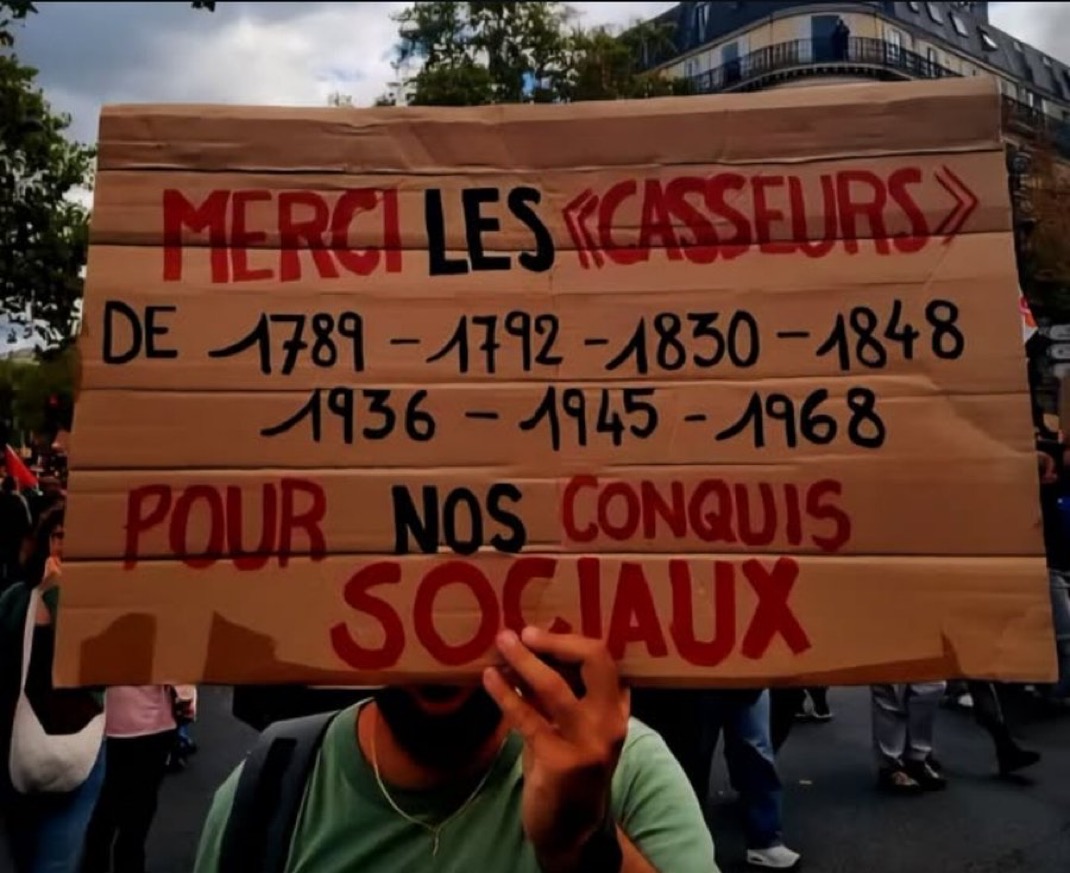
The marchers saw this coming. One sign carried through the streets on October 17 thanked the casseurs, the "breakers," of 1789, 1830, 1848, 1936 and 1968 "for our social gains." It was a sharp reminder that France's own national story, from the storming of the Bastille onward, is full of crowds once called rioters and later honored as founders of the republic.
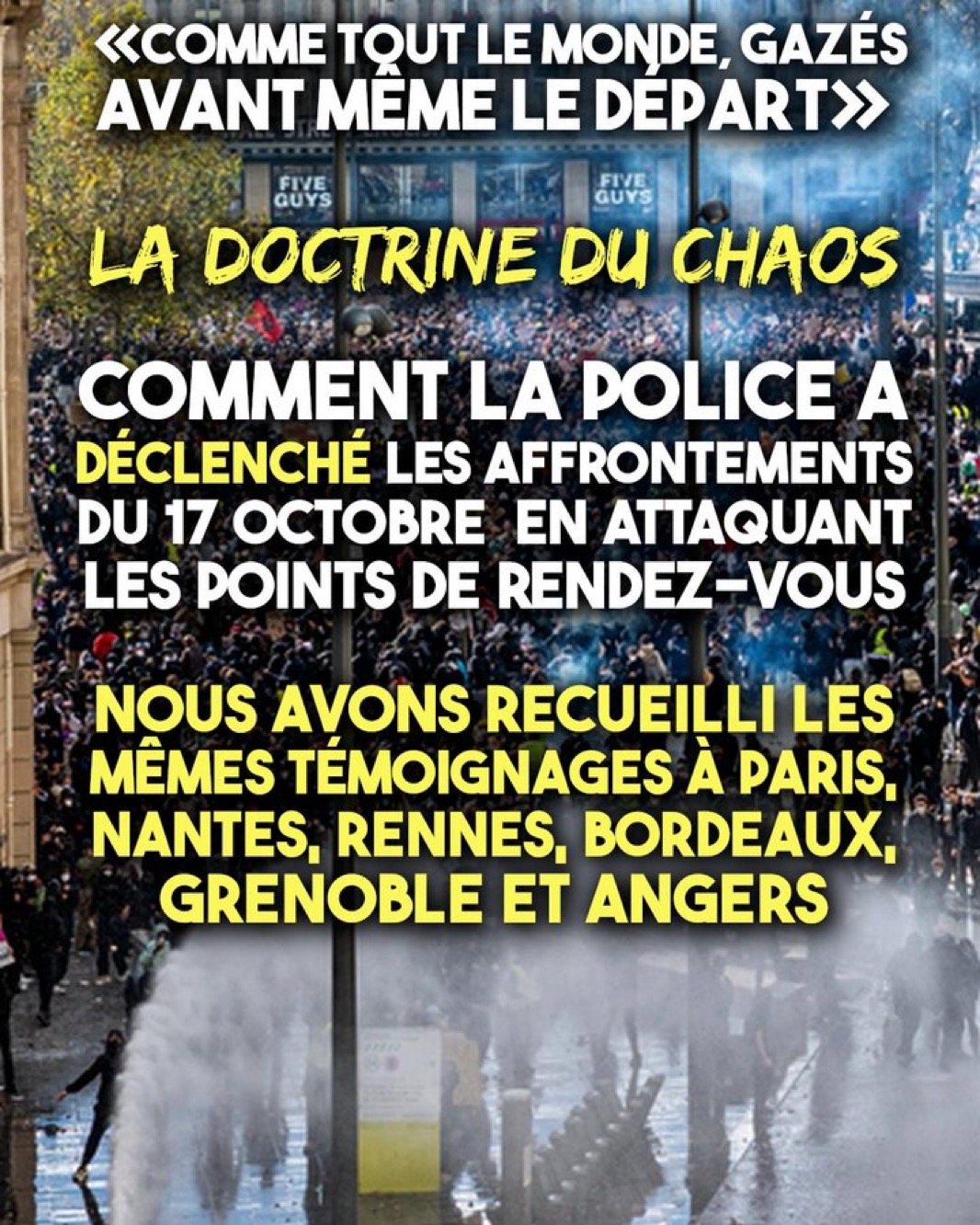
The marchers also told a different story about how the violence began. The activist collective Contre Attaque published what it called "the doctrine of chaos": accounts from marchers who said police fired tear gas and charged the gathering points before the marches had even set off. The group said it heard the same accounts in Paris, Nantes, Rennes, Bordeaux, Grenoble and Angers. These are activists' claims, not official findings. But they show how both sides fought over the same question: who started it, and so who gets to be called a rioter.
Abroad, the renaming went further. As the magazine Jacobin reported on October 19, Fox News, Donald Trump and J. D. Vance cast France's protests as an ethnic conflict, as if the country's long tradition of street protest were an import carried in by immigrants and their children. In that telling, the students were not citizens with demands at all. They were a foreign threat.
What the Word "Riot" Does
A protest has a cause. It asks a question of those in power: why are our schools falling apart, why does a machine decide our future, why are we policed this way? A riot, in the public imagination, has no cause worth discussing. It is disorder, and disorder has only one answer, which is force.
That is the work the word does. Once a movement is called a riot, three shifts follow.
First, the subject changes. Reporters ask how many cars burned rather than how many teachers are missing. A day of 550,000 marchers is remembered by its worst hour.
Second, the people change. Students, nurses and bus drivers become "thugs," "scum" or "breakers." They are no longer citizens with a grievance but a crowd to be managed. In France, that crowd is often pictured as young, Black or Arab, and from the suburbs, which turns a social question into a racial one.
Third, the remedy changes. If the problem is disorder, the solution is order: curfews, bans on gatherings, mass arrests, new police powers and harsher sentences. A law-and-order agenda arrives dressed as common sense, and it lands hardest on the very communities that marched. The original demands are set aside, sometimes for years.
None of this means that fires, looting or attacks on people are acceptable or imaginary. They are real and they cause real harm, often to the neighborhoods of the protesters themselves. The point is that the label "riot" is rarely applied evenly or innocently. It is a choice about which part of the story counts.
"Outside Agitators"
There is a companion to the riot label, and it is just as old: the claim that the trouble was stirred up by outsiders. If a protest can be blamed on strangers, then the grievances of local people never have to be taken seriously.
White officials across the Jim Crow South used this charge constantly. Freedom Riders in 1961 were denounced as Northern troublemakers. Volunteers who came to Mississippi for Freedom Summer in 1964 were called "invaders." Segregationist leaders, Alabama Governor George Wallace among them, insisted that the marches in Birmingham and Selma were the work of communists and agitators, not of Black Alabamians who had been denied the vote for generations.
Dr. Martin Luther King Jr. answered the charge directly. Jailed in Birmingham in April 1963, he responded to eight white clergymen who had called the demonstrations "unwise and untimely" and led in part by "outsiders." In his Letter from Birmingham Jail, he wrote: "Injustice anywhere is a threat to justice everywhere," and "Anyone who lives inside the United States can never be considered an outsider anywhere within its bounds."
The charge has never gone away. After a Ferguson, Missouri, police officer killed 18-year-old Michael Brown on August 9, 2014, officials and commentators repeatedly blamed the unrest on outsiders who had come to town to stir trouble. Missouri Governor Jay Nixon declared a state of emergency and a curfew, and armored vehicles rolled down West Florissant Avenue. Yet arrest records reviewed by reporters showed that most of those arrested lived in the St. Louis area. The label followed Black Lives Matter rallies from Ferguson to Baltimore after Freddie Gray's death in 2015, and beyond.
In late May 2020, after George Floyd was killed by Minneapolis police, Minnesota's governor and the mayor of St. Paul said that most of those arrested during the unrest came from out of state. Within days, arrest records showed that most of those arrested were Minnesotans, and the claim was walked back. In France in 2026, officials have spoken of the "ultra-left" and of organized gangs infiltrating the marches. The Jacobin report shows the same idea traveling in a new direction, with American commentators casting a homegrown French movement as something foreign.
The outside agitator, then and now, serves the same purpose. He makes it possible to say that the people of a place are content, and that only strangers want change.
The Long, Hot Summers
The 1960s offer the clearest test of these claims, because the federal government itself investigated them. Uprisings broke out in Watts, Los Angeles, in August 1965, where 34 people died, and in Newark and Detroit in July 1967, where 26 and 43 people died. Many white Americans and many politicians blamed agitators and radicals.
President Lyndon B. Johnson appointed a commission, chaired by Illinois Governor Otto Kerner, to find out what had happened and why. Its report, released on February 29, 1968, found no evidence that the disorders had been planned or directed by any organization. Instead, it named the cause plainly: "White racism is essentially responsible for the explosive mixture which has been accumulating in our cities since the end of World War II." The report pointed to segregated housing, police abuse, unemployment and poor schools, and it warned: "Our nation is moving toward two societies, one black, one white—separate and unequal."
Weeks later, King put the same truth in different words. He condemned violence, but he refused to stop at condemnation. "A riot is the language of the unheard," he said in his speech "The Other America" in March 1968. The question, he insisted, was what America had failed to hear.
The nation's leaders mostly chose not to listen. Congress wrote an Anti-Riot Act into the Civil Rights Act of 1968, making it a federal crime to cross state lines to incite a riot. It was the outside agitator theory turned into law, and it was soon used to prosecute antiwar and Black Power activists, including Bobby Seale of the Black Panther Party in the Chicago conspiracy trial. That fall, Richard Nixon campaigned for president on "law and order." The Kerner Commission's call for massive investment in jobs, housing and schools was largely shelved. As the historian Elizabeth Hinton has shown, the decades that followed brought a steady expansion of policing and prisons in the very neighborhoods the commission had described.
The same pattern runs deeper into the past. For most of the twentieth century, the white mob attacks on Black communities in Elaine, Arkansas, in 1919 and in Tulsa, Oklahoma, in 1921 were called "race riots," a phrase that blurred who attacked whom. Only recently have historians and public officials begun to call them by their right name: massacres.
2020: Peaceful Streets, Burning Screens
The summer of 2020 brought the largest wave of protest in American history. Millions of people joined Black Lives Matter demonstrations in thousands of towns and cities. The Armed Conflict Location & Event Data Project, which tracks political violence around the world, studied more than 7,750 of these demonstrations between late May and late August 2020. It found that more than 93 percent involved no violence or property destruction at all.
That is not what most Americans saw. Television and social media returned again and again to the same images: a burning police station in Minneapolis, broken storefronts, smoke over city streets. President Donald Trump called protesters "thugs" and warned, "when the looting starts, the shooting starts," a phrase first used by a Miami police chief in 1967. Federal agents were sent into Portland, and the language of "anarchists" and "outside agitators" returned to official statements.
The law followed the language. In April 2021, Florida Governor Ron DeSantis signed a sweeping "anti-riot" law, House Bill 1, that created harsh new penalties and a broad new definition of rioting. That September, federal judge Mark Walker blocked part of the law, finding its definition of "riot" so vague that people who were only present at a protest that turned violent could be swept up. Other states passed laws raising penalties for blocking roads or protesting near pipelines. Few of these laws addressed the police killings that had started the protests.
Europe's Suburbs and the Same Script
France has seen this script before, and so has Britain.
In October 2005, two teenagers, Zyed Benna and Bouna Traoré, died in an electrical substation in Clichy-sous-Bois while hiding from police. Days earlier, then Interior Minister Nicolas Sarkozy had promised to rid a suburban housing project of its racaille, "scum." Unrest spread to hundreds of towns. The government declared a state of emergency under a law first passed in 1955, during the Algerian War, a choice that many in the suburbs did not miss. The young people involved were described as delinquents and, often, as immigrants, though most were French citizens born in France.
In August 2011, police in London shot and killed Mark Duggan, a Black man from Tottenham. Unrest spread across England, and Prime Minister David Cameron called it "criminality, pure and simple." Courts handed down unusually harsh sentences, while questions about policing in Black neighborhoods drew far less attention.
In June 2023, a police officer in Nanterre shot and killed Nahel Merzouk, a 17-year-old of Algerian and Moroccan descent, during a traffic stop. Days of unrest followed and thousands were arrested. President Macron blamed social media and even video games for "intoxicating" young people, while many in the suburbs pointed to years of police stops based on race.
Each time, the cause of the anger, usually a death at the hands of police, was quickly buried beneath talk of looting and order. And each time, the young people of color at the center of events were pictured not as citizens with rights but as a problem to be contained.
From "Riot" to "Invasion"
Within days, France's protests over school funding and living costs were renamed again — this time across the Atlantic. Ahead of the U.S. midterms, President Donald Trump urged Macron to "close your borders and take control before it is too late!" and insisted of France and Italy, "that's not about school. That's about people coming into the countries that hate the country." At a Kansas rally, Sen. Roger Marshall called "radical Islam" the "single greatest threat" to American democracy.
An Associated Press fact-check found no evidence. French authorities have not linked immigrants to the rioting, no single group has been singled out, and the crowds appeared to mirror France's diverse society. Policing scholar Sebastian Roché of Sciences Po Grenoble attributed the looting mainly to opportunistic criminals.
The claim works because it merges two old scripts. The first is the "riot" label, which strips protesters of grievances. The second is the outside agitator, now recast as the foreign-born Muslim — the same figure at the heart of the "replacement" myth. Short, violent clips circulate on social media without context, a few broken windows stand in for 800,000 marchers, and a domestic fight over schools becomes evidence of civilizational threat. The cost falls on the communities named: Black and North African French citizens, many descended from France's former colonies, are asked to answer for a protest they did not define. As in Watts or Ferguson, whoever names the street also decides who is policed, punished and blamed.
A Massacre Once Called Order
October 17 is not a random date for France's young marchers. On October 17, 1961, thousands of Algerians marched peacefully in Paris against a curfew imposed on them alone. Police under Prefect Maurice Papon attacked the march. Many marchers were beaten, more than 11,000 were detained, and some were thrown into the Seine. The official toll at the time was two or three dead. Historians now estimate that dozens, and perhaps far more, were killed.
For decades, the French state described that night as the restoration of public order. It took until 2012 for a French president to acknowledge the "bloody repression." The lesson is not lost on the students of 2026. The words the state uses in the moment are often not the words history settles on later.
Who Pays the Price
The cost of the riot label falls mostly on the people who marched and the communities they come from. Arrest records follow young people into job applications and university admissions, including the very Parcoursup system French students are protesting. Curfews and bans on gatherings close off the lawful paths of protest, which leaves people with fewer ways to be heard. Surveillance expands. Neighborhoods are policed more heavily, and the next encounter with police becomes more likely to end badly.
Meanwhile, the demands fade. France's teacher shortage, crumbling buildings and admissions algorithm did not change because a city hall burned. The risk is that they will not change because the burning became the only part of the story anyone remembers.
Naming Is Power
Demonstrators and governments are not arguing only about what happened in the street. They are arguing about who has the right to speak, and whose speech counts as politics. To call a movement a protest is to admit that it has a point. To call it a riot, and to blame outsiders, is to deny that it has one.
History offers a check on the words of the moment. The Kerner Commission looked past "riot" and found racism. Historians looked past "race riot" and found massacres in Tulsa and Elaine. France itself took half a century to name what happened on October 17, 1961. The young people marching in France today, like the Black Lives Matter marchers of 2020 and the civil rights marchers before them, are asking that their cause be heard now, not decades later. The first step is to listen to what they call themselves.
Ask the Historian
Have a question about this story, or an idea for a future post? Send it here.