
.jpg)
Homecoming at HBCUs is more than a gathering of alumni from a college, it is a cultural event. But in many ways, it is about more than the culture. Homecoming represents an opportunity to observe tangible changes and the evolutionary trajectory of institutions that serve an important function in American society. HBCUs have educated thousands of students who have reshaped the social, political, cultural, academic and intellectual playfields of the nation. We as Americans owe them an immeasurable debt.
Returning to my alma mater, Morgan State University 32 years after graduating evoked many feelings and reflections on the past and present of the school. Founded in 1867 as Centenary Biblical Institute, the institution subsequently became Morgan State College and Morgan State University in 1975. The evolution of the school has led to many changes in the academic and physical trajectory of the school.
One of the first observations I made upon arrived on the campus were the many changes in the physical plant. Largely a walking campus, when I was a student— you could literally walk from Holmes Hall, the Humanities hub of the university, to Hurt Gymnasium on the other side of the campus. These two focal points largely defined the campus. New centers of interest have arisen which reflect the needs of 21st century students. A new Student Center, which largely dwarfs the McKeldin Center, the four-story structure which served as a meeting and conference space, student activity center, SGA headquarters, bookstore, and student cafeteria during my student years, seems larger than life. The new facility is modern, well-light, airy and includes a modern bookstore, cafeteria, food court, meeting, conference and reception areas, and an ATM.
.jpg)
The quad that contains the new bookstore has also dramatically changed. It also contains a new library— The Earl Richardson Library and a Student Services Center- The Calvin and Tina Tyler Center. Both buildings reflect the past and present. The library is named for Earl Richardson who served as Morgan’s President from 1976 to 2008. The student center is named for an alumnus of the school who amassed a fortune working in various leadership positions at UPS.
.jpg)
.jpg)
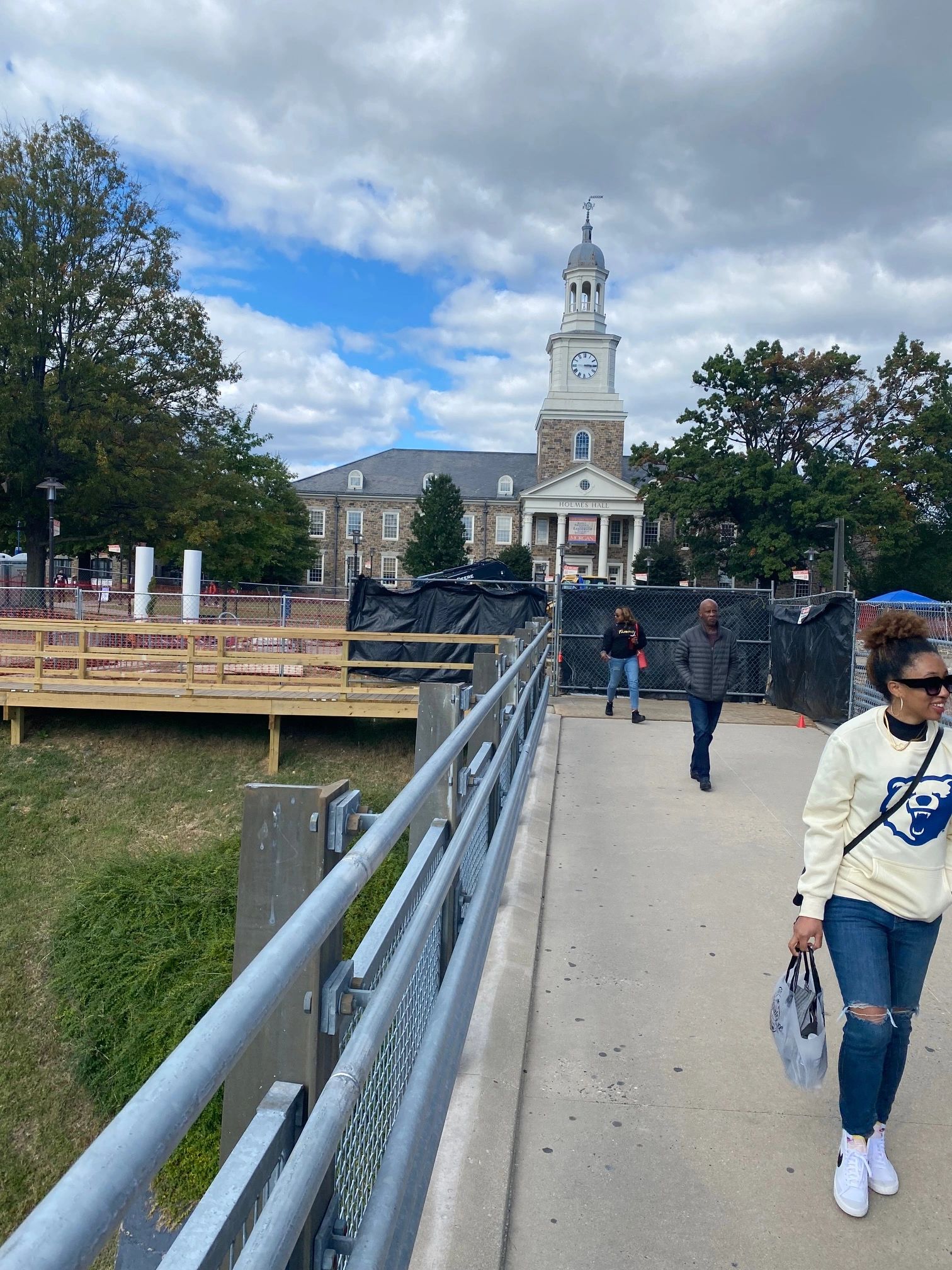
When I was a student, one bridge— the Verda Welcome Bridge, named after the first African American to sit in the Maryland legislature, was the only bridge on campus. It connected the two parts of the campus described earlier. That is no longer the case, two additional bridges connect the communications quad and the additional dorms on the other side of campus. This expansion is in keeping with the tremendous growth of the student body. When I was a student, the student body population was less than 2000, today the student body exceeds 9,000.
.jpg)
.jpg)
.jpg)
The most significant component of the homecoming experience was meeting and reconnecting with members of various classes. Generationally HBCU graduates are connected by our shared but radically different experiences on campus shaped by different contextual and personal agendas. Black students in the 1970s, 80s,90s and the 21st century have different outlooks on the campus experience. It was good talking to students from each of these eras and hearing their concerns and hopes and dreams. One student who graduated in 1980 described the impact of the Vietnam War draft on Black male students. Students who graduated in the 90s recalled the student protests and the rapid expansion of the physical plant. Twenty-first century graduates recalled the modernization of the campus and increased class sizes, especially in introductory classes. The best recollections came from students who entered the college as first-generation students. Although HBCU students come from a variety of backgrounds including legacy and fourth or fifth generation college students, some are first generation college students. These students are often unaccustomed to the rigors of college life. They were literally going where no person in their family has traveled before. The college experience, then, became a field of dreams. A place to explore your interests and to elevate oneself from the working to the middle class. Here, this journey would truly transform lives. One student told me he had entered Morgan as the youngest of seven. Struggling to gain admission through the summer program, he persisted. The opportunity to earn a degree in Communications transformed his life. I, too, shared this experience. Entering Morgan as a bookish and extremely shy teenager, and being transformed by my experiences there into a confident young adult.

Homecoming at a HBCU is as much about the culture as it the inner workings of the university. It is about a changing physical plant, the expansion of academic projects and most important, generations of students who have matriculated through the institution. HBCUs have a bright future. Morgan is currently moving aggressively to establish itself as a Research I institution. Homecoming is about the culture, but it also means so much more. The more is encapsulated in the rich legacy of these institutions and the countless lives shaped and reshaped by this unique educational experience.
Ask the Historian
Have a question about this story, or an idea for a future post? Send it here.