
As a young boy growing up in Baltimore, Maryland in the late 1970s and 1980's, I always thought that all veterans were African American. My father was a Korean War Veteran. His cousin, Harvey Hall was a World War II veteran. My uncle, Russell Hall was a Korean War veteran and several of my younger uncles on my mother's side were Vietnam War veterans. My father took great pride in making sure the American flag was properly and prominently displayed at our home on the required holidays. My brother and I were taught how to hang it. My father's pride and staunch belief in service have always lnigered in my mind. This pride coupled with the stories and attitudes of my uncles, their pride, refusal to compromise their rights and their pride in being African American soldiers, solidified the idea in my mind that military service was an essential part of citizenship for African Americans. It is not surprising, then, to discover that Memorial Day has its origins among African Americans.
At war's end in 1865, the city of Charleston, South Carolina lay in ruins. White residents had largely abandoned the city. Among the first Union troops to enter the city were the Twenty First U.S. Colored Infantry. The commander of this unit accepted the formal surrender of the city.
In the last year of the Civil War, Washington Race Course, a popular racing track, in Charleston, South Carolina served as a Union prison. Not unlike the situation at other Confederate prisons, the morality rate was very high. It is estimated that more than 257 Union soliders men died there and were buried in an unmarked mass grave behind the track's grandstand. How to commemorate the sacrifices of the dead and to understand the meaning of the war was a central preoccupation of those who survived the conflict.

African Americans took up the task of rememberance and honoring the dead. Twenty-eight Black workmen dug up and properly reburied the dead. They built a high fence around the cemetery and an archway on which they inscribed "Martyrs of the Race Course."

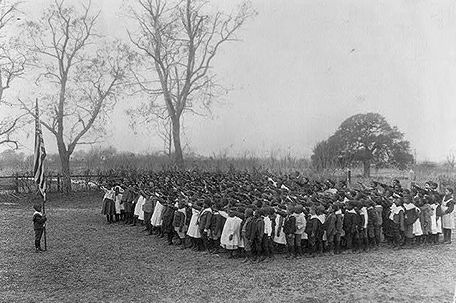
To further commemorate the sacrifices of these soliders, Black Charlestonians along with white missionaries and teachers staged a parade on the race track course that included more than 10,000 people. The parade began promptly on May 1st at 9 am. It was led by 3000 schoolchildren singing "John Brown's Body." More than 200 Black women following carrying baskets, flowers, wreathes and crosses. Black men and Union Soliders followed marching in cadence.
Members of the assemblage gathered in the cemetery enclosure and sang "We'll Rally Around the Flag," Star Spangled Banner and spirtiuals. Black ministers read from scripture. Afterwards, the crowd went into the infield. There they enjoyed food and conversation, speeches and military drills. Several brigades of Black troops participated, including the 54th Massachusetts and the 34th and 104th U.S. Colored troops. These brigades performed a special double columned march around the gravesite.

Decoration Day marked the beginnings of Memorial Day type celebrations. The national holiday we now celebrate as Memorial Day formally emerged in 1868, General John A Logan, Commander of the Grand Army of the Republic urged all northern communities to honor the Union soliders who died in the war. This occurred on May 30, 1868. We are enternally grateful to African Americans for their foresight and vision in commemorating those who made the ultimate sacrifce for Freedom and Democracy.
#DecorationDay #BlacksintheMilitary #MemorialDay #BlackCharleston #MartyrsoftheRaceCourse
Ask the Historian
Have a question about this story, or an idea for a future post? Send it here.